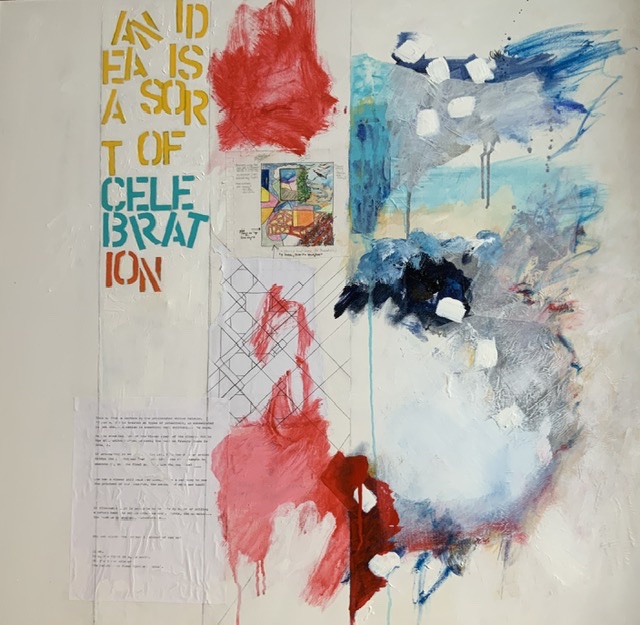
I am shifting to a new landscape, concentrating on small works of art, made at my coffee table, combining text and image. I will still comment on them, and on the art and the places we see, and the writers and artists I love. Here is my new blog: asmallfineartsketchbook.blogspot.com
And here is an example of my sketchbook-sized art you may see there. I found a drawing by
René Descartes from 1644, where he drew magnetism and gravity as a lettered
diagram (the earth is the piece I have colored blue). It is filled with the excitement of discovery … his … and so
I started thinking about another favorite theme of mine, audience: who would he
have shown this to? How would he have explained it? And then I pulled in
Motherwell’s idea of the colors black and white as protagonists, fighting and
succumbing to magnetism:
See you soon!
Artist in an A-frame
Sunday, February 3, 2013
Thursday, September 20, 2012
The Edge: Abstraction vs. Realism in Two Irish Painters
I love abstract art; it turns out that I also love art that rests on the edge between abstraction and representation. The two approaches are often defined pictorially, because they are, after all, pictures, but I think it might also help to find that edge between the two if we look at examples of prose from a master of each style.
Here is Henry James, in a passage from The Golden Bowl:
He
saw the sleeves of her jacket drawn to her wrists, but he again made out the
free arms within them to be of the completely rounded, the polished slimness
that Florentine sculptors, in the great time, had loved, and of which the
apparent firmness is expressed in their old silver and old bronze …. He knew
above all the extraordinary fineness of her flexible waist, the stem of an
expanded flower, which gave her a likeness also to some long, loose silk purse,
well filled with gold pieces, but having been passed, empty, through a
finger-ring that held it together. It was as if, before she turned to him, he
had weighed the whole thing in his open palm and even heard a little the chink
of the metal. When she did turn to him it was to recognise with her eyes what
he might have been doing. (from
the novel, first published in 1904)
And here is Gertrude Stein, writing about the increasing
dangers of World War II, in Mrs. Reynolds:
It
was getting pretty serious, nobody saw anybody they used to see and it was
getting pretty serious, oh dear me said Mrs. Reynolds and when she said oh dear
me she wanted to say to Mr. Reynolds that it was getting pretty serious but she
did not say that it was getting pretty serious she did not say it just then she
only said that she was not seeing any one she used to see no not any one, and
Mr. Reynolds said and what then but what he really meant to say was that he
still saw her and she still saw him, so what then. (published posthumously, 1952)
James appears, as a realist, to be giving us more details of
the moment he describes, but when we look again at this passage of his, we see
that the only actual details are:
--the
Prince sees that “the sleeves of her jacket [are] drawn to her wrists”
--he
notices that “[her] arms [are] rounded”
--he
observes her waist
All the rest is metaphorically described. Charlotte is
compared to three things: an “old” bronze or silver Florentine sculpture, an
“expanded flower” and a “long, loose silk purse.” These sound like lovely terms, and no doubt we are meant to
think that the Prince sees them as desirable and sensuous objects, objects that
he thinks may describe perfectly his need for her, and yet… we are, as readers,
also supposed to pick up on the fact that these are incredibly vague ways of
describing true feeling. Kenneth Burke wrote, in A Grammar of Motives, that "Metaphor is a device for seeing
something in terms of something else.
It brings out the thisness of a that, or the thatness of a this." But it isn’t, importantly, the “thisness
of a this.”
Stein’s writing may, in contrast, intially strike us as …
simple. But perhaps it would be too easy to say just that. Simple, stark,
repetitive thinking is a very human response to tragedy, when words seem wholly
inadequate and silence, horribly, seems easier. We do not say what we are thinking. And
this passage from Stein ends with a statement, “so what then,” that stops the
motion of all the previous thoughts; we are stilled by those words. She has
exposed us for our said and unsaid words of fear and love. We stop and think,
held in the moment, dreadful… or seemingly inconsequential… as it is.
And I think that, finally, this is the difference between
realistic and abstract artists: that representative painters form reference points that outline recognizable
things, but these realists can not produce the
things themselves; instead, they have perfected linear description. Abstract artists produce something
that, in itself, stops our usual referring back to an “other” object or state
of feeling. Abstraction is meant to arrest our attention in the moment, as our
attention would be held as we fall into extreme joy or sorrow. Painting at this
moment in our history often seems confused, torn between the two approaches,
neither of which is wholly adequate. It may be that the best of current art must
bridge these two methods of perceiving and creating: the outline of the
familiar combined with a more abstract
grasp of feeling.
To enter into this struggle, to create something that is,
itself, arresting, a painter needs to be able to pull together aspects of a
place or a sensibility that will still be accessible and enthralling to a
potential viewer. It is an incredibly difficult task, this kind of painting. Robert Motherwell talked about
recognizing the many “internal relations” in painting:
I
always looked at just the total over-all effect. And apart from the obvious sensuality
and color… there's something in Matisse that is as remorselessly, relentlessly
adjusted in terms of internal relations as somebody like Piero della Francesca….
That's why all painters really love him - well, not the only reason, but a
reason. He's as strong as Piero, and it was that double aspect that I liked-
the sensuality, and the color and the so-and-so plus this thing that is almost
- well, Georges Duthuit wrote … "Matisse is as strong as the mosaics of
Ravenna" - I've never seem them -- and whatever he's trying to say by that,
in my own way, I also saw. (Oral history
interview with Robert Motherwell, 1971 Nov. 24-1974 May 1, Archives of American
Art, Smithsonian Institution).
The Ravenna images, while realistic for their time, have a
kind of simple direct nature that does freeze us in our tracks:
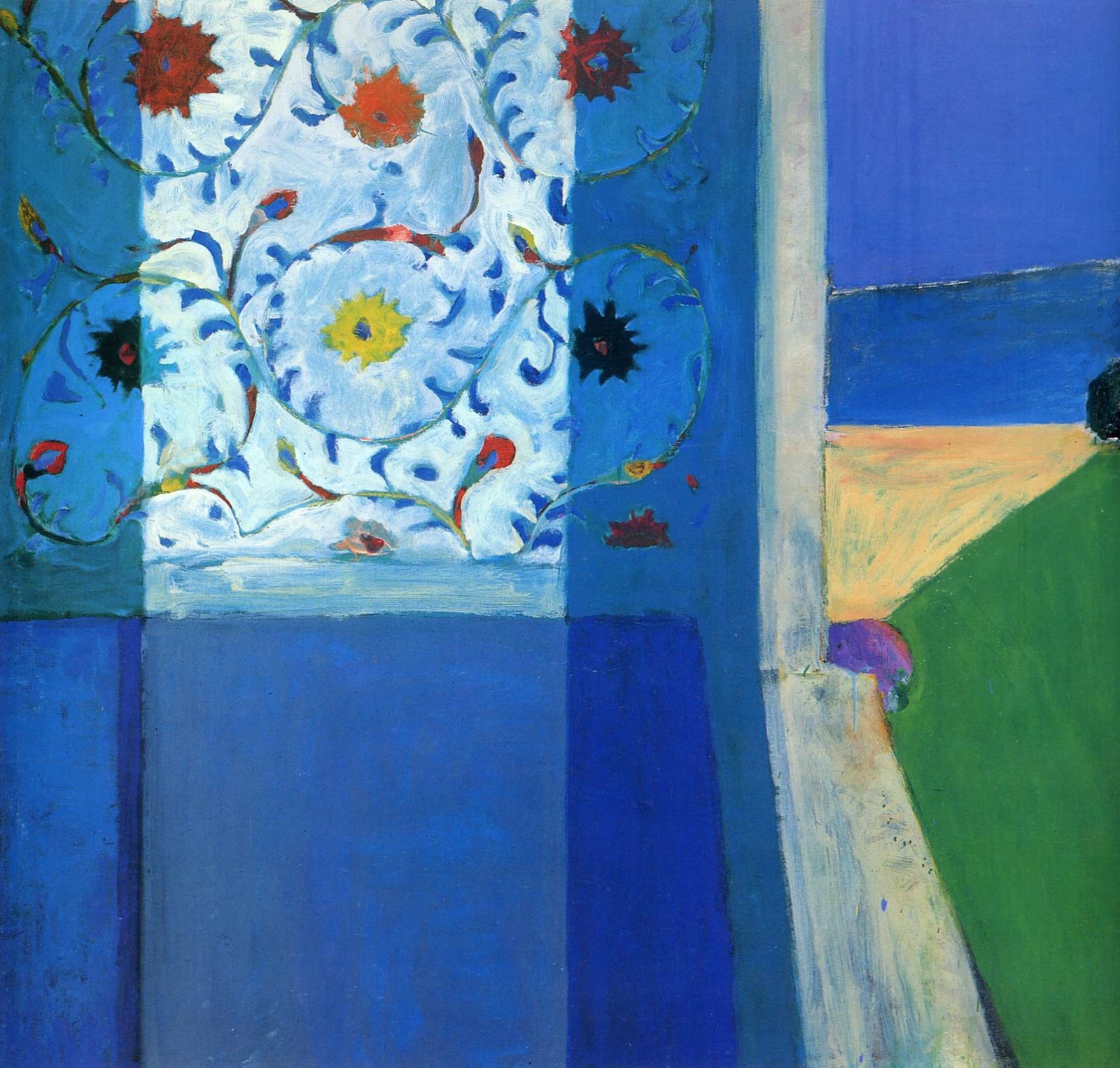
Rather like this Matisse, “Open Window at Collioure,” a view
into another space:
We can see “the sensuality, and the color” and the sheer
strength of these works; they come from the same intense scrutiny and sense of
space. Two painters here in Ireland have landed in that terrain between Piero
della Francesca and Matisse, the kind of “relentlessly adjusted” work that
pulls the viewer in: Keith Wilson and Donald Teskey.
Keith Wilson’s work, “A Change in the Air,” is showing
through October 25th at the Oliver Sears Gallery in Dublin. In the catalogue, Oliver Sears writes
That Keith Wilson, who lives in North County Mayo, has given us “changing time,
light and place … in [his] finely
honed mark making.” But the works
are not pure recording, or
metaphorical references. As Sears says, they are “part real, part imagined” in
what then becomes, for the viewer, “a distinctly contemporary construction.” Let’s take a look at Wilson’s painting,
“A Change in the Air, 8,” (oil on panel, 21.5 x 19.5 cm):
Wilson lived for a time not far from Assisi, where he could
hear the bells from two churches as he painted, and “Doves here too that sing
one extra note than the ones at home.” We can see the influence of Italian arches and loggias in this
painting, which opens through to a garden. And yet, while we could, potentially, “see” the outlines of
trees and branches and bushes and blossoms, we don’t actually see them… we see the traces they have left
behind, traces offered by an artist who has lived with them for a long time.
They become familiar to us – even though we don’t yet “know” them. When I see a photograph or a very realistic
painting of a place (for example, Canalettos’ Venice) I can feel regret that I
am not there. With Wilson’s paintings, I am
there. No need for regret. I am looking through that archway. I am, in short, involved.
Wilson says that he discovered that “I might study places in
order to figure out where I am” (from his catalogue essay). We all try to figure out where we are,
but Wilson has achieved his “place” to a spectacular degree. His work is of
Ireland and Italy, but it is also of the mind. With some perspectival
landscapes, we feel rooted to one spot. With Wilson’s work, on the other hand,
we feel as if we could continue to walk through. Here is “Across the Field,” (conté
crayon on gessoed paper, 56 x 76 cm) in full and then in a detail:
Yes, it’s descriptive. But it’s what he leaves out that
allows this drawing to give us the feeling of the air around the grasses, the
trace of weight under the tractor-wheel imprints… painters since Vermeer have
contested with ways to re-introduce breathing into their art. It’s happening here. The viewer is
invited in. Here is one more
painting, “Days Ahead, 5,” (oil on panel, 36.5 x 40 cm):
This has the quality of a beautiful morning after a fresh
rain. We all can “see” what’s here, and imagine what isn’t. We have a job to
do, to look, imagine, and be in the moment. This is Wilson’s gift.
The second artist I would like to discuss here -- an artist
working on these very same connections to “place” and fine evocation of
feeling-- is Donald Teskey. His show of paintings, “Nature Reserve,” has been
at the Town Hall in Macroom, curated by John P. Quinlan. Teskey spent several weeks as an artist
in residence in the Gearagh. The name comes from An Gaorthadh, meaning the wooded river. This is a valley just west
of Cork City, on a bed of limestone, the oak trees having formed in the basin
of the Lee River in the last Ice Age. This is the “only significant alluvial
forest in Ireland” (information from the plaque on site). Here are two photographs I took, in
early morning:
Close to, the wooden oak remnants appeal to you in an almost
human way -- faces, expressive shapes -- but from a distance, through the
filter of the light, you can see the mystery and the majesty of place
here. Donald Teskey wrote that he
worked “amongst the tangle of trees and grasses, on the mudflats and from the
higher vantage points on the surrounding hillsides and side roads. The light on
the Gearagh can, at times, be extraordinary … It is an inscrutable and
fascinating place for a painter” (www.artfirst.co.uk,
2008). Or a printer. We can see
the lines here that cross over between printmaking and painting (both areas of
expertise for Teskey), and see the space between the lines for what it is, an
entryway. Here is “The High Road 8” (30 x 30, acrylic on paper -- images
courtesy of John P. Quinlan):
This is that crossover between the familiar and the
imagined: we see rooflines, the vertical presence of trees, but we don’t really
attend to these, past the initial glance: we become lost in the wild markings
of the painting’s lower half, fabulous things. This is not a nostalgic view.
This is an explosion of feeling and mood, directed at us, inviting a response. Teskey
has noted that “keeping the spontaneity and urgency in the mark is vital”
(interview with Mike Fitzpatrick, 31 January, 2005, www.rubicongallery.ie). Done.
My particular favorite from Teskey are the paintings that
reach a little bit further into abstraction, almost daring us to “see” as he
does. Here is “The Gearagh Study VI”:
Yes, we can see the reeds, the oaks, the water, a little.
But what is that scattering of pale blue? And the underlying scraped white?
Part reflection, part “urgency.” I know, from my own painting experience, how
much of a risk he takes here. One foul scrape or too broad a gesture with the
brush and the work could easily be ruined. This is painting on the edge, indeed. One more, called “The Gearagh IV,” gives
us both earth and water and yet…
Both Donald Teskey and Keith Wilson explore this territory between
the two warring forms of the twentieth century, abstraction and representation,
a place “between” that is unresolved for so many painters. These two have come
to terms with their inheritance, and have achieved their own “way” onto the
edge. One of Ernest Hemingway’s
characters in Across the River and Into
the Trees said that “terrain is what remains in the dreaming part of your
mind.” Both Wilson and Teskey
merge the terrain, and the mind, in paintings that stay with the viewer. Seek
out their work.
Thanks to both Oliver Sears and John P. Quinlan for their
generosity.
Wednesday, September 5, 2012
A Murmuration of Starlings: The "Whitewashing the Moon" Exhibiton in Dublin
This is a still photograph of starlings moving in unison,
something called a murmuration, (see my source website, with video and explanatory
text: www.wired.com/images_blogs/wiredscience/2011/11/starling_murmuration;
the film was taken over the River Shannon by Liberty Smith and Sophie
Windsor-Clive). Last week, we were visiting County Clare, along the
beautiful, rugged Atlantic coast, and our hosts mentioned the murmuration, a
word I’d never heard; we had all been discussing swallows and starlings and
jackdaws, all of them flying by the window at one point or another, looking as
if they were trying to beat the thunderstorm that came a few minutes later. If you watch the film of the starlings,
or have seen them fly in these rapidly-changing patterns yourself, you can then
re-imagine all sorts of ways of seeing them: architectural blueprints, graphs,
elements of physics and biology, an arc of paint thrown by Jackson Pollock,
waves breaking over rocks, and the trust and belief inherent in moving together
in a project that has no obvious pattern or end.
The beauty of the murmuration came back to me as I was
thinking about having seen “Whitewashing the Moon” at the Project Arts Centre. Taken
as a single moment of delight, we know that the murmuration of starlings is
beautiful; the art in this show, taken both individually and as a group, similarly
compels us to respond and reminds us what art is for.
Five artists, from Ireland, France and Mexico, have created art
in "Whitewashing the Moon" that works. The curators, Tessa Giblin and Kate Strain, selected the pieces for this show. I think the art has been chosen because it speaks to our desire to believe in the "impossible," a desire that is central to a short story that is also part of this exhibition, "The Brick Moon," by
Edward Everett Hale (originally published in serial
form in the Atlantic Monthly in 1870, now published in its entirety at http://www.gutenberg.org/cache/epub/1633
). In this story, a group of
students imagine “the poor little fishermen … the bones of whose ships lie white
on so many cliffs” and think …. what if the students could launch an object
over Greenwich that would then pass by “the axis of the world” and would then
“forever revolve, in its obedient orbit” as “the blessing” of these sailors (and
anyone else, for that matter, who wanted grounding). In order to survive the power of its launch, the object
could not be “lathe and plaster,” but would need to be brick, which, sliced
through at any angle, would resemble “an immense rose-window, of six circles
grouped around a seventh,” all kinds of arches for internal support, but
enclosing, mostly, air. Two
gigantic fly-wheels would propel it into orbit.
Eventually, after seventeen years, the students grow up, funding
is found and the Brick Moon is begun.
The last months of work is undertaken by a group of some of the original
friends and their families; they live in the cavernous center of the completed
part of the moon. The fly-wheels are finished. The hope is that the moon can be bleached white after it is
completed so that it will resemble a moon more fully. But this never happens; the Brick Moon is launched
prematurely, with the workers and their families still inside. The narrator and those who remain on
land are in despair. They cannot
see anything in the skies for over a year; but some time later the Brick Moon
appears to the narrator as he looks through the lenses of a deserted
observatory. The Brick Moon was
“Red no longer, but green as a meadow in the spring” with “hemlocks” visible
and his friends were visible, “going and coming on the surface of their own
little world.”
They are able to communicate with the narrator by a series
of signals, and he can signal to them.
He hears of weddings, births, Shakespearean productions, and readings of
Austen and Thackeray. Much relieved, and sounding rather envious, the narrator
says, “The truth is, that silence is very satisfactory intercourse, if we only
know all is well.” Silence -- to
the earth-bound people -- had meant only dread of what might have happened;
silence from the Brick Moon, it turns out, had meant only contentment. The narrator says that, having helped
launch the creation, he can only say that it now “is there in ether. I cannot
keep it. I cannot get it down.” And,
most of all, he cannot visit, something he really seems to regret at the end,
as the world of the moon seems nearly perfect.
The art show is simply titled, “Whitewashing the Moon.” While this final artistic gesture never
actually happened in the story, artistic transformation certainly does happen in the gallery, which the brochure
calls a “twilit garden.” And it
is. Walking through this room, we
feel that same energy and flow as we would beneath that starling
“murmuration.” Each work of art offers a way of continuing and connecting to the themes begun in "The Brick Moon." There is no “ending”
here, in the “twilit garden,” only multiple continuities of the themes (dreaming, scientific discovery, the "negotiation" between artist and material, and reaching -- perhaps too far?) that are also introduced
in the story.
One of the pieces I really liked is by Caroline Achaintre, a ceramic, titled “Looney”:
The piece suggests a mask (both feudal and futuristic) or a
rock covered gently with cloth; it offers the fissures of brick, but the shape also brings to mind the green world of the orbiting Brick Moon. Another work, “Wadder,” seems to spill
over, growing outside of its form:
Are we seeing one moment in a rush of water, transparent over limestone? -- this form has
stilled movement, is silent, needing us to work through its layers.
In one corner of the “garden” is a spotlit sculpture, cast
in obsidian, by Eleanor Duffin, who lives and works in Dublin. Duffin’s website
says that she “focuses on the way in which ideas are conceived” and from that
she creates a visual “hypothesis.” Here is “Tephra,” both spotlit from above
and from an angle close-to:
The five forms seem to lie on the surface of a moon and sparkle like glass. Duffin’s art also appears
across the room, in a video installation of a revolving rock, called “Which do
you believe, your eyes or my words?”
The rock is oval, smooth-edged, and appears to be both revolving in
place and moving towards us and away from us, a perfect parallel to the
story’s idea of locating ourselves by virtue of another object.
Barbara Knezevic seems to have taken the idea of Daedalus
and Icarus (that also glimmers inside Hale’s story) and created her own cautionary
tale, called “An Exercise in Self-Destruction,” below, in a photo from across
the gallery, and then in a close-up:
When I first saw this piece, I thought it was a
pink-patterned marble, but it is wax, changing shape daily under the heat lamp,
dying quietly, in place. It seems conceptually far away from the sudden Brick Moon launch that we read
about in the story. But, as I think about it, the work does call to mind the narrator’s disquiet when he
cannot see the Moon or his friends, that quiet moment that we all know happens
after a disaster, the moment when no-one can reach out to do anything, because
the damage has been done. This is
a poignant piece.
On one wall, a video plays; “Rhombus Sectus,” by Raphael
Zarka. The brochure tells us it is a 16 mm film transferred into HD. It portrays
the National Library of Belarus at Minsk, a building shaped like a Rhombicuboctahedron,
which is close to the shape described for the original Brick Moon. Zarka says
that “the real subject of my work” is “the migration of certain forms through
space and time” (http://greyskatemag.com/2011/04/raphael-zarka-interview)
which is an apt description of the video, which I won’t try and reproduce here –
it needs to be seen in its space. The video has the weight of a documentary,
until we see it revolve around that central shape from many angles.
The fifth artist, Jorge De la Garza has created an installation called
“Untitled (Missing Links)” – it is both a nineteenth-century “desk” and a
twenty-first century objet d’art,
quite beautiful:
Each object is placed and lit as if it were a shard of
mosaic from Pompeii, or a rare Chinese vase, and these objects are just as
elegiac, calling out to us from another time; they wait for us to come and
complete them, as a group, and fill them with the narratives we re-construct.
If you are anywhere near Dublin, or can be, the show runs
through the 27th of October.
This is art that reverberates, stays with you, demands your attention,
rewards thought and participation. A truly remarkable show.
Saturday, September 1, 2012
“A Sequentiality of Improbable Possibles”: Liam Ó Broin’s Inferno Suite
Homer wrote The
Odyssey in Greek. Virgil wrote the Aeneid
in Latin. Dante Alighieri wrote
about the death of Ulysses in the Inferno,
part of his Divine Comedy, written in
the Italian dialect of Florence. James Joyce wrote Ulysses in … dozens of English languages. The reverberations, even in this broad list, are
astonishing. They fall together like the clicking of great dominoes. All of
these writers are tampering with the lives of heroes and gods, making
decisions, in effect, instead of gods, and playing with our collective
imagination in the process. Reaching for too much, perhaps? “Man’s reach must
not exceed his grasp,” wrote Robert Browning; Joyce will later come along to
say that he simply wrote “a sequentiality of improbable possibles” (Finnegan’s Wake).
It is impossible to escape Joyce while walking through
Dublin: Dawson Street, Davy Byrne’s, a statue, a plaque, a bookstore’s display
window, a busker.
Stately,
plump Buck Mulligan came from the stairhead, bearing a bowl of lather on which
a mirror and a razor lay crossed. A yellow dressinggown, ungirdled, was
sustained gently behind him by the mild morning air. He held the bowl aloft and
intoned
--Introvibo ad altare Dei.
This is the beginning of Ulysses,
where Joyce has Mulligan call out to Stephen Daedalus:
--Come
up, Kinch. Come up, you fearful Jesuit….
--The
mockery of it, he said gaily. Your absurd name, an ancient Greek.
So Joyce brings together priests, fathers, ancient Greek
myth, religious orders, bodies and morning ablutions, and the “mild morning air”
surrounding the tower…. spilling over onto just… two pages.
It’s a beautiful kind of Modernist pulling-together, an
equating of all things, to say that anything we notice becomes, then,
notice-able. Samuel Beckett had
worked for Joyce as a secretary. He told the interviewer James Knowlson that “I
realised that Joyce had gone as far as one could in the direction of knowing
more. I realised that my own way was in impoverishment, in lack of knowledge
and in taking away.” Two Irish writers, finding and clinging to extremes.
Joycean excess may stem, at least in part, not only from the
Modernist air the author inhaled (Pound, Stein, Eliot…) but from his reading:
everything, including the Inferno (in
the original Italian, in all likelihood). Dante’s journey with Virgil into Hell allows the poet to
create sublime cataracts and deep sorrows, to expose sins and “fitting” punishment
(think of the two lovers, Paolo and Francesca, attached through eternity:
“there is no greater sorrow/ than thinking back upon a happy time in misery”)
and, perhaps most importantly, re-imaginings, as in a new version of the death
of Ulysses. Instead of returning home to Ithaca, Ulysses and a small band of
his followers continue on their voyage, leaving behind families and lovers,
travelling
…. where Hercules ordained
The
boundaries not be overstepped by man.
[They
sail on, then ] …. from afar
Appeared
a mountain dim, loftiest methought
Of
all I ever beheld. Joy seized us straight;
But
soon to mourning changed. From the new land
A
whirlwind sprung …. so fate decreed
And
over us the booming billow closed.
(Canto XXVI)
Just in sight of an earthly paradise – drowned, down to the
bottom of a funnel of water, instead of arriving at the peak of a mountain.
This is one of the 34 images that have inspired the artist Liam
Ó Broin. Here is his
Canto XXVI print, “The death of Ulysses” (my photograph):
Many of the other lithographs offer stark black and white
contrasts, so this print is unusual for its colors. It struck me as stunningly
beautiful because the lithograph seems to offer us both the mountain and the
whirlpool in a few layered strokes, the greens and blues here simultaneously
offering hope and despair.
Ó Broin’s
series of lithographs respond to each canto in Dante’s Inferno, part of a projected series on the full Divine Comedy. These lithographs (singly, or in a full limited-edition
book) take the inclusive nature of the works of Dante and Joyce and pare that
abundance down to a spare, astonishingly stark and beautiful scene, worthy of
Beckett (whose Waiting for Godot
begins with the stage setting: “A country road. A tree. Evening”).
Ó Broin
has selected quotations from each canto, or has interpreted for himself the
essence of the vision. Here are two sample titles: from Canto X, “Heretics are
people with whom we simply disagree,” and from Canto XXX, “Truth – hidden by
lies, is even deeper, beneath silence.”
The artist says that this series is “not intended to be an illustrative
chronology,” but it certainly feels, to me, to be a thorough, and profound,
re-interpretation, pulling from the original a moment that “shimmers with
ambiguity” or another that “is scathing in its condemnation” or another that is,
simply, “deeply personal” to the artist (all quotes are from the artist, from
the brochure called “Inferno, A Journey”). Ó Broin notes that the concerns of the 14th-century
Dante “people’s aspirations, hopes, concerns, the battle against injustice,
poverty, ill fortune, and an evolving process of morality” and “the human
pursuit of peace, contentment, love and fellowship” resonate with us now and
“that continuity makes Inferno so
real” (brochure). Dr. Riann
Coulter notes that this is really a “collaboration” between Dante and Ó Broin. The images from
each canto that Ó Broin
has created pull Dante’s concerns into sharp focus, nowhere more so than in the
final image, from Canto XXXIV, of Lucifer (my photograph):
This portrait comes from Dante’s difficult description of
the three faces of Lucifer:
….words
would fail to tell thee of my state….
I
did spy
Upon
his head three faces….
At
every mouth his teeth a sinner clamped [Judas, Cassius and Brutus]….
[and
slowly, Virgil and Dante exit until]
Thus
issuing we again beheld the stars.
The three-part print here seems both ghastly and gorgeous;
in its very ambiguity it hints that, in seeing the vicious fate spelled out for
Lucifer, Dante will be able to climb back to tell the story -- the story he has
imagined for all of us – so that we can see in these three faces the stars
beyond.
If you are anywhere near the Graphic Studio Gallery in
Dublin, see these works, and talk with Ian Bewick at the gallery. He has much to say about the work.... See these prints if you can.....They are lovely "improbable possibles" that will stay with you.
Wednesday, August 15, 2012
"Anything is a Mirror": "Vexed Endings" at Green on Red Gallery, Dublin, Ireland
We have moved to Dublin, Ireland, for three months of visiting
(our daughter and her boyfriend live here) and to find a new perspective on art-making
and viewing.
A compelling show to start: an exhibition of six artists
called “Vexed Endings” at The Green On Red Gallery (a beautiful, bright loft
space at 26-28 Lombard Street East, Dublin 2, through August 25th). The
title implies that works are incomplete until … perhaps now, when the viewer
sees them, or perhaps not entirely, ever: the gallery statement says that the
works here “tend toward a material condition or conceptual state that is
unstable, open-ended, and incomplete …. [the] process is not concluded and very
much alive or ongoing …. The room for the viewer is ample and central.”
“Unstable, open-ended, and incomplete” like light through a
window … it isn’t all the available light,
we know that, but it’s the light we can see … and then it shifts. The collected works of “Vexed Endings”
change with the light and with the position of the viewer. They seem to me all
about reflected light, which we don’t always notice. It reminds me of the way light works in this Vermeer, “Woman
Writing a Letter, with Her Maid,” which we saw at the National Gallery of
Ireland (permission pending; see www.national gallery.ie for their photograph).
We can see the source of the light, the window, and the
women’s bodies it touches; we can sense that the maid would far rather be out
in the world (where she is looking) and that the woman writing seems totally
caught up in her letter. Then we can see a folded and discarded letter, lit by
that same sun, on the floor; perhaps that is the letter the woman is answering
so intently. The upper half of the window appears to hold clearer glass, and
the sun is high enough in the sky to concentrate mostly on that higher pane. Looking
again, we see that the green drapes at the left margin are lit, too, so there is
another window lighting them (probably the window depicted in Vermeer’s “Music
Lesson”). The light here is shown
as a single moment and we can almost trace the line from the source of that
light to the forms it lights.
The works in “Vexed Endings” intensify that line because they
show it shifting; for these works, it isn’t just a single moment. The line changes
for as long as the viewer is in the gallery.
A photograph, “Reflecting 1 (6th Generation)” by
Philomene Pirecki illustrates this shift in light; the work isn’t framed, and
hangs loose on the wall, leading me to photograph it from two different angles,
front (where I am the black form at left) and the side:
This is an abstract print (50.8 x 40.5 cm) that shifts, as you
can see from these two pictures, depending on where we are in relation to it
and to the light. A second print
of the same size, “Reflecting 3 (4th Generation)” appears to offer a
little more certainty:
The artist’s studio, we think. But each time we look, that line between the source of light
and the object moves, and we are no longer certain what we are seeing. This is, it seems to me, the essence of
abstract work, that it forces us to see what we cannot actually know.
Pirecki is showing two paintings as well, but I was most intrigued by
another work, “Equivalence (Copper, 3)” set on the floor that I photographed
from above:
The thing itself, and its portrait. The lines of the
floorboards are clearly reflected in the copper, and somewhat less clearly in
the print; here, and not-here.
Dennis McNulty trained as an engineer and is a musician; his
“Circuits”trails an electric wire across the floor to a digital reading that
almost, but never quite, spells out the character for infinity:
The base of the piece is stacked concrete and the top, draped soft plastic,
catches reflective light as it tries to create its own meaning, lit from within. Another McNulty installation reflects
light from the gallery windows and visitors and changes as we circle it. Here
is my photograph of “The time
inside (the spoil)”:
The title seems to suggest the deliberate imperfections of
the piece: the film twists away from the glass, as if trapped by heat or light.
I liked the way this piece brings
the “outside” in.
My favorite two pieces from this show are the pair of
etchings, “For Now 1” and “For Now 2,” by John Graham:
The lines have been slowly and carefully crossed, then
printed, black lines against a white surface (referring back to Agnes Martin)
and as we look we can see the gallery reflected:
Or the viewer:
The lines weave in and out, gaining volume, almost becoming three-dimensional
fabric. The two prints are very
similar, but the artist stresses that they are not the same; there are delicate
lines across the top of the horizontal and vertical patterns so that the light
is not caught in quite the same way in each form. I kept coming back to these two; they have a calm and
contented presence.
It’s John Graham’s fault that I am reminded of Agnes Martin,
who wrote “Anything is a mirror…. There are two endless directions. In and
out.”
Thanks to Jerome O Drisceoil for his help! Go and see the show if you are in Dublin (there are many more fine works that I didn't get to here) and see for
yourself the “In and out.”
Friday, July 27, 2012
San Francisco: The “Angular Invariability” of Day or “Groping in the Darkness” of Night?
I don’t mean when
artists work. I mean… how. I would like to propose two categories,
ways of thinking about the way art is made: DAY or NIGHT. (I like the way
these seem like opposites, but as Keith
Richards wrote in his song “Slipping Away,” it’s “First the sun and then the
moon. One of them will be around soon….”)
Day
This morning there was a
clear silver-blue cloudy light over the Bay, the basic white light that alerts
us all: it’s time to get to work. Some artists work best in this bright light
of day and find stability, continuity, a kind of plotline managed through
repetition, a plan approaching a blueprint.
SFMOMA has been exhibiting
the notes (and lots of other things, but it is the notes that got me) of
Buckminster Fuller. He wrote a brief definition of STABILITY on an index
card: “A necklace is unstable. The lengths of the beads in a necklace do
not change. Only the angles between them change. Stability refers only to
angular invariability.” Surrounding this quote were endless cards with formulas
and diagrams. We could probably find other ways to define stability, but stay
with this idea, this single idea, just for a moment. And then think about painters
who have chosen to work with “angular invariability.” The bright light of
day and of persistence, image(s) seen in the mind, a sketch in full bloom, played
large on canvas. Ellsworth Kelly, for example, in this painting, “Il Cerf
Volant,” looked for a particular “fit” of image and space:
Kelly said of his work that
“I have worked to free shape from its ground, and then to work the shape so
that it has a definite relationship to the space around it; so that it has a
clarity and a measure within itself of its parts (angles, curves, edges and
mass); and so that, with color and tonality, the shape finds its own space …” I
hear a formal declaration here. As a painter, I see this as Kelly describing a
path, a path followed in painting after painting. Agnes Martin, even more
clearly, insisted that she did not begin a painting until she saw it first, entire,
in her mind; here is her “Friendship,” from 1963:
Daylight, the repeated
gesture, each line a familiar presence, but each its own presence. Martin
said that her works were really about “innocence,” and there is a kind of
innocence in her following each gesture with another just like it until the
work is completed. You can trace her progress; we can see the time she
took.
As we visited galleries in
San Francisco, I found several artists who follow this architectural structure
as they paint. One artist, who marks over graph paper, Indira Martina Morre, says
she uses the images she sees on computer screens: “Dots, circles, lines,
crosses, arrows, … networks … departing onto canvas where it all disintegrates
to become a psychological map, to become a hand-made document of a presence in
time, to become a mark” (artist’s statement, http://indiramorre.com).
Here is one of her works representative of those we saw at K. Imperial
Fine Art, this image from her site:
The characters Morre
chooses are carefully delineated; the soft paint around them diminishes the
contrast between each mark and the “screen” or background here…. The fading towards
the bottom gives you a sense of perspective from across the room. Morre
says: “Rendering perfect, utilitarian, and timeless signs by hand is a
consequence of my desire to access an imperfect, contradictory, time-bound
being on the other side of a screen” (artist’s statement on her site).
This “rendering” takes considerable forethought and time, just as Agnes
Martin’s did. Another artist whose marks add up is Teo Gonzalez at Brian
Gross Fine Art; here is his “Untitled #618” from 2012 (the photograph is
from http://www.briangrossfineart.com/artists/tgonzalez:
We can see calm and
perfection here; time, the time taken to create the work, slows and passes.
From a distance Gonzalez’s work, like Morre’s, takes on a softness, but, also
like Morre’s paintings, Gonzalez’s paintings change subtly when viewed
close-up: we can see the surface bristle and shimmer with each little
mark, as we can see here in my "detail" photo:
Judith Foosaner, also at
Brian Gross, repeats motifs, here by stopping and starting with forms that seem
torn and re-grouped from a precision die-cutter. Here is my photograph of
“Breaking and Entering #17," 36” x 72” collage and acrylic on canvas:
This seems to me to echo
Picasso’s “Guernica,” in its majesty and its carefully-blocked spaces. Here is
a detail:
There is a steady movement
here, a planned progress, that has then been deliberately undercut in the tough
light of day.
A different kind of
daylight comes about in Patrick Wilson’s “Slow Motion Action Painting” at Marx
& Zavattero. Here is his 17” x 17” painting “La Estrella,”
photographed by Alanna Yu:
If the painted surfaces
appear to be coming at you online, wait till you see them in person. We first
thought the work was painted on layered supports and pieces of angled mirrors,
but they are not; the works are simple layers of paint, glass-smooth and
softly-graded color across some parts of a piece, rough and bumpy in other
sections. Here is another, “Mixed Greens,” (30” x 72,” my photograph):
This is a light-of-day,
blueprint painting. Here is what Wilson says about his process: “I am a
painting junkie. I am a slow motion action painter, trusting my gut and my
eyes. My paintings are intuitive, built one shape, one color, one line at a
time. They are meant to be experienced at a leisurely pace. I am in pursuit of
beauty, but well aware that pleasure is the more likely outcome. Pleasure is
good too” (from the gallery website, http://www.marxzav.com/artist.php?id=10).
He says his work is intuitive, which would lend it spontaneity, and perhaps
that’s the way it seems to him – but to me, this looks as though no brushstroke
could move out of its planned space.
“Pleasure is good.” And
with that thought in mind, let’s move to the next group of artists.
Night
I have been reading the new
edition of A Farewell to Arms, which
includes drafts and several endings Hemingway considered for the novel; here is
an excerpt from the novel (that remained): “I know that the night is not the
same as the day; that the things of the night cannot be explained in the day
because they do not exist…” (p.
216, Scribner Edition, 2012).
We tell ourselves stories
about these “things of the night.” They go bump. Sometimes we paint or
write these “things.” Rauschenberg wrote that he “always felt a little
strange about the fixedness of a painting” and if you look, you might perhaps
see what we can call the night-time of his works: the shifts, the shadows, the
objects, the sweep of the brush, the partial print of a photograph all conspire
to suggest working in the moment, without the help of a blueprint. Here is
Rauschenberg’s “Prize,” a lithograph from 1964:
The work is filled with
chances taken, with creating in the moment. Alberto Giacometti said that "When
I make my drawings ... the path traced by my pencil on the sheet of paper is,
to some extend, analogous to the gesture of a man groping his way in the
darkness." Here
is Giacometti’s portrait of Jean Genet:
The portrait “cannot be
explained” logically but has its power because of its freedom. I found
three artists whose work is on show in San Francisco whose lines and paints are
not coming from the precise light of day, but of this un-fixed night.
Marilyn Levin at Toomey Tourell dazzles with “Morning Offerings” (my photo):
The dripping gold, both
banner and airy light -- that gold wouldn’t have its power if not for the
layers beneath it and the power of chance, of accident. The way the gold paint
has congealed in spots, remained soft and unlined in the round line of
“tassels” at the bottom, the way Levin has managed to conjure the feeling of
night receding, it’s all gorgeously tumbled together. The power that stems from these layers does not seem like
the result of a clear plan to me.
This power comes from experimentation, taking chances, working with the
materials, but letting the hyper-self-critical faculties of day go on vacation
for a few hours. This is the gesture or footprint that falls and is not taken
back….
Lora Fosberg’s work is at
Jack Fischer. She has a series of paintings in gouache, collage and wax on
panel called “The Miracle of the Actual.”
These are humorous, ironic, skilled (“she has a fine way with line,”
says the gallery owner) and yet the works I want to talk about somewhat
different. Fosberg has taken a large, heavy German world atlas from the early
twentieth century as her canvas, and sketched in many of the pages (175
drawings, roughly), and these works collectively are called “The Way of the
World.” Here is the cover, from the gallery’s website:
This studied collage is in the mode of “careful,” and would fit nicely with the “day” works above. But not so once we page through the book. There we can see Fosberg’s inventive and knowing hand pulling together threads that, as I see it, she isn’t sure of until they land on the paper. These seem to be freer, looser, drawings that show her hand leading her brain. One drawing shows logging trucks pulling across an index, sandwiched under “INHALT” and above “Sud Und WestEuropa.” My favorite is the four Eiffel’d power-towers apparently installed at (the) “Nordpol”; here is that double page, again from the gallery website:
Visit the gallery and leaf
through the book with the owner. These are delightful innovations, and make
great use of the contrast between the maps and labels and Fossberg’s inked
overlays. The Jack Fischer gallery also has a promising show coming up in
August by the artist Lauren Dicioccio (see her “cross stitch into found book”: http://www.jackfischergallery.com/artists/lauren_dicioccio/index.htm).
(Probably a “day” artist).
One last “night” person;
here is Reed Anderson at the Gregory Lind Gallery, “To All a Good Looking
Stranger” (66” x 72,” acrylic, block cut and collage on cut paper, taking up
most of a wall; this photo is from http://gregorylindgallery.com/artists/anderson):
And, smaller, but very
similar, “Lady Faces,” acrylic on cut paper, 29” x 27,” (photo also from the
gallery site):
What I love about these
works is that Anderson has given us precision and spontaneity, certainty and
the unknown, clean cuts and awkward drips. He has cut the scallop shapes
cleanly and created these mapped planes, yet they are against a border of un-carefully-muddied thick
paper…. These are good images to end with, because they combine the planning of
the first group of painters with considerable devil-may-care, a kind of
Hemingway bravado… who else would cut paper and lay in geometric shapes and
create something that looks as though it ought to be set carefully on a
side-table in a drawing room, and then allow drips and footprints and coffee
stains around the perimeter, doilies and warts all in one? Anderson neatly
pulls together both categories of day and night.
“First the sun and then the
moon, one of them will be around soon…”
Tuesday, July 3, 2012
"Too Olympian"? or, Use Your Words, Dammit: What is the Effect of "Gerhard Richter Painting"?
I recently saw the film “Gerhard Richter Painting” with my
son and his fiancée in Los Angeles; it is still showing through the summer in
some cities. I urge you to see it or, failing that, find and go to see his
newer work, the big abstractions.
My husband and I just visited the Hess Collection in Napa, again, and
saw “S.D.I. 1986” (painted in 1993, 126” x 157 ½”):
“S.D.I.” is
really made up of many paintings: on the left lower border is a soft, smooth
abstract (of the sort I was being taught to paint in the early 70’s, “no visible
brushstrokes, uniform color, please”) where Richter has placed black, grey and
red angles against a gentle blue. Then there are the layers, moving left to
right, rough strata, scraped, with the interaction of paints and new
combinations of colors, each new formation captured as it dried. The horizontal
lines mark the artist’s movement, while the vertical red and yellow columns,
holding their own, seem to refute it.
Smooth agreement or jagged layers: Richter’s critical
reception also splits just this way, neatly into two. One camp, the smooth-agreement people, simply review the
film, positively, offering a paragraph or so of amiable enthusiasm. The best remarks from this group are
true observations, and were written by Kenneth Baker (The San Francisco Chronicle sfgate.com, posted May 3, 2012) and
Alissa Simon (Variety, posted online 9/19/11). Baker says that “the film’s second
portrait subject is Richter’s studio … immense …. The viewer finally
experiences it the way the painter must: as playroom, as production site, as
hideout and as prison.” Perfect.
The huge, clean, white, silent studio is filmed with Richter moving
through it (mostly immaculate himself, in creased slacks) with the occasional
presence of the two assistants or a gentle question from the director, Corinna
Belz. And it is clear that Richter
alternately has fun, works very hard, looks for calm or isolation in the studio,
or feels trapped by a painting that will not work. Alissa Simon notes that the film is “intelligently
assembled,” and is an “intelligent pic,” (she is
writing for Variety) with a “sparsely
modernist score” assisted by “birdsong from the garden.” The film disturbs the
process as little as possible: even the birdsong goes on despite the lights and
cameras. Here is a still from the film’s website:
But these brief critiques of the film offer little insight
into or discussion of Richter’s work. The second camp, critics who do write
about Richter’s paintings, all seem to offer us one point of view: jagged
layers. Richter’s painting is
dismissed as one thing after another, changeable, un-categorizeable. He is seen
as relentless, an unfeeling, forward-moving painting machine, emotion-less, merely
an “industry.” The fact that Richter rejects inclusion
and labels irritates people who like them. The lack of an attempt, on the part of the painter, to seduce
the critical world leads the critic to spurn the non-seduction with a nasty
review.
The most thorough essay on Richter’s work that I have seen
falls into this angry camp. In its defense, the essay is, at least, a real
attempt to sum up his legacy. T.J.
Clark gave us “Grey Panic” (The London
Review of Books, www.lrb.co.uk, posted
17 November 2011). It is ostensibly a review of the Richter retrospective,
“Panorama,” at the Tate Modern (last October through this January). This is a review that deserves
attention, because it appears to recognize Richter’s massive achievement and influence
(the Tate show is a “great event,” he assures us), but, really, Clark undercuts
Richter’s artistic efforts, first in a kind of code and then … openly.
Clark approaches the retrospective by first praising, at
some length, a concert he had attended two nights before: Boulez’s Pli Selon Pli , and his feeling that the
music he had heard that night represented the “last intransigence of modernism
on the wing.” Now, that description
sounds so lovely and seductive, but “intransigence” is … negative . Had Clark
written “the last obstinate note of modernism on the wing,” the intention
behind this juxtaposition of Boulez and Richter would have been a bit less
poetic. That “thud” we hear, the clash of the end of modernism with Richter’s
body of work, should set us up nicely to read on.
The “Grey Panic” of the review’s title refers, in Clark’s
view, to Richter’s work of the 1960’s, the “mostly monochrome oils done from
photographs.” Clark feels that
Richter’s softened and neutered palette here is not any kind of definitive
answer to the problem of painting vs. photography [oh, were we looking for
that?], and that, in fact, “the drawing away of chroma is a figure for a
general lapsing out of spatial (and therefore social) relationship.” Clark goes on to say that Richter has a
“fundamental, and persistent, sense of his own time” [which sounds like a good
thing] but goes on to say that painting is, for Richter, “essentially a way of
keeping that sense from overwhelming him.” I think, first, that “drawing away of chroma” isn’t really
the way to describe Richter’s grey work.
Perhaps Clark does not know that grey paint is mixed by combining
opposing colors on the wheel: red and green, or yellow and purple, or blue and
orange -- the opposite, then, of “drawing away of chroma.” And, next, Richter told an interviewer (Irmiline
Lebeer) that “space in painting …. doesn’t exist. It’s a false problem” (Gerhard Richter Writings 1961-2007,
d.a.p. press, 2009, p. 81). Two
dimensions, whatever they might offer, are never three -- I thought that was a
modernist tenet? Perhaps we have not heard the death knell of modernism just yet.
Richter is not worried about space. But I do believe that he is worried about
“his own time” and the “society” he lives in; he is hardly “lapsing out.” Look
at Richter’s “Miland: Dom” (Milan Cathedral) from 1964 (from the artist's website; this may not have been
in the Tate show, but it is representative of the “grey” 1960’s work):
This is still a kind of extension of modernism, I think. One
feels that the “Grey Panic” is not Richter’s, but Clark’s. “Grey does the work of mourning,” Clark
says. “It and the blur stand for
dirty, but also sterilized, secrets.”
Clark continues: “the big colored abstracts [that] emerge in
the following decade … make no sense unless they are seen against this
background of grey panic.” Clark
ends the review in a kind of unlovely series of personal reactions to the work:
the paintings offer only “heavy impenetrability” and “parody.” Any kind of
“vividness for Richter, if it comes, will have to have falsity written deep
within it” and Clark says of one of the works of the 18 October 1977 series
that it “brings on (in me) a feeling of utter impotence and incomprehension”
and that this “nihilism” is “too Olympian.” [The series -- 18 October 1977 -- was based on photographs
of the German Baader-Meinhof Group, who kidnapped and killed their targets;
three of the four were captured and later found dead in their cells. It was
never made clear whether their deaths were caused by suicide or murder.] Here
is a painting from that series, from MOMA’s collection:
I don’t know; this does not seem at all “too Olympian” to
me. And maybe “utter impotence and
incomprehension” in response to paintings about Baader-Meinhof is really
appropriate. I don’t see “deep
falsity” here; I see a very human face, presented for scrutiny. Richter said in 1981 that that “I want
pictorial content without sentiment, but I want it as human as possible” (GRW, 119).
Can the film do anything to change the minds of people like
Clark, who believe that Richter has broken modernism through “parody” and
“Olympian” indifference??
I think it can.
This artist is no parodist. “Gerhard Richter Painting” shows us that he
keeps just five or six postcard-size reproductions above his work table. One is a chipped statue of a nude
woman, seen from two angles: “The scarring is brutal,” he says. Another picture shows a tree painted by
Courbet, which I think might be this, “The Oak at Flagey”:
He keeps these works, he said, as a kind of motivation; they
are works that have moved him. Another of the pieces was a drawing by Picasso,
a woman’s head, that looked something like this “Head of a Woman” from 1933:
Richter carefully traces the “deformed, squashed” features,
tracing them and marveling at the imperfections. The one documentary photograph on his wall is a picture of
Nazi soldiers at a concentration camp, behind a pile of naked dead bodies and
wafting smoke from a fire. The
bodies will all be burned, it is clear, and Richter points to the men smoking
and talking in their long dress coats: it looks “so normal,” he says.
Perhaps Clark is right: Richter does have a “sense of his
own time,” of his own country’s history, and perhaps his paintings are a way of “keeping that sense from
overwhelming him.” He tells the
film’s director that the 18 October 1977 series was “very difficult,” but that
“doing it makes you feel good.”
The “doing” of painting is what this film is, in essence,
about. The noise of the squeegee
he uses to scrape paint across canvas seems enormous; the sound of the artist’s
movements in his studio has been amplified. The first shots of Richter at work show him straining with
the big squeegee, but then stopping, looking, and going over minute details
with a delicate paintbrush. “They do what they want,” he says of the primarily
neutral-colored paintings in these first shots. “I planned something very
different … very colorful.” Here
is a still from the film’s site, showing the massive squeegee:
The film shows Richter preparing for a show at the Marian Goodman
Gallery in New York; Goodman comes to visit during the filming to discuss the
hanging of the show. We see tiny,
perfect models of each work hanging on tiny perfect walls. The film also brings
in some older photos and films; one movie dates from 1966, and in that film
Richter says that “Painting is another form of thinking.” Yes. And Richter does all the thinking. His two assistants do not paint. They mix paint, clean up, and worry. For these larger
abstract works, the paint has to be “clean” so that the only “grooves” come
from deliberate movements by Richter, so the assistants stir the paint -- only
white, back, red, ultramarine and yellow, no earth tones, they say -- with an
electric stirrer and strain it through … cheesecloth? (They mention that the photo-based realistic works merely
needed tube paint). We see Richter working on several
canvases. Sometimes the squeegee
is dragged with great force, completely crossing the canvas, and other times
the artist uses only a small, light gesture.
He shows us disappointments; “I don’t know what to do next,”
he says, of a painting that he dislikes.
If they make it past the point where he thinks they might be finished (“When
I feel it’s right, then I stop”), then, he explains, still, paintings sometimes
only look good for a couple of hours, or perhaps a day or two. If they last longer than that, they are
hanged on white walls in a portion of the studio that looks like a gallery; if
they make it there, they can make it anywhere, he must reason. But my son was stunned when Richter
approached a painting that seemed to our audience perfect, and pulled a
canvas-high squeegee across the length of it. Gone.
He obviously was concerned about painting before a camera:
“Painting is a secretive business,” he says, “between being caught and being
seen, something you do in secret and then reveal in public.” But we get to know a lot about him,
through this film, and it’s clear that, as he says in GRW to an interviewer, that art is “the highest form of hope”
(488). I will leave you with an abstract from 2009, taken from
Richter’s site, from 2009, the time of the filming:
Subscribe to:
Posts (Atom)