Showing posts with label SFMOMA. Show all posts

Friday, November 25, 2016

Matisse/Diebenkorn: Paint It Black


The Baltimore Museum of Art (BMA) is set in its own majestic portico’d place, augmented with a sweeping addition. It seems very far away from the city, and to travel there is to be (somehow) in art. BMA presents the “Matisse-Diebenkorn” through January 29, 2017 and then, after a re-hanging, the show opens again at SFMOMA in the spring.

What would these two artists say to one another across time? We know that Matisse went all the way to the edge of abstraction and just peered over with great delicacy, (with “View of Notre Dame” in 1914, for example):


and then retreated a few inches.  Diebenkorn set up shop just past his predecessor, but would make use of Matisse’s floral grillwork for safety’s sake.  You’ll see.

Pretty much everyone can picture a Matisse. Close your eyes. Okay? Got one?

This is my Matisse, “Red Room (Harmony in Red)” from 1908:


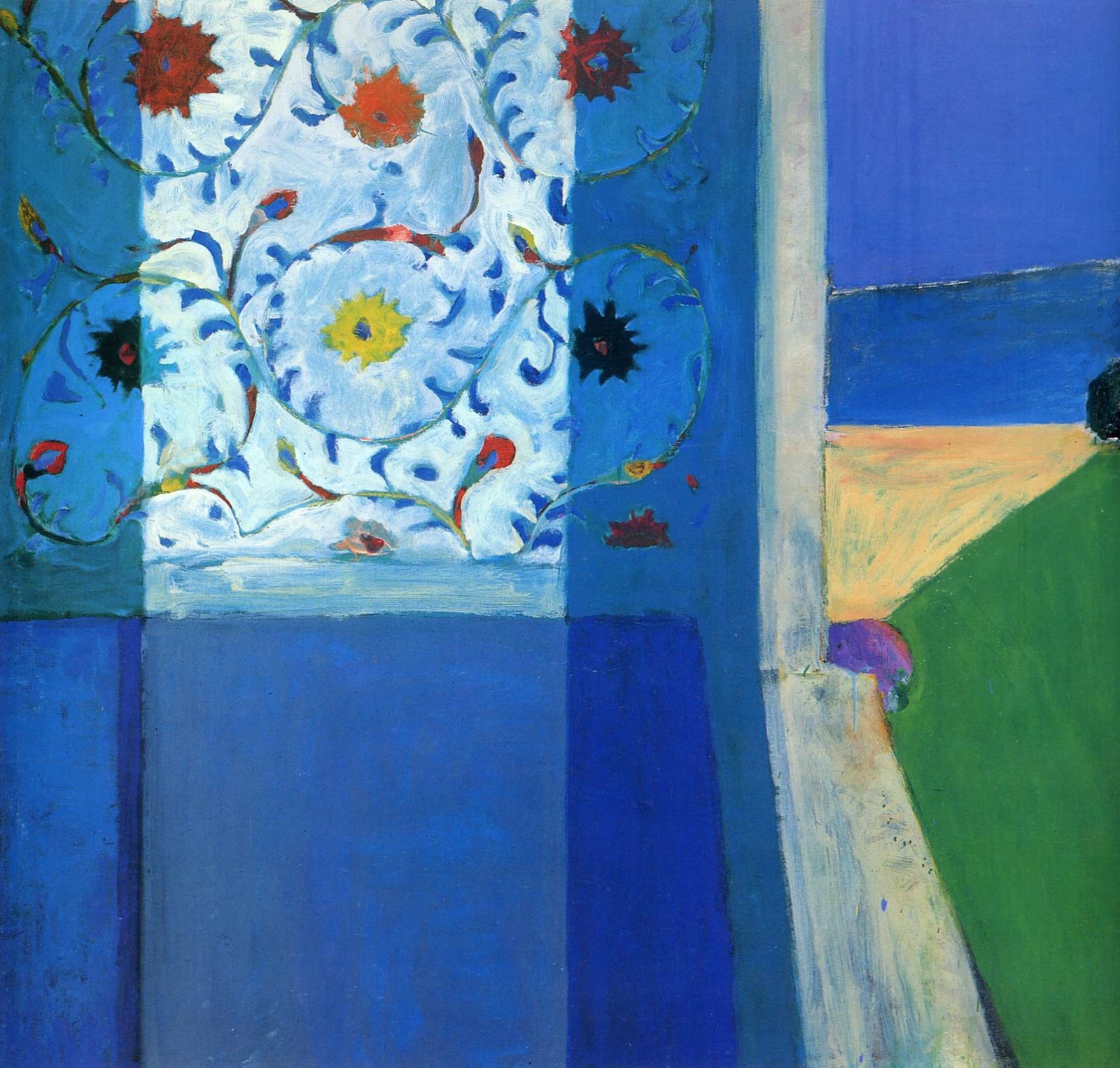
But not everyone can pull a Richard Diebenkorn image out of thin air.  And if you could, what period would you choose? Abstract? Figurative? or Ocean Park? Maybe, after seeing the show at BMA or SFMOMA, it would be this one, “Recollections of a Visit to Leningrad,” 1965, which is Matissean but also Diebenkornish:


To Begin with Diebenkorn
Let’s start by thinking about the “new” guy. I had seen a massive Diebenkorn exhibition at the Royal Academy (RA) in London in the spring of 2015.*  The Royal Academy offered generous texts on their walls and a thorough introduction to the artist on their site. Here is an example:

To weigh Diebenkorn’s reception in England, so Paul Carey-Kent, a financial policy analyst and art critic, brought 6  “well-established painters” to the RA’s Diebenkorn show, and recorded their comments along with his own. Carey-Kent started with the assumption that Diebenkorn is “a painter’s painter.” Half of his guests were pleased with the art on view, half were not. The painters are: Katrina Blamin, Claudia Carr, Christina Niederberger, Michael Stubbs, D.J. Simpson and Dolly Tompsett ; see the article for details (www.artcritical.com/2015/05/04/paul-carey-kent-richard-diebenkorn).

In the article, Michael Stubbs observes that Diebenkorn’s abstract work of the 1950’s was “typical of the early ‘50’s, in developing a Cubist space into more fluid forms which value spontaneous gestures, and which simultaneously construct and contradict the space.” YES. Diebenkorn faced into everything, right up through Cubism and Abstract Expressionism, and found his own voice. This is what makes him a “painter’s painter”: we can see him struggle, almost watch him think. Diebenkorn reveals everything beautiful and unsightly, brushstrokes that lesser artists would worry about exposing. Here is a detail from “Ocean Park 43” (Royal Academy of Arts exhibition catalogue, 14 March-17 June, 2015, p. 140):


Look at the escaped blue squiggle, up against a deliberate long dripped line. Now take another look at the gray line that anchors the blue triangle: there is another shape partly visible inside that. There are no straight lines on either top or bottom of the purple stripe; the artist didn’t auto-correct. The green drip slams into an orange line that then veers off to nothing, allowing the green to re-appear. This is not the work of a minute. This apparent spontaneity is earned through time and incredible patience on the part of the artist.  Marking, erasure, marking, stopping.

Another of the artists brought to the RA exhibition, D.J. Simpson, uses an electric router to mark/draw onto his wood support, and then paints in the backgrounds to make his art (his art is “fetishising,” says the artist and critic John Chilver). Simpson thinks that Diebenkorn knew exactly “when there was enough push and not enough pull.”  I think that, by “push” Simpson means the sustained agitation in the painting, flowing and just a bit untethered. Here is the question... Does Simpson mean that Diebenkorn would then add in the “pull” to lock in the work? Or does he mean that Diebenkorn would allow the painting to remain un-resolved, that this state of flux was the goal?

Matisse and Diebenkorn
The RA ‘s Diebenkorn show was big and beautiful. But it was a show that crested with the Ocean Park series, as if all the previous work was only preparatory.  The hanging was rather convincing as a yellow brick road, and it left me very little room to breathe. In this context, I saw the 1950’s work as flawed, and left feeling odd. I should have liked it; Diebenkorn is a painter’s painter, and, even more, an abstract painter’s painter.

So I was really eager to see the Matisse-Diebenkorn show.  Would Diebenkorn flounder in the face of the older man’s work? I had expected, because I have always loved him, to gravitate to the Matisses.  A brief aside: here is a lovely Matisse, (not at the show at BMA), called “Entrance to the Casbah,” (1912/3):

Years ago, I had gone to a Matisse show** and loved many paintings with this intense blue-dominated palette and come home immersed in what I thought of “Matisse blue.”  Bonnard said of a Matisse on his walls that

By day it is the blue that takes the lead. What an intense life the colors have, and how they vary with the light!  (1946)

On impulse, I added the color to every canvas then on my studio walls. It ruined them all, of course, because the paintings hadn’t called for that kind of interference.  What kind of interference would Matisse cause Diebenkorn? I thought blue might be involved.

But I was wrong. It was black, deep and abiding black. (Black is so important that one artist has recently claimed exclusive rights to the newest, strongest black mixture, Vantablack  (http://hyperallergic.com/279243/anish-kapoor-gets-exclusive-rights-to-the-worlds-darkest-pigment).  
But I get ahead of myself.  I should start with the observation that the wall texts and the essays for this show are entirely convincing. The research is solid, the relationship clear. Diebenkorn studied Matisse beginning with his days at Stanford. He saw Matisse’s paintings in the home of Sarah Stein. He visited MOMA in New York and the Pompidou in Paris. Diebenkorn owned forty-one books on Matisse, even loaning one to MOMA’s curator John Elderfield in 1983 to help with an upcoming exhibition. Diebenkorn saw little-known Matisse paintings as a guest of the Soviet Artists’ Union (Matisse/Diebenkorn catalogue, eds. Janet Bishop and Katherine Rothkopf, BMA and SFMOMA, 2016).

Near the show’s entrance, I found myself moving back and forth, looking at Matisse’s “Studio, Quai Saint-Michel”:


And his “Goldfish and Palette”:


And then, with those two firmly in mind, I took in “Urbana 2”


And “Urbana 6”:


 And basically didn’t want to move on. (So I will basically stay here for this writing, but know that there are many, many more works in the show and go see it!). The irony of the day was that the two Diebenkorn paintings had both been in the RA show, but I obviously hadn’t SEEN them.  I saw them now. And they blew me away. I remember thinking about each one, “is it a room? a landscape? a state of mind?”  The “Urbana” series was all that abstract paintings are meant to be. They were open, un-resolvable, but there might be a key, if I stood there long enough, maybe... I wanted to stay in front of them forever. And what held me in was the black pigment. Look back at “Urbana 6” and imagine just the black in outline as I drew it in my sketchbook:

The shapes are powerful, even in outline, but here they are again in black:

The black paint won’t give it up.  It hangs there, receding and coming forward as if it were actually moving. Curator Janet Bishop writes about “Studio, Quai Saint-Michel” and “Urbana #4” that

... the young painter appears to have repurposed the blocks of color that make up the Parisian studio interior to create a composition seemingly devoid of familiar points of reference (catalogue, p. 23)

This is the goal. The “pull,” Mr. Simpson, is left up to the viewer. 

It is as if Matisse lived long enough to move a little closer to that abstract edge; Diebenkorn completes Matisse’s line of thought, taking the loose shutter of  “French Window at Collioure” (which, curator Katherine Rothkopf writes, was changed by Matisse to cover over  ‘a balcony and a landscape in the distance” were covered over by “a wash of black paint” [!!] (catalogue, p. 123) :


 And fastening it down (the “shutter” in Ocean Park #105):


*My husband, Charles Tarlton, wrote a series of ekphrastic tanka prose about the Ocean Park paintings, based on our visit; see artistinanaframe.blogspot.com, the entry on Diebenkorn from 11/21/16; there is a drama in prose & poetry on the relationship of Matisse and Picasso printed there as well.

**”M

Monday, November 21, 2016

Charles Tarlton, "The Turn of Art"

This piece was originally published in Fiction International, Issue 45, "About Seeing." It is dedicated to Janet Bishop, Thomas Weisel Family Curator of Painting and Sculpture, SFMOMA, whose tour around "The Steins Collect" was so exhilarating.


The Turn of Art
A dramatic scene in prose and verse

Gertrude Stein and Alice B. Toklas’s atelier at 27 rue de Fleurus, Paris.  It is 1907.
The room is filled with heavy furniture, a large writing desk, sideboards, tables, and cupboards.
1. Pablo Picasso (Left Stage Center) and Henri Matisse (right Stage Center) sit in low chairs across from each other in front of the fireplace (Up Stage Center). They face us as if looking into a camera (think of the famous photo of Gertrude Stein and Alice B. Toklas by Man Ray taken in 1922).
On the wall (Up Stage Left) behind PICASSO, 5 MATISSE paintings are hanging—Woman in a hat (1905), Madame Matisse (1905), Le Bonheur de vivre (1905-6), Blue Nude (1907), and Self-portrait (1906).

On the wall (Up Stage Right) behind MATISSE we see 5 PICASSO paintings—Boy Leading a Horse (1905-6)), Gertrude Stein (1905-6), Young Acrobat on a Ball (1905), Nude with Joined Hands (1906), and Self-portrait (1906).
PICASSO
once we had turned
our backs on the museums
            Pause.
where could we go?
            Indicates MATISSE, sarcastically.
then he started drawing
lines of paint an inch wide
MATISSE
wasn’t easy
while so many others
were portraying
the fine line of a nose
details in strands of hair
PICASSO
not enough, not
for him.  Just to make it
look like real fruit
            Pause.
no more trompe-l'œil for him
            Pause.
dot’s enough for a nipple
MATISSE
I drew with brush
loads of flat blue house paint
made my lines thick
all around the outside
black between trees and sky
Pause.

MATISSE stands and crosses the room.  He takes Boy Leading a Horse from the wall and carries it back to his chair.  He leans it against the wall beside his chair and sits down.
Not every one, however, followed my lead.
Pause, admiring Picasso’s picture.
browns and some grays
this is a precocious child’s
drawing.  A horse!
a boy’s dream of the West
the open plains to ride
PICASSO
a poetic
dream might more easily
bring in the cash
hung on their wall till 1913
you often saw it there
Pause, PICASSO points to a spot on the wall
later Nazis forced
von Mendelssohn-Bartholdy
to liquidate
hispano-judaic
art smuggled out and sold
MATISSE
marketable
like pigeons in St Marks
swarmed around you
as they changed to property
they escaped like wild birds
Pause.
I was waiting
for you to drop it all
come up to art
renounce celebrity
stop showing off—show us!
works of genius
make us feel supremely
diminutive
genius has to give it up
forfeit its advantage
PICASSO
has to give up what?
MATISSE
superiority
Pause.
they used to say
I wish I could draw like that
now they say, anyone could
            Pause.
PICASSO
I felt deeply
every brush stroke of these
as I made them
but in cold aftermath
just financial success
            Pause, as if reflecting.
I was watching, you know, despite my cool demeanor.  But, I loved the life in the cafés, you know, the money, spreading my name around.  And the women, they all wanted to touch my genius. 
            Pause.
You did none of that.  You ran no races, gave no quarter.
How was that?
you were ahead
tossing off thick-limbed monsters
driving me mad
you made these obstacles
I had to climb over
MATISSE
Finally!
PICASSO
I wanted to paint
with a heavier hand
lose all my fear
of teachers, my father
forget about the saints
MATISSE
could see clearly
down into the world’s heart
below surfaces
but you kept painting them,
the surfaces, the smiles
PICASSO stands and claps.  He then crosses the room behind MATISSE and removes Woman with a hat and carries it back to his chair and holds it on his lap, partly turning it so the audience can see.
PICASSO
this is, of course
all odd lumps of color
unexpected
rub out the woman’s face
PICASSO covers the face with his hand.
—and behold Kandinsky!
you sped ahead
on wings of distortion
shape and color
yours to waste, invent
new wonders for the eye
Pause.
no milliner
could make a hat like that
it was conceived
on an insane palette
laughing, you were laughing
MATISSE looks around the room, as if trying to orient himself. Coughs.
MATISSE
Somewhere near here, art’s roadmap changed abruptly.  Up ahead or looking just behind us, out of the corner of my eye, we were poking forward, looking for the line just so we could step over it. 
I saw you coming up.
PICASSO
the other side,
how I longed to be free
overstepping
there’d be no looking back
MATISSE
make the first real pictures!
2. The stage goes dark. Two middle-aged men emerge from the wings (Down Stage Right) under a single spot, dressed as GERTRUDE STEIN (PETER CARMODY) and ALICE B. TOKLAS (ANDREW BLIGHT) and wearing the same hats worn in the famous snapshot taken in Aix-les-Bains, 1927.
CARMODY (GERTRUDE)
they never knew
what the very next thing 
might be—tiny
legs, an arm, thick as trees
palm tree fronds like fish bones
BLIGHT (ALICE)
They were always searching for it, for the new.  At first in different ways; Picasso, of course, classically trained, gifted, was a long time shaking off the lessons, his tutored instincts.  The Blue and Rose periods—he could have been using a camera. 
            Pause.
Henri was different, all for crude outlines, sudden colors, rough dabs of paint, the merest suggestion.
CARMODY
he made it strange
defied the viewer’s eye
BLIGHT
no matter what
it was, it disappeared
CARMODY
into paint, just the paint
Pause.
That’s it, of course.  He overthrew the subject.
Only the paint counted.
That was where the eye fell; there, on the paint, the thick paint piling up, the paint on top of other paint, the paint plowed by the brush like a field readied for planting. 
Pause.
Look on the wall!  You see the picture of his wife, Madame Matisse, with the green line down her nose?  See what I mean? 
Compare that to Picasso; choose one there on the wall.
What about the portrait of Gertrude Stein?
            Pause.
I mean, my portrait.
PICASSO and MATISSE rise and retrieve their respective paintings and bring them (Down Stage Right).  They stand under the spot, holding the paintings in front of their chests.
BLIGHT
He meant it to look like you, a resemblance, but, he said, if it didn’t look like you right now, that was all right, because it eventually would.
CARMODY
it was just exactly me.
PICASSO holds the painting out and turns it so he can see it.  He looks at CARMODY.
PICASSO
I was looking for truth
not just surfaces
behind those eyes, a mind
was watching for a sign
CARMODY
You’re right, I had seen so much
Pauses, musing.
on the lookout
PICASSO
your eyes reach out to probe
what you’re hearing
as if to say, I had hoped
you’d not be like the rest
MATISSE
And, what do we say about Madame Matisse’s portrait? 
Can your discerning eye probe deeper meaning there? 
What do you make of that green stripe?
BLIGHT
perhaps you meant
only to encompass
her, register
your discontent with life
the burden of marriage
I always felt
MATISSE
pushed into the background
disapproval
in those black eyes, stern lips
BLIGHT
how would you even know?
CARMODY
I still say it’s the paint; the spirits of all the wild emotions caught up in spread paint, bone splinters in the ambergris—color, thickness, smell—wide brushes. 
It looks like whatever you want it to look like. 
Pause.
No. It was not about looking, or smelling, or being like anything at all. 
It meant in fact—red, the green, the violet, and orange; just as it means blue, black, and yellow—in any of their many permutations, in a chance encounter, as crude parts of the world.
MATISSE
it was to paint
because I was making
PICASSO
objects from paint
Pause.
my mind’s eye gave the world
only the quickest glance
3. CARMODY AND BLIGHT exit. Spot off, Stage lights up. MATISSE and PICASSO are back in their chairs.  PICASSO points up at a painting, The Young Acrobat on a Ball.
MATISSE
there’s a story
in that one for certain
pure narrative
tempts us to wondering
who the large sad man is
Pause.
I contemplate
more the lonely woman
child, boy, and dog
dreamily facing hills
where a white horse grazes
the acrobat
is a boy or a girl
learning to stand
on such uncertainty
focussing attention
PICASSO
it was Giotto
or me, could draw perfect
freehand circles
MATISSE
painted like Velázquez
aims now to be a child
MATISSE crosses the room and stands under his painting, Le Bonheur de Vivre. He points up to it.
PICASSO
Childishness, to be sure, yet there’s nothing childish about it. 
Your hills and distances are but suggested (did you notice?) while the big ideas, all the rest, are wild reds and greens, hints of mythology in all the playful poses, but circles and careless dots for eyes, spring frolics, and a touch of sensuousness, perspective out of whack
—verges on humorous.
far more expressive
than my pouting giant
or my morose
pale hills.  Your lovers run in
search of cartoon nudity
MATISSE
So, you want to talk about nudes?
MATISSE reaches up and removes Nude with Joined Hands.  He looks closely at it.
You were still painting like Velázquez.
            Pause.
you’re so polite
your nude’s too well-mannered
covers herself
could be from Pompey’s walls
a goddess or priestess
she’s a mural
painted on Spanish stucco
inside a church
PICASSO
I meant to paint
women someone could love
I was out to show the world who was master.  Infinite reflection and dark resignation show on the faces of my men; the deepest sadness, calm, or joy appears on the faces of my women, because they are so beautiful. The children know so much. 
I could not paint the kind of pulsing stones, the female boulders you were so happy to make.
Pause.
I dreamt women
you could take out walking
they’d hold your arm
it took time seeing how
wrong; longer catching up.
4. PICASSO goes behind his chair and takes out a long pointer rod.  He goes over to the paintings and stands in front of Blue Nude.  He points to it.
            Long Pause. He is just looking at the painting, transfixed for a moment.
this was vulgar
so I at first decided
androgynous
whore-sailor all in one
promiscuously drawn
PICASSO comes to (Down Stage Center), Pauses again, and leans intimately toward the audience, in confidence.
Pornographic.
            Pause, sighs in resignation.
this beautiful hulk is
REALITY
Look at it!  Look at it!
a carcass of hip bones
ankles, twisted rib cage
Pause, to MATISSE directly, as if, for the moment, giving in.
This was your high water mark. 
I knew it instantly.  I ran home and drew a hundred chunky naked women leaning on their elbows, sharp hip bones and one leg flung over the other—a hundred, at least. 
You had launched a thunderbolt, for certain, but I thought to myself, “I will rise to that, rise up to that!”
MATISSE
caught by surprise
lost sight of the way ahead
in a fever to catch up
            Pause.
with this the history
of modern art resumes 
PICASSO
that we could teach
the art world to embrace
this meaty toad
MATISSE
love and art together
move closer to the truth
PICASSO
The way ahead congealed, the compass and the raw materials were set. 
MATISSE
If anyone could have seen into the future, this would have been…
MATISSE makes an all-inclusive gesture with his waving arm.
…where it all started.
5. PICASSO reaches up and takes down the Self-portrait by MATISSE; MATISSE takes down the Self-portrait by PICASSO.  They both come (Down Stage Center) and stand holding the paintings and facing the audience. PICASSO pulls a false beard from the portrait of MATISSE. The two portraits reveal a strong family resemblance—the portraits of two brothers.
Curtain


Tuesday, January 10, 2012

"Faithful to the Process": A Review of Richard Serra Drawing


(The Retrospective has been at The Metropolitan Museum Of Art in New York, and is, for a few more days, at SFMOMA and will soon move to the Menil Collection in Houston)

You might feel you know Richard Serra’s work, having walked through two curving walls of one of his steel sculptures.  This is "Band," now at the Los Angeles County Museum of Art:


You may feel, too, that you know and understand the limits of drawing, a concept so basic that most artist’s dictionaries don’t bother to define it. My painter friend says “marks on paper, perhaps,” or “lines, generally in a single color by pen or pencil,” or “maybe a work on its own, or a study for something greater.” A drawing by Raphael is not so different in kind from a drawing by Jasper Johns (who, by the way, has collected Serra’s work; the “Gutter Corner Splash” lines of thrown-lead works in this show are a gift from Johns).  I think of a Nicolas de Stael show we saw years ago, a show of drawings that I thought re-energized the possibilities: a border around the central room of a New York gallery, abstract lines of varied colors on paper torn from notebooks.  

None of this will help you find an immediate kinship with Richard Serra’s work in this show, however: you will not want to wander into any of these rooms unaware. Serra attempts to do with drawing (using paintstick on paper or linen) what he once did with sculpture: to disconcert, to undermine, to bother, to change, to move the goalposts and remove the pedestal -- permanently.  The drawing is neither an architectural plan for sculpting nor a framed bit of abstract gesture. Because it is not anything you have seen before, it may, indeed, infuriate you. In an interview with Charlie Rose (charlierose.com, dated April 21, 2011), Serra says that the intention of these drawings is “to create a volume of space within the architectural volume of the space that is different in kind.”  So, the space inside each museum room is going to have to matter, because the drawings are meant, like the sculptures, to disrupt where we had been walking. As we move, we see a different light, a different angle on each room.  Serra wants to avoid drawing an object, to avoid representing: “I draw interval or I draw space.”  He isn’t using a Rapidograph or an HB pencil or a marker; “artists make up their own tools and make up their own procedures,” Serra tells Rose., and so he melted paintsticks together into bricks, creating a wall of drawing that will be difficult to crack.

The reviews I have read come mostly from the show’s installation at the Metropolitan, and the remarks are – generally – reverential.  Walter Robinson wrote, in “Richard Serra: The Met Goes Modern” (artnet.com), that “Serra is our most powerful formalist, as everyone knows.”  [If we need a gloss on the word “formalism,” we can go to the Tate Museum, where they tell us that the word means that “the most important aspect of a work is its form … the qualities of colour, form, line and composition” (tate.org.uk)].  Serra said (to Charlie Rose): “I don’t draw image.” If it is possible to do it, he seems to want to draw … form. And the critics seem pleased; they have their language at the ready. Robinson calls the drawings “elemental things” and says they “easily command their galleries.”  Jane Panetta, writing of the piece “Taraval Beach,” says that it “dominates and dramatically alters the gallery it inhabits …. [it] seems to become space” (Art in America, June 16, 2011).  David Hansen, writing in The London Review of Books (Vol. 33, No. 13,  30 June 2011), is a little more helpful, though he, too, rhapsodizes, bringing in Edmund Burke and Kant: “faced with the grandeur of the Sublime you can no longer think, let alone act, only be.”  How is that helpful? you may ask. But, wait, other notations of Hansen’s do help: he explains that some of the drawings are textured like “combed animal pelt, or a hairy tweed, or like the squeegee drag and blur found in Gerhard Richter’s abstract canvases …. [or] sugary black molasses with faint traces of bootprints … [or] maps, reptile skin, leaves.”  (At last, a description! This is what they look like – because, for some reason, photographers allowed to take pictures of these works only capture them head-on, where they look flat and black. Un-textured).  So we begin to see a little, perhaps, a little of what it might be like to stand in front of one of these pieces. But, overall, the reviews can feel far too distanced, a kind of unquestioning admiration for “our most powerful formalist.”  Only Roberta Smith, in an otherwise very positive review, acknowledge a weakness or two, such as: “the work can sometimes seem at once meager and histrionic” or “[it]can present empty echoes of traditional authoritative formats” (The New York Times, April 14, 2011).  So what of the work itself … what is it like to be THERE?

My reflections on Serra’s drawing break neatly into two segments (which correspond precisely to my two visits to this show at SFMOMA).  If I had to give a title to my first response, it might be Gertrude Stein’s “If the artist knows exactly what he is going to do and more importantly how it will be done and what it will become then there really is no use in doing it since there will be nothing new in it” (How to Write, xiv). This is the strain of thought I lapsed into after seeing the show for the first time.  I mainly saw -- and remembered -- only the huge black presences called “Abstract Slavery,” “Taraval Beach” (below),  “Pacific Judson Murphy,”  “Blank” and “Union.”   


My reaction to all these works was direct, visceral and angry. Why continue on past the first experiment?  One piece, I thought, would have been enough, a single exploration on this scale, a single try at covering a large surface with a tool that was originally designed to add notations on steel or highlight a line of painting with texture or color.  Once finished, move on: simple.

Two of these pieces,  “Blank” (from 1978, paintstick on Belgian linen) and “Union,” (from 2011, also paintstick) are installed as massive “walls” opposite one another. Two rooms, two sets of black drawings, two sets of white walls, each time.   The other three drawings are also wall-sized, but each is given its own space.  These five, their massive scale, came together for me only in terms of how much space they wasted. These works in particular seemed to repeat a single formula: rub, rub more, rub again, repeat, cover the surface entirely as if covering a schoolyard with asphalt, hang with staples.  The drawings did not seem, to me, to contain the power of Serra’s sculptures, nor did they live up to the elegiac language of many of their critics. Why were they there … except that they were signed “Serra.”

I should pause here and note that I always believed that abstract art revealed the truth of its making; I believed that I could tell when an artist was invested and when s/he was simply going through the motions. I felt supported in this because I had seen an interview with Robert Motherwell, who said (in my rough paraphrase), “I have made many paintings that are failures, but none that are lies.” I felt I could smell lies. And these five drawings, and perhaps one or two others, in this show, seemed to me … lies.  These were not sketches, revealing the coming sculpture; these were … simply … big.  And monotone.  And yet -- I love the erased de Kooning by Rauschenberg (now at SFMOMA; see the video explanation of that process here: http://www.youtube.com/watch?v=nGRNQER16Do&feature=related) and his all-white series. I have seen Ryman’s and Pousette-Dart’s white paintings.  I have read Yazmina Reza’s Art.  I like the fact that Agnes Martin traces horizontal lines across a five- or six-foot canvas, over and over again.  I like Gertrude Stein, who says, in “Portraits and Repetitions,” that “I continued to do what I was doing in Making of Americans.  I was doing what the cinema was doing, I was making a continuous succession of the statement of what that person was until I had not many things but one thing.”

What?  Many repetitions make one thing?  Wait, that’s … what’s happening here.  On Belgian linen.  Wait. Wait. I don’t like not liking something that seems so obviously, on the face of it, the art I should love: a departure from the art before it, a Herculean effort, a non-narrative but still thoughtful attempt at form and substance, “not many things but one thing.”   So I went back.

The title, if I had to give one, of this second visit to SFMOMA would come from Serra himself, from his interview with Rose: in discussing his “Untitled (14-part roller drawing),” made in 1973 at Gemini Press in Los Angeles, Serra created “a very serial proposition … [I was] just paying attention … I could care less about what it looks like. I’m just staying faithful to the process.”  Three things: first, the point of the work at SFMOMA is that it is “serial,” it is “process,” and the artist remains “faithful” to the initial proposition. These works are records of an encounter with scale and material. Serra clearly feels he is still working with these, a straight line from 1969 through to 2011.  I have no trouble with this claim at all. Second, he was “paying attention,” Serra says, and this would be, for me, the thing I needed to find visible, somewhere. Third: yes, “new work will seem ugly” to its first audience, Picasso said once, because it is working through something difficult; Cubism and the Demoiselles were ugly once (then, Picasso said, the imitators come along and make pretty versions).  The exhibition offers up ugly moments, certainly: the drawings can seem like discarded, well-worn rubber, the paper is stapled to the walls, and the oil from the paintsticks makes a yellow stain around the edges of some pieces.  The black paint sucks the air out of some rooms, and the unrelieved raised furrows seem endless and unrelenting in the larger pieces.  Pretty is not the point; the point is power.  Even Hansen, the critic who wrote about the Sublime in relation to this work, concludes his review with: “But don’t try to get too close. Make no mistake, Serra is a tough guy, a front-end-loader philosopher, a ‘don’t give a damn’ democrat. While he is happy to share his hard-labour, hard-nut ontological confidence, he doesn’t solicit your vote. Sublime indifference, that’s what it is.”  Besides making Serra into a combination of Sam Spade, Willem de Kooning and Nietzsche, Hansen makes a good point.  One characteristic of the work is that it stands alone, like death. It doesn’t care what you think.  But art, like death, needs a considered response.

So, what of my concern about whether or not Serra was “paying attention,” whether he was, in my old notions of measuring art, telling some kind of “truth”?  As I walked through the show this second time, I understood the serial, the process, the labour, the confidence, the ugly exposure of the oily edges, the staples, the rubbery surfaces.  But -- does it seem to be “real,” this work, in the way the sculptures are “real”? 

The five pieces I most disliked on my first visit grow a little more receptive on a second go-round.  Coming near to the surfaces of these massive pieces makes it possible to see all the textures that Hansen mentioned.  “Texture and illusion,” my husband said. There are moments of Richter, there is a kind of vertical parade of harsh markings, the light comes and goes into ridges and valleys just as it does over a hillside, and is trapped or reflected without reference to the viewer, unrelievedly. I still find these pieces difficult because they seem to simply begin and end (I would assume that is the point) without a focal point, any carved-out edge, without any relief at all from its “dark declivities” (a Yeatsian phrase from his poem “Parting”).  No relief is also the point.  Drawings, Serra said to Charlie Rose, are “the subtext of how an artist thinks.”  So, yes, we have that “subtext,” textualized in paint, here.  Perhaps I object to the perfection of the unforgiving, unrelenting surface.

Other works that this I found myself far more inclined to love, on second viewing, involve not the perfection of those first five pieces, but a kind of imperfection that comes from the spaces that Serra creates on the ground, the linens or papers. These spaces appear between or around the form or figure and provide some breathing room, a way for the audience to enter in (as Serra said he wants us to).  Barbara Rose writes “Serra is not interested in the mixing of light and shadow but in the absolute differentiation of the two” (exhibition catalogue, page 43). One of the earliest pieces where this “differentiation” occurs is “Untitled,” from 1972-3, a dark black horizontal triangle, with a smudged ground; this is more attuned to traditional figure-ground drawing, of course, and so it seems a bit friendlier. Here is a detail:


 There are three works from 1989, each composed of paintstick on two jointed pieces of paper; all of these appear to be responses to the removal and destruction of Serra’s “Tilted Arc” in that same year.  The titles are “The U.S. Government Destroys Art,” “The U.S. Courts are Partial to Government,” and “No Mandatory Patriotism.”  They are all in one large space, each displaying two black forms that collide with or incline towards one another, and they all make use of negative space and seem light, weightless, despite their layers of paint.  Another group that seem to me to be describing space through line and form, one of Serra’s aims, is the trio from 2001 and 2002, all on one wall, of “Vico,” “September” and, below, “Black Tracks” :


The works called “Solid 1,” “Solid 11” and  “Solid 13” contain an off-square central shape that reaches nearly to the edge of the (handmade) paper, and in that edge is, for me, the payoff: droplets, Pollock-ian lines, smudges, oily smears.  Where the work tapers off and the viewer can then see the body of the work more clearly, that edge, is what I love here.  “A Drawing in Five Parts” from 2005 is composed of five drawings, each with (sideways) arched lines, again with splashes and drips at the edges and thicker and thinner applications of paint.  These are the imperfect ones, the ones I have come to see are the record of the process, the artist’s hand, the true thing.

Serra may have said it best (he’s a pretty articulate Sam Spade):  “I think in order to see a work, it has to generate a sensation that engages you with what you’re looking at.  Otherwise, you’ll dismiss it. Otherwise it’s like other things.  There has to be some factor of engagement, some emotional connection – something has to get you to the point where you’re aware of your reaction, your emotion, where you analyze the content of your perception. Only then will you become conscious of what you’re looking at “ (catalogue, p. 77).  My old friend Kent Jacobson was right: never trust your first impression.  Always go back, look, repeat, think, look, repeat. And then you might get it, sublimely indifferent though it may be.

Monday, May 23, 2011

The Last New Picasso...

You will know by now all about the newest San Francisco Museum of Modern Art (SFMOMA) show, called The Steins Collect: Matisse, Picasso, and the Parisian Avant-Garde. I quoted from the catalogue yesterday, which I now have and am slowly looking through ... the show is wonderful. It begins here and moves to Paris and New York. There are drawings, paintings, pieces of furniture, letters, plans by Le Corbusier, photographs and the collections are gathered together in the museum as they were acquired and displayed in each home ...  this will not be happening again! The show helps explain the way the Steins' purchases and salons helped encourage the understanding and reputation of the newest wok of the twentieth century. Do go if you possibly can!

Gertrude Stein was able to purchase Picasso's work through the first World War, but his prices soon escalated and her final purchase, in late winter 1923, may have involved the exchange of an older Picasso. It is a still life now owned by The Art Institute of Chicago. In an attempt to see how this "final" Picasso was composed, I sketched it ... my version has some adjustments, made as I was reconciling my angles with Picasso's.  The painting feels to me less like a collection of objects on a table, which it must be, given its title, than a nude or pair of lovers... and that would fit with one of the interesting discoveries we made while looking at the show: the Steins were exceedingly fond of nudes. Here is my version:


(Details, provenance and the reproduction published in the exhibition catalogue, pages 229 and 434)

Sunday, May 22, 2011

Leo had Cezanne, Gertrude Picasso... one apple for five!

When Leo Stein left Rue du Fleurus, he and his sister Gertrude had to choose the pieces each wished to keep from their joint collection. Gertrude kept most of the Cubist works, and the Picassos, and Leo the Matisses and some of the older works. But they both loved the Cezanne sketch, "Five Apples." Leo prevailed, saying "The Cezanne apples have a unique importance to me that nothing can replace.... I'm afraid you'll have to look upon the loss of the apples as as act of God."  Gertrude was not without resources, however, and when Picasso learned of the story, he painted Gertrude and Alice a replacement apple, and gave it to them for Christmas 1914.  (Recounted in The Steins Collect, edited byJanet Bishop, Cecile Debray, and Rebecca Rainbow, SFMOMA and Yale University Press: 2011, p. 97).

Here is a sketch of a sketch of a sketch....

Monday, May 16, 2011

Gertrude Stein says "It is not clarity that is desirable but force.

Clarity is of no importance because nobody listens and nobody knows what you mean no matter what you mean, nor how clearly you mean what you mean. But if you have vitality enough of knowing what you mean, somebody and sometime and sometimes a great many will have to realise that you know what you mean and so they will agree that you mean what you know, what you know you mean, which is as near as anybody can come to understanding any one."
                                            from "Henry James," by Gertrude Stein, written in 1932-3

Stein is writing about, first, "clarity," by which she means, for instance, approaching writing a novel with the outline done, then writing with the trail for the reader well-lit and the ending clear. No matter how magnificent the writing is, or what points the writer may have intended to make, this kind of writing is, ultimately, forgettable, "nobody listens." It is, as Richard Foreman would say years later, the kind of art that puts readers or viewers to sleep, because they know what will happen (see my post from May 4, "find the heretofore un-mapped"). But, second, Stein writes about the kind of writing that she wishes to do, and does, (unless she is overwhelmed by audience... see my post from April 7, "artist, audience, performance").  This second kind of writing comes of "vitality" (and is met, she suggests, with "vitality" from the reader) because you know what you mean. That is, the expression comes from somewhere inside you, as you write, and, like Hemingway's "truest" writing, cannot be prescribed, pre-planned, does not describe, but keeps the writer, and the reader, in the present moment of reading. This is why it can be so important for us to hear Stein's work being read... because the sounds keep the reader feeling that she "mean[s] what" she "know[s]."  The reader is not, then, de-coding Stein, but walking, as my poetry Professor Robert Weisberg said once about reading T.S. Eliot, around the poem [or the prose] as if it were a sculpture.  Stein wants you to walk around the words, hearing them, staying awake, and be "as near as anybody can come to understanding any one." Which is, after all, at least part of the point....

The reason I am interested in the "force" of Stein's writing today is... a new exhibit at the San Francisco Contemporary Jewish Museum, called "Seeing Gertrude Stein: Five Stories." The show features Stein in her own world, the one of her own making, and it begins with Stein reading from her work "Picasso." It starts with her voice.  And then it proceeds to her writing, her friends, to Alice B. Toklas, the life they created together in Paris and the countryside, and brings together art-work, first editions, photographs and videos that have never shared the same space. There is a wonderful photo of Stein in a Balmain velvet suit at his fashion show, and another one of Stein and Toklas, about 3 years into their relationship, tanned and laughing and dressed in matching flowered dresses. Go. See it. There will also be a show at SFMOMA opening later this week about the Steins....

Years ago, we went to see Stein's house in Bilignin. At the time, it was lived in, and the residents were not willing to take us indoors, but we did walk along the terraces, and see the views and the gardens. It was beautiful.  Afterwards, we drove down to the road below and took a photo of the house (below) and remembered what we had read, once, about the way residents of the town loved her and sheltered her in World War II: one of them said "credit for her until hell freezes over."