Showing posts with label orange slices. Show all posts

Friday, September 23, 2011

Orange slices series: a change to "CRANE"


--- this is 2 x 4' --- have finished it today, I do believe (and have brought it into the living room to look at it and feel certain)...

It may not look like it, but this is a short treatise on love, loss and perspective. The scraping and sanding and over-painting is about time and its passing... as it passes, our landscape changes. We are in a different place; we have changed, and not everyone that we started with is "right here" anymore.  But that doesn't mean that we don't remember what we have lost -- as we stop for a millisecond and see what we have gained.  We are often in two places, presence and absence being something we all know ... and yet, traditional perspective doesn't allow the viewer to look back. It is not "for" movement or feeling. It is meant to be a reasonable, scientific scan of the world... but there is no method that grants every body, flower, tree, parent, child or building or pig its place.  As we move, the world blurs, and we must choose what to see. But we do choose. And we must not let perspective, well-dressed and recommended though it is, choose for us.

The painting above concerns a crane in Coyote Hills (present)... and it is also a recipe for the pie of my childhood... the recipe that came out once a year (absent).  My father was the only person who truly loved it... later, my mother would add strawberries in an effort to appease the rest of us. This came in the mail from Rob and Barbara yesterday:

We are there, in the hills of middle Connecticut, at a small summer family dinner, and here, driving to and fro in the hills and the fog:

And a CRANE "in the midst of all."

Wednesday, August 31, 2011

A sketch for the nest and cottage series....

Taking yesterday's beginnings, sketching something to try tomorrow, thinking of the final stanza of my new favorite Wallace Stevens poem, "Final Soliloquy of the Interior Paramour," which is

"Out of this same light, out of the central mind,
We make a dwelling in the evening air,
In which being there together is enough." 

The ideas of light, of making, of together, of air and having two as one... here is the newest drawing, crossing picking up rocks on east Beach at Watch Hill with a stay at Pacific Grove, East and West coasts:

Saturday, August 27, 2011

Annotation: Orange Slices

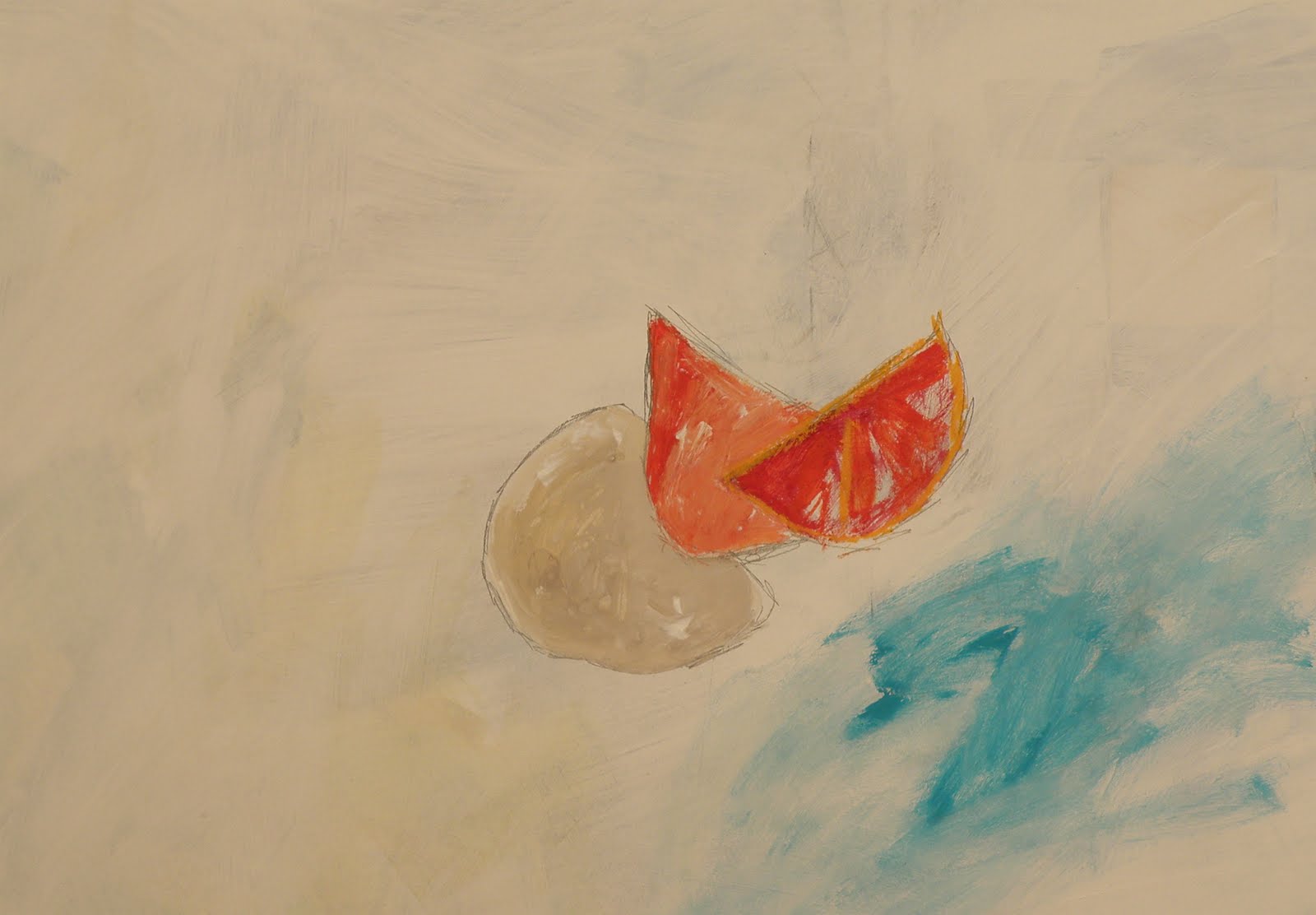
So my (2 x 4') painted annotation has become a little more complete, today:


Gertrude Stein wrote, in Paisieu (the full title is PAISIEU: A WORK OF PURE IMAGINATION IN WHICH NO REMINISCENCES INTRUDE) that:
"A name is always cut in orange slices."

And the same can be said for an annotation....

Friday, August 26, 2011

Annotation, in paint

After yesterday (and dreaming about orange slices), I went into the studio and looked at one of my large whited-out wooden canvases and decided to try a centered start; here is a detail:

Presence and absence... I expect I will be working through hiding and revealing and overlaying these shapes. One of Patricia Meyer Spacks's characteristically subtle annotations for Pride and Prejudice (see yesterday's post as well) occurs in Volume III, Chapter 1, where she writes that "Elizabeth's change of feeling towards Darcy takes place mainly in his absence" (and she also draws our attention to an article by Susan C. Greenfield called "The Absent-Minded Heroine; or, Elizabeth Bennet has a Thought' from Eighteenth-Century Studies 39;3, 2006, Spacks p. 292).  I hadn't really worked that through; Elizabeth needs time, and letters, and stories, and, yes, absence, to "see" Darcy's true person, to see past the "presence" of his apparently poor behavior.

I don't have an orange in my house.

Thursday, August 25, 2011

An annotation for Cy Twombly

 "                    ....  Then we,
As we beheld her striding there alone,
Knew that there never was a world for her
Except the one she sang and, singing, made."
                                     from Wallace Stevens, "The Idea of Order at Key West," from 1934


I have been reading Patricia Meyer Spacks's annotated Pride and Prejudice. I was worried that she might include too many instances of mere "translation":  Bingley's "design" means his "plan," that sort of thing.  And there are a few simple explanations... but principally what matters to Spacks is her observations.  She discusses the importance of the "visit" -- acquaintances must begin, yet only a man may visit another man, and that first visit should be made promptly (p. 31, note 13) -- I feel these notes are very useful to twenty-first-century readers, who do not "visit."   About a request from her father, "What say you Mary? for you are a lady of deep reflection..." that poor Mary is unable to answer, "Mary wished to say something very sensible, but knew not how," Spacks says this: "Austen's capacity at least momentarily to solicit sympathy for foolish Mary, as earlier for foolish Mrs. Bennett, suggests the breadth of her comprehension" (p.37, final sentence of note 17).  It isn't simply vocabulary, or story ... it is the very nature of the author's "comprehension."

This got me wondering about the nature of annotation, and, beyond its meaning an explanation or comment,  the origins of the word: it comes from the Latin annotare, "to mark."  And I thought how used we are to annotating texts and reading marginal notes in texts; but we are not at all used to the idea of annotating a painting. Museum and gallery labels inform, but distract from the thing itself. Perhaps words are not the useful thing to comment on painting. Maybe we need to go back to Stevens's "Idea of Order": creative marks may be made to comment on other creative works... paint and pencil annotate paintings and drawings. So here is an annotation for Cy Twombly from me, a drawing called "Orange Slices":