Showing posts with label "Madame Matisse". Show all posts

Friday, December 23, 2011

"Music is feeling, then, not sound ... " wrote Wallace Stevens

We had a small earthquake last night ... about a 2.7 on the Richter Scale ... and we were upstairs, where we could really hear the little "boom" and feel the earth -- uncertain earth -- for just a moment. And it seems to me, as we have now had a few of these, that earthquakes are "feeling, then," AND "sound." Both.  And so, to get myself away from worrying about earthquakes, I am thinking about Wallace Stevens and the poem where the line about "feeling" and "sound" shows up, "Peter Quince at the Clavier":

Music is feeling, then, not sound;
And thus it is that what I feel,
Here in this room, desiring you,

Thinking of your blue-shadowed silk,
Is music ....

Beauty is momentary in the mind --
The fitful tracing of a portal;
But in the flesh it is immortal ....

When I first read this poem, I wondered about that.  Thinking about a thing makes it "real" and permanent -- gives it a place in the mind. But memory shifts, often because we will it to shift:  Friedrich Nietzsche wrote "'I have done that,' says my memory. 'I cannot have done that,' says my pride, and remains adamant.  At last -- memory yields" (an aphorism, from Beyond Good & Evil).  So even a thought, a memory, disappears into another shape.  So the live thing, the one we can hold, or hear, or see, or feel, that is the "immortal" thing.  This may be why earthquakes, quite aside from the damage they can cause, are so scary -- because they can take up two senses at once, hearing and feeling.

So, in yet another attempt to escape these earthquakean ideas, I turn to paintings -- with  music as subject. Here is a smooth-surfaced Caravaggio, "The Lute Player," from 1590:


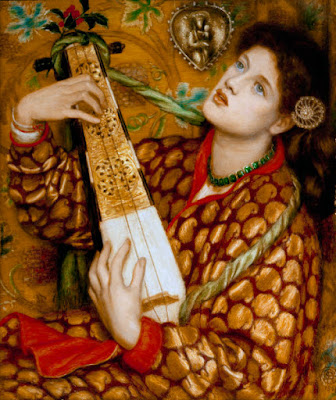
The painter may have used a lens here for help -- David Hockney argues, in Secret Knowledge, that Caravaggio did use lenses in the 1590's -- just look at the photographic shadows and lighting here.  Now, we skip ahead to a very different aesthetic, Dante Gabriel Rossetti, a detail from his "Christmas Carol" of 1867:


Is she playing?  The strings here are of far less interest than her fingers (and eyes) ...  Gustav Klimt was inspired by the final chorus of Beethoven's Ninth Symphony to paint this in 1902:

Here, the bodies and cloth and light is all reduced to beautiful patterns -- notes -- musical.  The last painting is Matisse's "Music," from 1939:


The most musical, to me ... the eye is as engaged as the ear.

Wednesday, December 14, 2011

Ukiyo-e: "pictures of the floating, fleeting world ..."

French artists first became familiar with Japanese art at the Exposition Universelle in Paris in 1867. The characteristic subjects, the differences of scale, the unfamiliar intensities of color, and the innovations in the nature of background in these Japanese works soon found their way onto easels and sketchpads in the West. Here, just to remind ourselves what it must have looked like, at first, is a lovely print, "Irises," by Hokusai:


Look at the sharp edges of the leaves and the insect, the way the bottom does not feel heavy, but rather reaches upwards, and the ivory of the iris blossoms, though close to the color of the white-gray sky, are softly outlined and distinct.

What started me thinking about Japonisme? I recently saw a picture of a Renoir painting. Generally I think we see Renoir as a painter of sensuous women or small children immersed in gardens. Yet, here was this painting, "Still Life with Bouquet," from 1871:


Rembrandt (the framed work on the wall), Impressionism (the bouquet wrapped in white), the books and tablecloth (generic!) but then we see that vase and that fan ... they float.  The influence is there. Then we look to Whistler, who has used Japanese styling in his landscapes and portraits ... but here is a beautiful little study, which appears to be called "The Blue and White Covered Urn" (really?):


Simple lines, elegant against the background, each mark with a slightly different shape, nothing repeated, all observed closely. Now to Van Gogh, who, again, is someone we know loved Japanese prints; here is his "Still Life with Japanese Vase with Roses and Anemones," from 1890:


Definitely not the still, calm world of the Whistler, and with a vase at an angle worthy of a Cézanne, here is energy -- tucked inside the Japanese envelope.  And now to the latest of the artists in this group, Matisse, and his "Still Life with Apples on Pink Tablecloth," from 1924:


Here, Matisse has complicated the background, pulling the wall into the foreground just a bit, and he is taking chances, too, with the colors pink and yellow, which often tend to fight one another. Here, they seem to have just enough interaction to keep the eye moving around the canvas... and the blues here come from the traditional vase patterns that Whistler was studying but here they are given to us with  a larger, freer brushstroke. Matisse would work in this mode pretty extensively ... but he seems to have been the only one of these artists to take the lessons of the Japanese print and apply them across his work.

And then I thought -- who else has looked at Hokusai and Horishige since the late nineteenth and early twentieth centuries? There have been people here and there -- Brice Marden's "Cold Mountain" series, inspired by Japanese calligraphy, would be one contender -- but no movement, as such. And why not?
While we think about that -- why the excitement stopped with Matisse -- I did think of one painter who is working through her Japanese influences: Helen Frankenthaler. In a show at Knoedler & Co last winter, "East and Beyond," Frankenthaler exhibited work in the ukiyo-e tradition that she began in the 1980's. Here is one of my favorite works by Frankenthaler from this show, "For Hiroshige," a painting from 1981:


And here is another work, a woodcut, "Weeping Crabapple," from 2009:


These demonstrate, I think, the possibilities ... we have come full circle, but without losing anyone's own artistic "voice."

Monday, November 14, 2011

Artist Statement VI: "The picture did not live within the frame ... it did not belong within the frame"

One thing that needs to be included in my artist's statement is the question of movement. I have always felt that one of the chief weaknesses of traditional landscape painting -- and perhaps even of portrait painting -- is the fact that the figure and ground, the objects and the composition, often show no sense that the whole thing could move at any second.  That is, the model could get up, the artist could turn her head or move the easel closer to the stand of trees, the light is changing ... The Cubists and the Futurists considered this point, but I believe it still needs to be resolved pictorially -- now.

If we look back at Constable's "Hadleigh Castle, the Mouth of the Thames: Morning After a Stormy Night" (see my post from November 10), we see the castle, the river, the rocks, the sky spread out before us.  But -- how wonderful would it be if we could see all the things he could see as he was actually painting? The castle comes into greater focus, or the dog runs ahead ...

In her Lectures in America, in "Pictures," Gertrude Stein talks about movement: "Does an oil painting tend to go back into its frame because after all an oil painting belongs in its frame. Or does it not .... And if it does belong in its frame, must an oil painting be static."  And she answers her own question -- no -- a painting need not be "static," and Stein goes to the example of a painting that seems --to her -- to move, Leonardo Da Vinci's 1499 work, "The Virgin, the Child, Saint Anne and John the Baptist."  As it happens, we saw this painting at the National Gallery in London last year; it is a "sketch" for a more formal painting that was never completed, stretched across eight sheets of paper, but it is more beautiful than any "final" painting could be, I think:


Stein says that "in this picture there was an internal movement, not of the people or light or any of these things but inside .... In other words the picture did not live within the frame, in other words it did not belong within the frame .... [and since then] I have passionately hoped that some picture would remain out of its frame."  And there is internal movement here; you can feel it, walking around in the gallery with it. This can be explained in part by the figures' sinewy curves, and by the background that dances just a bit beyond specificity.  But really, as Stein goes on to say, a painting "must not completely only exist in its frame. It must have its own life. And yet it may not move nor imitate movement, not really, nor must it stay still. It must not only be in its frame but it must not, only, be in its frame." This is, in part, a discussion of the Modernist idea that a painting must be a thing in itself, and not representative of something outside of itself, but I also think this is about the life in a painting, the way a painting can feel like a very brief, exciting moment in a life.

So the artist, and the work of art, have this difficult task, to allow the art to move without moving.  Can this be done now, without resorting to one-point perspective or any sort of illusion? Well, look at Helen Frankenthaler at work:


She is moving, the paint is moving, but it will all have to stop and, at some point, the painting will be in a show ... will it survive? I think so. Let's look at "Madame Matisse," from 1983:


Matisse had painted his wife with an enormous hat and a green stripe along her nose, a painting bought by Leo and Gertrude Stein, actually, and this painting takes that stripe and makes it move.

Part of what I am still working on, both in my statement and in this new series, is the idea that paintings should encourage the viewer to see ... to see just as if you were in the same landscape as the painting, and see the colors and the shapes as you would if you were walking by. Sometimes this will lead to the shapes seeming to be a blur, or to seem as if they were shrinking or growing; other times it will lead to one thing seeming specific, because it is what the painter chose to look at and to paint. We turn our heads, we focus in on objects, as we walk ... anywhere.  Here is an early example of my landscape-as-movement idea, a 2 x 4' painting called "Landscape as Drama":