Showing posts with label Georges Braque. Show all posts

Monday, November 28, 2011

Out of the Usual Categories ... "hors-catégorie" ... Cubist, Impressionist... and Into... Brushstrokes

Continuing with Barbara Rose on Jasper Johns ... in Artforum in March 1970, she wrote that Johns's "single images did not depend on Cubist 'rhyming' for their structure ... they were understood first as holistic gestalts .... [and because of the small-sized] brushstrokes" which were "methodically applied with equal pressure over the entire canvas surface," Rose says that Johns's work is "reminiscent of mature Impressionism" ("The Graphic Work of Jasper Johns, Part I," p. 39).

Okay, so let's unpack that for a second ... the front-and-back-and-all-sides images present in Cubist work were not Johns's aim, she argues. Instead, there is an all-over "whole," which is intended to be visible at first glance, and to remain visible as the viewer continues to "see" the work.  So, he is not exactly Cubist, and his steady, all-encompassing brushstrokes identify him with late Impressionist work.  Rose is persuasive. But this is a really interesting angle of attack. If Johns isn't Cubist, can he really be an heir to the Impressionists? Does that place him up against, say, Van Gogh?

I started to think that perhaps at least some artists burst free of categories, and that Johns is one of them.  None of the movements I have seen him tied to fit him, exactly. Yes, there are the bronzed beer cans, but they shift into a painting like "Decoy," from 1971, and then (see yesterday's post), he goes from "The Seasons" straight to Cézanne.  The Tour de France has developed a term for the mountains too towering to be classified, the most demanding for the riders; the term for these is hors-catégorie. There must be artists like Johns that are hors-catégorie, beyond the normal reach of art-historical labels. Where can we find Jasper Johns's peers, his lines of inquiry and influence?

Start with the basics. I like to see, as I argued yesterday, traces of the artist's hand -- in paintings, this is the brushstroke.  So, since that's a famous trait of Johns's work (think of the cross-hatch paintings), let's set up some artists whose strokes are, in Rose's words, "methodically applied with equal pressure over the entire canvas surface" and see what we get. We'll go chronologically, starting in 1870.

I have a new admiration for Camille Pissarro, having seen him at the Legion of Honor recently (see November 7th post) and think his "The Stagecoach at Louveciennes" is a good place to begin:


The clouds, the water on the path, the horses, the tree limbs -- they are not offering us the sort of brush-free illusion we see in a Vermeer.  If we take just a corner of the piece, the lower left:


This shows us -- not quite as clearly as I'd like -- what we could see if we were before the actual work.

Now look at the surface of Vincent Van Gogh's  "In the Cafe: Agostina Segatori in Le Tambourin" from 1887:

 
This is not the Van Gogh we tend to think of ... pointillism and grand distortions are for other paintings. But this is an energetically painted work.  Now look at Braque's "The Portuguese," from 1911:

 
We aren't looking at subject matter here ... but at the application of paint. Again, we are seeing, I think,  brushstrokes applied with "equal pressure over the entire canvas surface."   Here comes a sketch from John Singer Sargent, "A Mountain Stream, Tyrol," from 1914:

  
You can feel Sargent painting here. Now, for Monet, one of the "mature Impressionists" that Rose was likely thinking about. This is "Nympheas," from 1916-1919:
And, yes, there are a few brushstrokes here!  On to the man of the hour, Jasper Johns, and his "Canvas," from 1956:


There is a lot of Monet here ... and now to Joan Mitchell, who has been called Monet's heir, with "Row Row" from 1982:

If you take away the brilliance of the colors, for just a second, (perhaps imagine some grays?) this energy and application is very close to that of Jasper Johns.  I have one more person to bring in. In an interview, Gerhard Richter is asked about his mark-making. The implication is that the application of paint is "quasi-mechanical or anonymous," but Richter responds: "A brush is a brush, whether it's five millimetres wide or fifty centimetres." And he goes on to say that the two yellow brushstrokes under discussion "only look like two strokes of a giant brush. In reality they were painted with a lot of little strokes .... it's all genuine, so to speak" (interview with Benjamin Buchloch, 1986, from Gerhard Richter, The Daily Practice of Painting: Writings and Interviews, 1962-1993, pp. 161-66).  I could not find the two-brushstroke work, but here is a 2009 painting by Richter, called "Vienna":


I think if you scroll back over these, you will see another way of looking at these works, the way of the brushstroke, something that unites them across their named movements. This is Johns's tribe.

Thursday, November 24, 2011

"I don't like Cubism," he said...

We were talking about the current show of Georges Braque's work at Acquavella Galleries in New York, which is breaking attendance records.  There have been many big-name shows (that once would have been undertaken by museums) sponsored by galleries; we saw one, last year, of Monet's late large works, at the Gagosian Gallery in Chelsea. I read that William Acquavella is bringing these works to the public in his usual risk-taking vein:  early on, he brought Sotheby's in to help him buy the entire contents of Pierre Matisse's gallery (Pierre Matisse was Henri's son and, as you can imagine, his collection was unparalleled) -- there were nearly 4,700 works.  Later, Acquavella visited Lucien Freud and bought all of his portraits of the performance artist Leigh Bowery, at a time when no-one thought a naked man could be a painterly subject.  Here is a photograph of Lucien Freud and his model, with the famous "Seated Leigh Bowery" painting, in process:


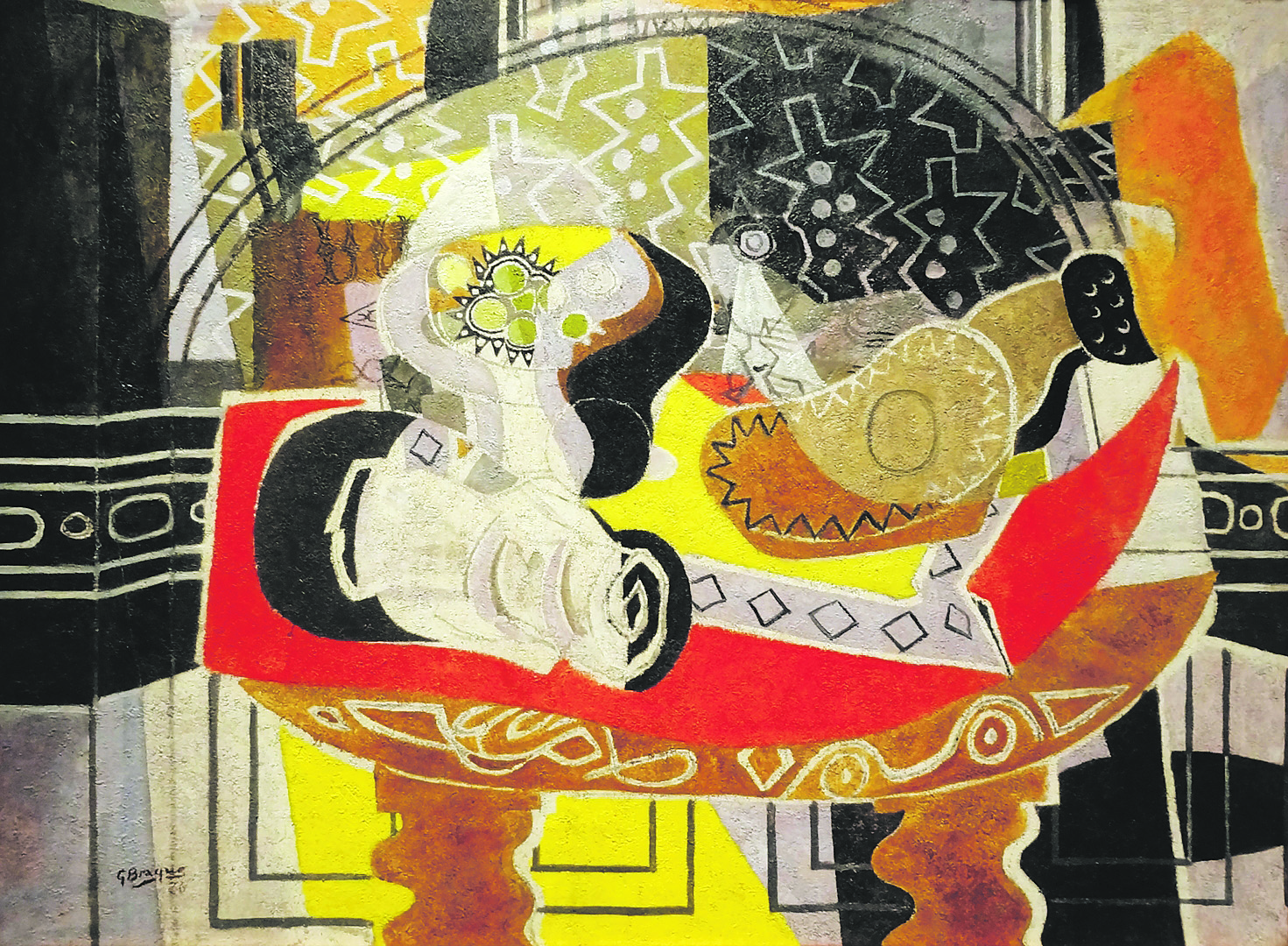
I love the Leigh Bowery series; he is one of my odalisques (see post from October 6).  But I digress... my husband says he doesn't like Cubism... we talked a bit... (there are many "Cubisms."  I talked about the phases here on August 1).  My theory is that Picasso and Braque worked their way through the discovery of picture planes and all-sides-at-once and the pre-eminence of the line and came out on the other side, Picasso would continue to change styles, Braque would continue to refine a single way of seeing.  I think these later paintings, from 1936, (these are in the Acquavella show) gain from Braque's Cubist experimentation, but are wonderfully complete in themselves. The picture plane is filled -- and yet it still has air and light. Here is "Still Life with Guitar I (Red Tablecloth)":


And here is "Woman at Easel (Yellow Screen)":

You can see the echoes of the flattened and tilted planes, the patterned, collage-like background, and yet there are sources of light here that were not present in the early Cubist works. And by the way, my husband really likes these!!! Go and see the Acquavella show for me... it closes November 30! And Happy Thanksgiving!

Monday, August 1, 2011

Thinking, once more, about Cubism

The "early"/Analytic phase of Cubism came together through the combined efforts of Georges Braque and Pablo Picasso. Cubism came of real struggle. No-one had ever pulled all the pieces together before. And the resulting new painting was harsh, jagged, deep, an ugly overthrow of everyone whose recent art was so pleasing, from Klimt to Renoir. "Synthetic" Cubism, then, coming later, when the tempest winds were calmer, amounts to something far less potent.

I had not ever worried about this distinction until now. But I have just been reading "Dime Novels," the final chapter of Rosalind Krauss's "The Picasso Papers." And while distinguishing between these phases is not her full argument, it is a distinction she feels to be crucial. Were the later practitioners leaning on their oars?

Douglas Cooper's The Cubist Epoch changes the names and takes, as he says, the terminology of Renaissance art (which, he says, held sway for about four hundred and fifty years by painting "only what the eye sees of things, incomplete and deceptive though this may often be" until Cubism arrived). Cooper prefers the terms "early" Cubism (from the end of 1906 until the summer of 1910), "high" (summer of 1910 until winter 1912), "late" (a.k.a. Synthetic, the time of collage, roughly 1912-14) and an "aftermath" (not a Renaissance term, but a time of freer development of the art by Braque, Gris and Picasso).  "Early" and "high" Cubism are also, for Cooper, "True" Cubism, and Picasso's "Three Musicians" was the end of Cubism entirely, he says (pp. 11, 13 15-6).

If we think of the important phases of Cubism as those which taught us to see... taking the slight upward tilt of Cezanne's tables all the way, or thinking of all sides of an object instead of just one... yes, both sets of categories, Krauss's and Cooper's, work perfectly. The latter phase does seem to be weaker. Let's look....

Two examples, one from "early" and one from "late" Cubism here.... The first, "early" work is by Georges Braque, "Piano and Mandola," from 1909-1910, here shown in a detail:

Cooper says that, generally, Braque's work from this time is "painterly, lyrical, suave and cohesive," and he says about this work that it is "superb," the "faceting" is "elaborate," yet "the objects represented remain legible' (p.44).  Yes, to all that; also, there is an incredible, dizzying depth here, that I can't readily unpack.... and yet the whole work looks effortless.  Our second example is by Albert Gleizes, again in a detail; this "late" Cubist painting is called "Harvest Threshing," and it is from 1912:

Cooper is very critical of this work, saying that "nowhere are the geometric forms derived from the objects represented, nor do they serve to create volumes; sometimes they are awkward stylizations, often their significance is ambiguous" (p. 74).  And I agree; while the painting is very pretty, with a round frame of figures that functions almost as a wreath, its tidiness is very flat.  It is totally off its point, it seems to me; if I were looking at this without its title, I would see it as a portrayal of an indoor scene, dancers and spectators on couches.  One-point perspective is still there, I would argue, just a little dazzled by a refined re-arrangement; not the point of the Cubist endeavor, not at all.

So,  the "late" works, the Synthetic works are, with a few exceptions, different. Perhaps it isn't fair to say that the painters are leaning on their oars, since Gleizes, for instance, is a co-author of a treatise on Cubism; he took its directives seriously. Maybe the temptation towards the harmonies of one-point perspective are unconscious, here, but the pull seems clear to me. Stand just there and don't move. The pull of that vanishing point is so ingrained that these artists didn't see it there... it's just that, in this painting, the vanishing point is in the center. Still pulling us in, hypnotically, not breaking the spell... Cubism may not be "a monument" (see my May 11th entry) but it does mean to break the spell.