Showing posts with label Matisse. Show all posts

Friday, November 25, 2016

Matisse/Diebenkorn: Paint It Black


The Baltimore Museum of Art (BMA) is set in its own majestic portico’d place, augmented with a sweeping addition. It seems very far away from the city, and to travel there is to be (somehow) in art. BMA presents the “Matisse-Diebenkorn” through January 29, 2017 and then, after a re-hanging, the show opens again at SFMOMA in the spring.

What would these two artists say to one another across time? We know that Matisse went all the way to the edge of abstraction and just peered over with great delicacy, (with “View of Notre Dame” in 1914, for example):


and then retreated a few inches.  Diebenkorn set up shop just past his predecessor, but would make use of Matisse’s floral grillwork for safety’s sake.  You’ll see.

Pretty much everyone can picture a Matisse. Close your eyes. Okay? Got one?

This is my Matisse, “Red Room (Harmony in Red)” from 1908:


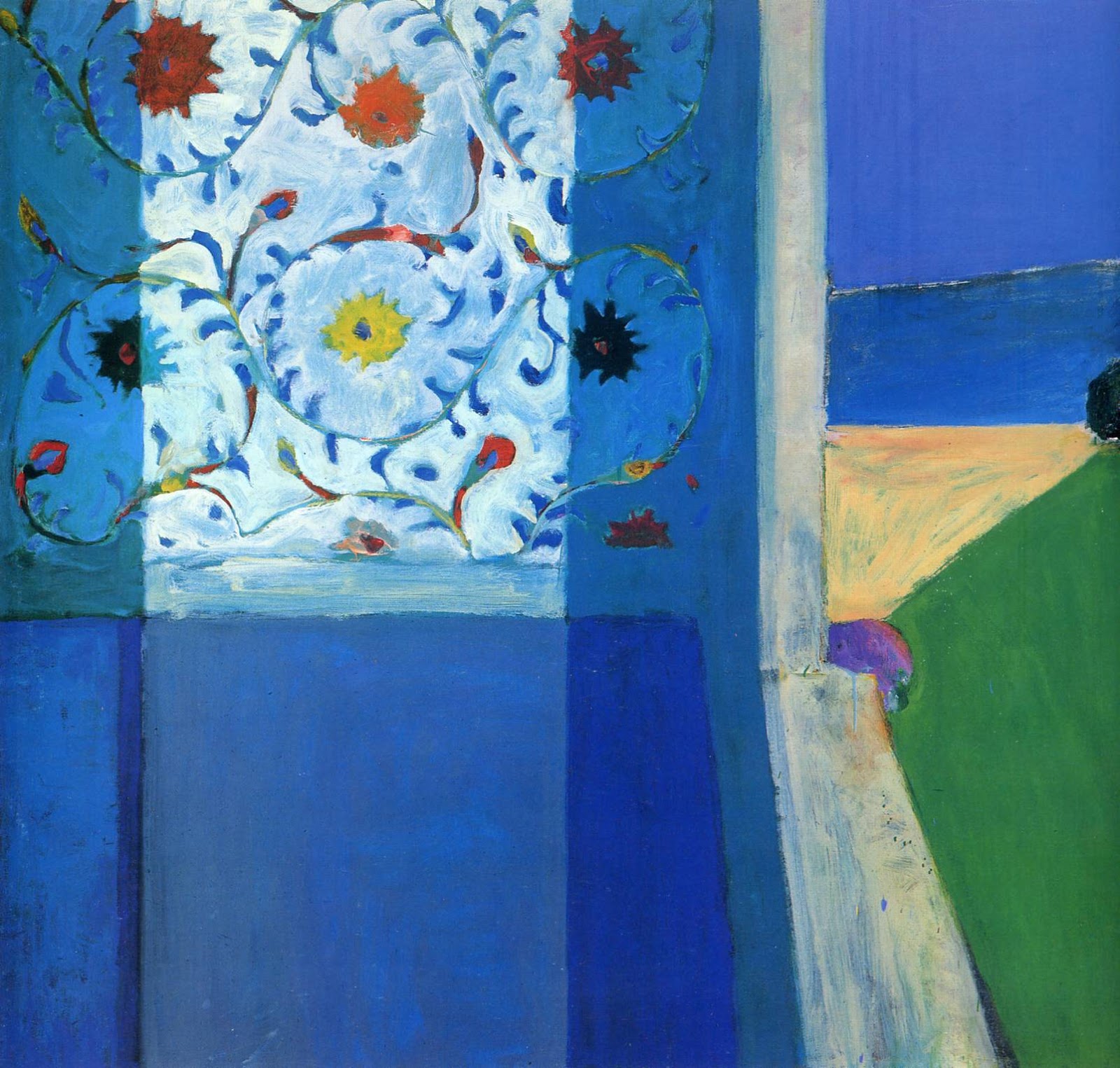
But not everyone can pull a Richard Diebenkorn image out of thin air.  And if you could, what period would you choose? Abstract? Figurative? or Ocean Park? Maybe, after seeing the show at BMA or SFMOMA, it would be this one, “Recollections of a Visit to Leningrad,” 1965, which is Matissean but also Diebenkornish:


To Begin with Diebenkorn
Let’s start by thinking about the “new” guy. I had seen a massive Diebenkorn exhibition at the Royal Academy (RA) in London in the spring of 2015.*  The Royal Academy offered generous texts on their walls and a thorough introduction to the artist on their site. Here is an example:

To weigh Diebenkorn’s reception in England, so Paul Carey-Kent, a financial policy analyst and art critic, brought 6  “well-established painters” to the RA’s Diebenkorn show, and recorded their comments along with his own. Carey-Kent started with the assumption that Diebenkorn is “a painter’s painter.” Half of his guests were pleased with the art on view, half were not. The painters are: Katrina Blamin, Claudia Carr, Christina Niederberger, Michael Stubbs, D.J. Simpson and Dolly Tompsett ; see the article for details (www.artcritical.com/2015/05/04/paul-carey-kent-richard-diebenkorn).

In the article, Michael Stubbs observes that Diebenkorn’s abstract work of the 1950’s was “typical of the early ‘50’s, in developing a Cubist space into more fluid forms which value spontaneous gestures, and which simultaneously construct and contradict the space.” YES. Diebenkorn faced into everything, right up through Cubism and Abstract Expressionism, and found his own voice. This is what makes him a “painter’s painter”: we can see him struggle, almost watch him think. Diebenkorn reveals everything beautiful and unsightly, brushstrokes that lesser artists would worry about exposing. Here is a detail from “Ocean Park 43” (Royal Academy of Arts exhibition catalogue, 14 March-17 June, 2015, p. 140):


Look at the escaped blue squiggle, up against a deliberate long dripped line. Now take another look at the gray line that anchors the blue triangle: there is another shape partly visible inside that. There are no straight lines on either top or bottom of the purple stripe; the artist didn’t auto-correct. The green drip slams into an orange line that then veers off to nothing, allowing the green to re-appear. This is not the work of a minute. This apparent spontaneity is earned through time and incredible patience on the part of the artist.  Marking, erasure, marking, stopping.

Another of the artists brought to the RA exhibition, D.J. Simpson, uses an electric router to mark/draw onto his wood support, and then paints in the backgrounds to make his art (his art is “fetishising,” says the artist and critic John Chilver). Simpson thinks that Diebenkorn knew exactly “when there was enough push and not enough pull.”  I think that, by “push” Simpson means the sustained agitation in the painting, flowing and just a bit untethered. Here is the question... Does Simpson mean that Diebenkorn would then add in the “pull” to lock in the work? Or does he mean that Diebenkorn would allow the painting to remain un-resolved, that this state of flux was the goal?

Matisse and Diebenkorn
The RA ‘s Diebenkorn show was big and beautiful. But it was a show that crested with the Ocean Park series, as if all the previous work was only preparatory.  The hanging was rather convincing as a yellow brick road, and it left me very little room to breathe. In this context, I saw the 1950’s work as flawed, and left feeling odd. I should have liked it; Diebenkorn is a painter’s painter, and, even more, an abstract painter’s painter.

So I was really eager to see the Matisse-Diebenkorn show.  Would Diebenkorn flounder in the face of the older man’s work? I had expected, because I have always loved him, to gravitate to the Matisses.  A brief aside: here is a lovely Matisse, (not at the show at BMA), called “Entrance to the Casbah,” (1912/3):

Years ago, I had gone to a Matisse show** and loved many paintings with this intense blue-dominated palette and come home immersed in what I thought of “Matisse blue.”  Bonnard said of a Matisse on his walls that

By day it is the blue that takes the lead. What an intense life the colors have, and how they vary with the light!  (1946)

On impulse, I added the color to every canvas then on my studio walls. It ruined them all, of course, because the paintings hadn’t called for that kind of interference.  What kind of interference would Matisse cause Diebenkorn? I thought blue might be involved.

But I was wrong. It was black, deep and abiding black. (Black is so important that one artist has recently claimed exclusive rights to the newest, strongest black mixture, Vantablack  (http://hyperallergic.com/279243/anish-kapoor-gets-exclusive-rights-to-the-worlds-darkest-pigment).  
But I get ahead of myself.  I should start with the observation that the wall texts and the essays for this show are entirely convincing. The research is solid, the relationship clear. Diebenkorn studied Matisse beginning with his days at Stanford. He saw Matisse’s paintings in the home of Sarah Stein. He visited MOMA in New York and the Pompidou in Paris. Diebenkorn owned forty-one books on Matisse, even loaning one to MOMA’s curator John Elderfield in 1983 to help with an upcoming exhibition. Diebenkorn saw little-known Matisse paintings as a guest of the Soviet Artists’ Union (Matisse/Diebenkorn catalogue, eds. Janet Bishop and Katherine Rothkopf, BMA and SFMOMA, 2016).

Near the show’s entrance, I found myself moving back and forth, looking at Matisse’s “Studio, Quai Saint-Michel”:


And his “Goldfish and Palette”:


And then, with those two firmly in mind, I took in “Urbana 2”


And “Urbana 6”:


 And basically didn’t want to move on. (So I will basically stay here for this writing, but know that there are many, many more works in the show and go see it!). The irony of the day was that the two Diebenkorn paintings had both been in the RA show, but I obviously hadn’t SEEN them.  I saw them now. And they blew me away. I remember thinking about each one, “is it a room? a landscape? a state of mind?”  The “Urbana” series was all that abstract paintings are meant to be. They were open, un-resolvable, but there might be a key, if I stood there long enough, maybe... I wanted to stay in front of them forever. And what held me in was the black pigment. Look back at “Urbana 6” and imagine just the black in outline as I drew it in my sketchbook:

The shapes are powerful, even in outline, but here they are again in black:

The black paint won’t give it up.  It hangs there, receding and coming forward as if it were actually moving. Curator Janet Bishop writes about “Studio, Quai Saint-Michel” and “Urbana #4” that

... the young painter appears to have repurposed the blocks of color that make up the Parisian studio interior to create a composition seemingly devoid of familiar points of reference (catalogue, p. 23)

This is the goal. The “pull,” Mr. Simpson, is left up to the viewer. 

It is as if Matisse lived long enough to move a little closer to that abstract edge; Diebenkorn completes Matisse’s line of thought, taking the loose shutter of  “French Window at Collioure” (which, curator Katherine Rothkopf writes, was changed by Matisse to cover over  ‘a balcony and a landscape in the distance” were covered over by “a wash of black paint” [!!] (catalogue, p. 123) :


 And fastening it down (the “shutter” in Ocean Park #105):


*My husband, Charles Tarlton, wrote a series of ekphrastic tanka prose about the Ocean Park paintings, based on our visit; see artistinanaframe.blogspot.com, the entry on Diebenkorn from 11/21/16; there is a drama in prose & poetry on the relationship of Matisse and Picasso printed there as well.

**”M

Monday, November 21, 2016

Charles Tarlton, "The Turn of Art"

This piece was originally published in Fiction International, Issue 45, "About Seeing." It is dedicated to Janet Bishop, Thomas Weisel Family Curator of Painting and Sculpture, SFMOMA, whose tour around "The Steins Collect" was so exhilarating.


The Turn of Art
A dramatic scene in prose and verse

Gertrude Stein and Alice B. Toklas’s atelier at 27 rue de Fleurus, Paris.  It is 1907.
The room is filled with heavy furniture, a large writing desk, sideboards, tables, and cupboards.
1. Pablo Picasso (Left Stage Center) and Henri Matisse (right Stage Center) sit in low chairs across from each other in front of the fireplace (Up Stage Center). They face us as if looking into a camera (think of the famous photo of Gertrude Stein and Alice B. Toklas by Man Ray taken in 1922).
On the wall (Up Stage Left) behind PICASSO, 5 MATISSE paintings are hanging—Woman in a hat (1905), Madame Matisse (1905), Le Bonheur de vivre (1905-6), Blue Nude (1907), and Self-portrait (1906).

On the wall (Up Stage Right) behind MATISSE we see 5 PICASSO paintings—Boy Leading a Horse (1905-6)), Gertrude Stein (1905-6), Young Acrobat on a Ball (1905), Nude with Joined Hands (1906), and Self-portrait (1906).
PICASSO
once we had turned
our backs on the museums
            Pause.
where could we go?
            Indicates MATISSE, sarcastically.
then he started drawing
lines of paint an inch wide
MATISSE
wasn’t easy
while so many others
were portraying
the fine line of a nose
details in strands of hair
PICASSO
not enough, not
for him.  Just to make it
look like real fruit
            Pause.
no more trompe-l'œil for him
            Pause.
dot’s enough for a nipple
MATISSE
I drew with brush
loads of flat blue house paint
made my lines thick
all around the outside
black between trees and sky
Pause.

MATISSE stands and crosses the room.  He takes Boy Leading a Horse from the wall and carries it back to his chair.  He leans it against the wall beside his chair and sits down.
Not every one, however, followed my lead.
Pause, admiring Picasso’s picture.
browns and some grays
this is a precocious child’s
drawing.  A horse!
a boy’s dream of the West
the open plains to ride
PICASSO
a poetic
dream might more easily
bring in the cash
hung on their wall till 1913
you often saw it there
Pause, PICASSO points to a spot on the wall
later Nazis forced
von Mendelssohn-Bartholdy
to liquidate
hispano-judaic
art smuggled out and sold
MATISSE
marketable
like pigeons in St Marks
swarmed around you
as they changed to property
they escaped like wild birds
Pause.
I was waiting
for you to drop it all
come up to art
renounce celebrity
stop showing off—show us!
works of genius
make us feel supremely
diminutive
genius has to give it up
forfeit its advantage
PICASSO
has to give up what?
MATISSE
superiority
Pause.
they used to say
I wish I could draw like that
now they say, anyone could
            Pause.
PICASSO
I felt deeply
every brush stroke of these
as I made them
but in cold aftermath
just financial success
            Pause, as if reflecting.
I was watching, you know, despite my cool demeanor.  But, I loved the life in the cafés, you know, the money, spreading my name around.  And the women, they all wanted to touch my genius. 
            Pause.
You did none of that.  You ran no races, gave no quarter.
How was that?
you were ahead
tossing off thick-limbed monsters
driving me mad
you made these obstacles
I had to climb over
MATISSE
Finally!
PICASSO
I wanted to paint
with a heavier hand
lose all my fear
of teachers, my father
forget about the saints
MATISSE
could see clearly
down into the world’s heart
below surfaces
but you kept painting them,
the surfaces, the smiles
PICASSO stands and claps.  He then crosses the room behind MATISSE and removes Woman with a hat and carries it back to his chair and holds it on his lap, partly turning it so the audience can see.
PICASSO
this is, of course
all odd lumps of color
unexpected
rub out the woman’s face
PICASSO covers the face with his hand.
—and behold Kandinsky!
you sped ahead
on wings of distortion
shape and color
yours to waste, invent
new wonders for the eye
Pause.
no milliner
could make a hat like that
it was conceived
on an insane palette
laughing, you were laughing
MATISSE looks around the room, as if trying to orient himself. Coughs.
MATISSE
Somewhere near here, art’s roadmap changed abruptly.  Up ahead or looking just behind us, out of the corner of my eye, we were poking forward, looking for the line just so we could step over it. 
I saw you coming up.
PICASSO
the other side,
how I longed to be free
overstepping
there’d be no looking back
MATISSE
make the first real pictures!
2. The stage goes dark. Two middle-aged men emerge from the wings (Down Stage Right) under a single spot, dressed as GERTRUDE STEIN (PETER CARMODY) and ALICE B. TOKLAS (ANDREW BLIGHT) and wearing the same hats worn in the famous snapshot taken in Aix-les-Bains, 1927.
CARMODY (GERTRUDE)
they never knew
what the very next thing 
might be—tiny
legs, an arm, thick as trees
palm tree fronds like fish bones
BLIGHT (ALICE)
They were always searching for it, for the new.  At first in different ways; Picasso, of course, classically trained, gifted, was a long time shaking off the lessons, his tutored instincts.  The Blue and Rose periods—he could have been using a camera. 
            Pause.
Henri was different, all for crude outlines, sudden colors, rough dabs of paint, the merest suggestion.
CARMODY
he made it strange
defied the viewer’s eye
BLIGHT
no matter what
it was, it disappeared
CARMODY
into paint, just the paint
Pause.
That’s it, of course.  He overthrew the subject.
Only the paint counted.
That was where the eye fell; there, on the paint, the thick paint piling up, the paint on top of other paint, the paint plowed by the brush like a field readied for planting. 
Pause.
Look on the wall!  You see the picture of his wife, Madame Matisse, with the green line down her nose?  See what I mean? 
Compare that to Picasso; choose one there on the wall.
What about the portrait of Gertrude Stein?
            Pause.
I mean, my portrait.
PICASSO and MATISSE rise and retrieve their respective paintings and bring them (Down Stage Right).  They stand under the spot, holding the paintings in front of their chests.
BLIGHT
He meant it to look like you, a resemblance, but, he said, if it didn’t look like you right now, that was all right, because it eventually would.
CARMODY
it was just exactly me.
PICASSO holds the painting out and turns it so he can see it.  He looks at CARMODY.
PICASSO
I was looking for truth
not just surfaces
behind those eyes, a mind
was watching for a sign
CARMODY
You’re right, I had seen so much
Pauses, musing.
on the lookout
PICASSO
your eyes reach out to probe
what you’re hearing
as if to say, I had hoped
you’d not be like the rest
MATISSE
And, what do we say about Madame Matisse’s portrait? 
Can your discerning eye probe deeper meaning there? 
What do you make of that green stripe?
BLIGHT
perhaps you meant
only to encompass
her, register
your discontent with life
the burden of marriage
I always felt
MATISSE
pushed into the background
disapproval
in those black eyes, stern lips
BLIGHT
how would you even know?
CARMODY
I still say it’s the paint; the spirits of all the wild emotions caught up in spread paint, bone splinters in the ambergris—color, thickness, smell—wide brushes. 
It looks like whatever you want it to look like. 
Pause.
No. It was not about looking, or smelling, or being like anything at all. 
It meant in fact—red, the green, the violet, and orange; just as it means blue, black, and yellow—in any of their many permutations, in a chance encounter, as crude parts of the world.
MATISSE
it was to paint
because I was making
PICASSO
objects from paint
Pause.
my mind’s eye gave the world
only the quickest glance
3. CARMODY AND BLIGHT exit. Spot off, Stage lights up. MATISSE and PICASSO are back in their chairs.  PICASSO points up at a painting, The Young Acrobat on a Ball.
MATISSE
there’s a story
in that one for certain
pure narrative
tempts us to wondering
who the large sad man is
Pause.
I contemplate
more the lonely woman
child, boy, and dog
dreamily facing hills
where a white horse grazes
the acrobat
is a boy or a girl
learning to stand
on such uncertainty
focussing attention
PICASSO
it was Giotto
or me, could draw perfect
freehand circles
MATISSE
painted like Velázquez
aims now to be a child
MATISSE crosses the room and stands under his painting, Le Bonheur de Vivre. He points up to it.
PICASSO
Childishness, to be sure, yet there’s nothing childish about it. 
Your hills and distances are but suggested (did you notice?) while the big ideas, all the rest, are wild reds and greens, hints of mythology in all the playful poses, but circles and careless dots for eyes, spring frolics, and a touch of sensuousness, perspective out of whack
—verges on humorous.
far more expressive
than my pouting giant
or my morose
pale hills.  Your lovers run in
search of cartoon nudity
MATISSE
So, you want to talk about nudes?
MATISSE reaches up and removes Nude with Joined Hands.  He looks closely at it.
You were still painting like Velázquez.
            Pause.
you’re so polite
your nude’s too well-mannered
covers herself
could be from Pompey’s walls
a goddess or priestess
she’s a mural
painted on Spanish stucco
inside a church
PICASSO
I meant to paint
women someone could love
I was out to show the world who was master.  Infinite reflection and dark resignation show on the faces of my men; the deepest sadness, calm, or joy appears on the faces of my women, because they are so beautiful. The children know so much. 
I could not paint the kind of pulsing stones, the female boulders you were so happy to make.
Pause.
I dreamt women
you could take out walking
they’d hold your arm
it took time seeing how
wrong; longer catching up.
4. PICASSO goes behind his chair and takes out a long pointer rod.  He goes over to the paintings and stands in front of Blue Nude.  He points to it.
            Long Pause. He is just looking at the painting, transfixed for a moment.
this was vulgar
so I at first decided
androgynous
whore-sailor all in one
promiscuously drawn
PICASSO comes to (Down Stage Center), Pauses again, and leans intimately toward the audience, in confidence.
Pornographic.
            Pause, sighs in resignation.
this beautiful hulk is
REALITY
Look at it!  Look at it!
a carcass of hip bones
ankles, twisted rib cage
Pause, to MATISSE directly, as if, for the moment, giving in.
This was your high water mark. 
I knew it instantly.  I ran home and drew a hundred chunky naked women leaning on their elbows, sharp hip bones and one leg flung over the other—a hundred, at least. 
You had launched a thunderbolt, for certain, but I thought to myself, “I will rise to that, rise up to that!”
MATISSE
caught by surprise
lost sight of the way ahead
in a fever to catch up
            Pause.
with this the history
of modern art resumes 
PICASSO
that we could teach
the art world to embrace
this meaty toad
MATISSE
love and art together
move closer to the truth
PICASSO
The way ahead congealed, the compass and the raw materials were set. 
MATISSE
If anyone could have seen into the future, this would have been…
MATISSE makes an all-inclusive gesture with his waving arm.
…where it all started.
5. PICASSO reaches up and takes down the Self-portrait by MATISSE; MATISSE takes down the Self-portrait by PICASSO.  They both come (Down Stage Center) and stand holding the paintings and facing the audience. PICASSO pulls a false beard from the portrait of MATISSE. The two portraits reveal a strong family resemblance—the portraits of two brothers.
Curtain


Monday, December 5, 2011

"Are we there yet?": Just when is a work of art ... finished?

I decide, sometimes, that a painting I have been working on is "done" because it seems ... fresh.  Charles Hawthorne, a painter who established a school in Provincetown in 1899, once said that "a sketch has charm because of its truth, not because it is unfinished."  We are attracted to the new, emerging "thing" before we really know what it is because it says something we are straining to hear; but "charm" is not often what we are about.  I find myself working on two paintings right now that are trying to break through ... but I am not sure where they intend me to go, yet.  They are, decidedly, unfinished.

But what about works by ... Michaelangelo?  His "Saint Matthew," the only one of the commissioned apostles statues that he began (in 1504? 1505?) was intended for the Cathedral in Florence:


The statue is emerging from the marble; critics and artists have studied this statue for its clues to Michaelangelo's working methods.  The artist was unlikely to have thought this piece finished; his other work is so highly sanded and smooth, perfect, in fact.  And yet, I think this piece blows Hawthorne's statement wide open.  This is not "charm," but it is "truth." I think it stands on its own as a work of art, with the body twisting itself into an "S" shape and the block of marble stiff with resistance.  The tension here, the organic vs. the geometric forces, the rough vs. the polished, is palpable.

Then we can visit Rodin's "Torso (A study for Ariane without Arms)" from about 1905:


Clare Vincent writes (on the metmuseum.org website's Rodin page) that this torso offers us a glimpse into Rodin's process: "the deliberate breaking apart of sculptures in order to reassemble the parts in new ways."  We can see the breaks.  In some ways, then, this is a sketch. Rodin would not have considered it complete.  And yet, it is on show.  It is, to me, beautiful, its cracks and dents and breaks all asking the viewer to imagine as if we were to take the next steps. Where from here?

Matisse created a series of four massive sculptures, all of a woman, each with her back to us, between 1909 and 1930.  Each stage had been sculpted in clay before it was cast.  Below, "The Back III," from 1916:


This is part of an increasingly abstract progression; Matisse did, I believe, consider this a completed work.  I certainly do ... I think the presence here is significant.

So how can we tell when a work of art is complete?  We could say that if an artist is still looking, the work is unfinished.  But we could also say, as the audience,  that there might be another way to look at it. Even if you might agree that the original intent of the artist would have been to keep going, you have the right to agree ... if you can say ... where the work should go from here.

Saturday, October 29, 2011

Nakedly Nude, II: The Through-Line from Cézanne and Matisse to Roy Lichtenstein

Dorothy Lichtenstein told the art critic Michael Kimmelman that, in his last year, her husband Roy was working on paintings of women "derived from Cézanne's bathers ... which he was thinking of developing into a whole series of works when he fell ill" (The New York Times, January 4, 1998).  I was surprised when I ran across this remark; I hadn't seen any works by Lichtenstein that seemed influenced by anyone but Picasso. So I looked around and found two sets of drawings and paintings that I find just gorgeous.

Here is Matisse's "Blue Nude," from 1907:

This continues that conversation (the entry of October 27) about the angular, un-idealized nude, women who are really -- purely -- naked.  Now look at Lichtenstein's "Collage for Still Life with Reclining Nude" from 1997:


Lichtenstein re-creates Matisse's figure here; but he also opens up the view behind her. This open window is also Matissean, French plane trees and views out a shuttered window to the Mediterranean.  Rpy Lichtenstein is coming back full circle, to people whose work he barely mentions in interviews. Now look at Cézanne's "Large Bathers," a painting from 1899-1906:

Cézanne painted several of these studies of monumental figures posed against trees, with a tunnel out to a larger plain or river. Now here is Lichtenstein's "Landscape with Figures," this one from 1980:

And here is his "Collage for Interior with Painting of Bather" from 1997, as he was returning to the same theme:

This bather is more nude than naked, more stylized, like Lichtenstein's early women from comic books. The artist is still experimenting ...  but see how the model's surroundings have changed since those early enclosed squares with speech bubbles. She is reclining -- in a painting? out of an open window? -- somewhere near Aix-en-Provence, and she doesn't need to say anything.

Thursday, October 27, 2011

Nudely Naked: The Through-Line from Degas to Van Gogh to Matisse

"Look out my window, look at the way things are
Just wonder how, how did things ever get this far ...
Vince Taylor used to live here, nobody's heard of him,
(Ain't that a shame), just who he was, just where he fits in."
                                     lyrics from "Goin' Down Geneva" by Van Morrison

Last Friday, October 21, The New York Times published an article by Karen Rosenberg called "An Unblushing Career of Undressing Women," about an exhibition called "Degas and The Nude" (which she says, only half joking, should have been called "Degas and the Naked") at Boston's Museum of Fine Arts (p. C25).  It got me to thinking, with Van Morrison echoing in my mind, "just where he fits in."

There's a distinction familiar to art students and their teachers, a distinction between "nude" and "naked." The nude in art history is often Venus, Diana, Susannah (and the elders), an odalisque in an inaccessible harem, mythological, fantastical, glorious, nearly air-brushed, and not anything you'd see in your own world. Here is a lovely, smooth-skinned example from Ingres, the master of the nude, called "The Bather of Valpincon" from 1808:


She is perfect. (I should add that David Hockney has traced this perfection to its -- very likely -- source. There was an article in The New Yorker, "The Looking Glass," by Lawrence Weschler on January 31, 2000, which traced the beginnings of Hockney's theory that painters including Ingres, Caravaggio, Vermeer, Hals, Chardin, and Vélazquez all must have employed lenses or some form of camera obscura to achieve their photographic images. This article was then followed in 2001 by the book Secret Knowledge. In both, Hockney tells us that he suspects that Ingres must have used lenses ... how else would he be able to have such an assured line with no preparatory drawings, why else would the drawings be so small, and, I would add, how else could he reproduce that back over and over again, here and in the "Turkish Bath"?). Ingres draws fantabulous nudes. But Degas's women are naked. (And after enough time has passed, Hockney argues, with Cezanne, the lenses are discarded for a new kind of art and, as Weschler reports, then "[deliberate] awkwardness returns to European painting, for the first time, really, since Giotto," and continues on through Cubism). And awkwardness = nakedness, no?. In her article on the Boston MFA's Degas show, Rosenberg writes that the museum unflinchingly presents "the raunchiest of his 'brothel monotypes' alongside the the more genteel voyeurism of his women at their toilette ... His working girls are plump and slovenly, with tufts of dark hair between their thighs. (Even Manet never went that far) ... [but] In Degas naturalism cancels out voyeurism."  So, to finish the explanation between "nude" and "naked," Degas's women are naked. And we can see that, exactly, here, in The Tub," from 1886:


This does look like someone, anyone, that we might know .... And I began to see something. I have been looking at Van Gogh's nudes (there are not very many, and the ones I love come from his time in Paris, in 1886 and 1887).  And I began to wonder if Van Gogh might have seen Degas's women in Paris then. And then the new biography, Van Gogh: The Life arrived (by Steven Naifeh and Gregory White Smith, New York: Random House, 2011). And yes, Van Gogh saw the Impressionists in 1886, but was not impressed with them as a group: "one is bitterly, bitterly disappointed, and thinks them slovenly, ugly, badly painted, badly drawn, bad in color, everything that's miserable" and he says, as opposed to most of the painters in the group, "I have faith in color" (519).  And yet, and yet, the biography notes that Van Gogh "commented favorably only on a suite of nude women, in pastel, by Degas (520).  Yes! he did. Here is Van Gogh's "Study for Reclining Female Nude" from 1887 in Paris; it's difficult not to see Degas in this:

There is no idealized goddess to be found here. This woman is naked, formed from rough pencil strokes. Her skin is wrinkled, her breasts are not perfectly-formed oranges, she is a bit uncomfortable and awkward. This is a body, not a dream.

So then, I wondered, because I have been doing this series of nudes with some references back to Henri Matisse, whether he refers to Degas and Van Gogh.  Degas, one feels, would have been inescapable, given Matisse's contacts and Degas's reputation. But Van Gogh was relatively unknown.  In 1899, Matisse bought a Van Gogh drawing from Vollard. Years later, in 1945, Matisse would say that "Van Gogh and Gauguin were ignored. A wall had to be knocked down in order to get through" (p. 158, Matisse on Art, edited by Jack Flam (revised edition, Berkeley: University of California, 1995).  See for yourself; is this "Seated Nude" from 1906 (she's looking pretty naked!) knocking down that wall?

Saturday, October 1, 2011

One more pair ... this, a set of drawings from the Odalisque series

after yesterday's Austen quotes. I have changed the Matisse "Blue Nude" -- clearly she was lonely! -- here is (a detail of) her company for Tea:

Sunday, June 5, 2011

Not "Seven Types of Ambiguity" but Three Types of Calligraphy, equal a drawing, and

" ... all drawing is collage," says David Hockney.

In 1816, Hokusai wrote, in his Album of Drawings in Three Styles, that he would like to bring together the three types of writing and ... drawing (mentioned, with examples from his work, Hokusai: Prints and Drawings, ed. Matthi Forrer, Prestel: Munich, 2010, discussion of figure 59).  The three most common styles of Japanese writing, as I understand from my brief research on several sites today, are:
1. shin/kaisha: block characters, with clear shapes and structure
2. gyo/gyosho: where the points and lines of a character are connected, a near-cursive rendering,
rhythmic
3. sho/sosho: true cursive, sometimes called running, abbreviated, fast

The general progression from kaisha to gyosho to sosho is toward fluidity and abstraction. I shouldn't imply that any particular style is "best," however, because, as I read about him, I doubt Hokusai would say anything like that. I think he was trying to give lines in a drawing the same chance to be recognized and described as those in writing. So, I thought, the Hokusai book shows us his response; what about putting together three examples from other people?

So, for kaisha, I choose Ingres, "The Source":


There is some lovely fluidity in the portrayal of this body and the falling water; I am saying that this is like block or clear characters in writing because it is so crystal clear and clean of line. To demonstrate gyosho, or everything being connected, a Matisse, "Faith the Model," (this detail from the catalog The Steins Collect (plate 135),  because it was purchased from Matisse by Sarah and Michael Stein, and this nude now lives in San Francisco):


There she is, completely moving into cursive, blending the colors of background and foreground, but still keeping recognizable form. For sosho, the style of writing that one source said might not even be readable to some people, I collaged and drew a form myself:


It is no longer as clear what is being "said" here ... and I would say that it is fully "cursive."

Wednesday, June 1, 2011

Road-trip games and artistic hierarchies


So the game went like this: we each would be given one painting, only, to live with forever, can’t sell it, can’t trade it… so not necessarily your favorite painting, but the one you could look at … all the time.  My husband’s is “The Piano Lesson,’ by Matisse, right now in the possession of MOMA New York. 


Why? He says “It is representative painting just about to disappear like the Cheshire cat. The haunting little face – so ironic, that look, such a strange thing – is just about the only concession to realism. If that face (the Cheshire cat) should disappear, then what is left is a fabulous abstract-patterned painting, a Diebenkorn or a Hans Hoffman. One step beyond this painting is everything that follows, and one step beyond that? It would be one step beyond an e.e. cummings or Gertrude Stein poem, and then it would be like firing letters out of a shotgun … one step beyond their literature is total meaninglessness, because they are already doing abstract work.  Second choice for the "forever" painting? Cy Twombly, because he is all about making the mark.”

For me: “The Demoiselles D’Avignon,” for many of the same reasons ... almost abstract, almost. It surprises me, that I didn’t choose an already-abstract work. And my second choice is even stranger, but I am sticking by it… “The Bar at the Folies-Bergere,” by Manet.  So here I am, a confirmed non-representational artist, and I choose canonical works? So, okay, why these two? First, because I find them beautiful, and intriguing. I could easily look at them forever.  So, yes, but there has to be something more.

So I am thinking, maybe what it is, is … a question of hierarchies.  Thinking back, for the sake of brevity, just through the lines of Western art. Cave paintings, scratchings in the sand, then modest art for funerary purposes or  literature, as with mummies or hieroglyphs, mythological illustration, then, more religious art (altarpieces, explanations of major events and stories) … and then patrons enter the picture, and things begin to change. A hierarchy is created, both for artists (within “school of…” and in competitions)  and for works of art (an altarpiece pictures the conquering hero, the saintly donor’s face contemplated the Annunciation, the Night Watchers come forward out of the shadows).  Religious or mythologically-themed paintings, historical portrayals (Washington, Napoleon) , even, a little further down in the list, a grandly-painted landscape showing the grandeur of England or France… but the still life? Not so much.

A pity, about the still-life, and its bottom-rung status.  Because both Picasso and Manet were fabulous at still-life (we have all seen Picasso’s guitars and wine-bottles, but I was stunned when I first saw a series of Manet’s flowers – so beautiful!).  But artists cannot make their reputation on  a still-life or three, so each artist had to be thinking, what can I do? The age of Napoleon and the great altarpieces is past by 1883 and 1907, when my two chosen works were completed. What would be new enough? Picasso once said, lamenting that he was not Raphael, something along these lines: “since I cannot top the scale of hierarchies, I’ll destroy the scale.” Each of "my" two paintings, in its way, destroys the scale. Manet had already completed “Olympia” and “Dejeuner” (the modern woman in a classical setting), but now, with the woman in “Bar,” he pushes through the boundaries once more. This woman has no mythology, no religion, no great battles to justify her existence. Nothing backs her up … only a mirror. This may be one of the first truly modern paintings. It is she, alone, who must hold our attention. (And, simultaneously, the attention of the artist’s stand-in, her customer). She does. The painting works: the top of a new, grand, scale.


And Picasso would follow, years later, with his own bid for fame, although, as I have said before, I think he did not know what to do after that…

And the game is retired, for another day.