Showing posts with label Gertrude Stein. Show all posts

Wednesday, March 11, 2015

Arguing for a Long Look at Emily Dickinson


I came across an article on Agnes Martin and Gertrude Stein. Since they are my heroes, I stopped everything I was doing -- working on Emily Dickinson -- to read “The Meanings of Acts: Agnes Martin and the Making of Americans,” by Brendan Prendeville (Oxford Art Journal, 31:1, 2008, pp. 53-73).  Prendeville is questioning the way the artist makes her work, and, in a kind of mirror image, how that directs the way the audience perceives the work of art.

He begins by showing us Agnes Martin’s “Little Sister,” from 1962, (not re-printable: http://www.guggenheim.org/new-york/collections/collection-online/artwork/5653)... The painting is oil, ink and brass nails on canvas and wood. Martin’s paintings do not reproduce well. They are horizontal ruled lines, in soft penciled greys and whites, usually, and they are very subtle. Here is "Untitled," an 11" square, pencil, ink and watercolor on paper, from 1995:


If you have ever seen Martin’s work for yourself, you know that one of Prendeville’s threaded arguments in this article is true. He finds two views of any given painting: the one you see from across the room, which will look like a regular 5-foot or 6-foot square, seeming perfectly angular, with measured marks. Then there is the one you see when you get close, close enough to touch the canvas; you see the hesitations, the pencil marks, the times the pencil slid almost imperceptibly out of grip, the ever-so-slight deviations, almost like little breaths. Prendeville calls these “the trace of her actions” (54).

He uses Stein in this essay as she relates to this mark-making of Martin’s: Stein was interested in what she called “the continuous present,” which Prendeville describes as “the present as we live it now, making it as we make it; the reader of a Stein text participates in its making of the present” (and he cites Ulla Dydo, to whom we are all indebted for a better understanding of Stein, 69).  The “making” is something we see in Stein, and we see it through her repetitions and her insistence on seeing the object....

Voilà. When we get close to an Agnes Martin, when we read a Gertrude Stein sentence or poem aloud, we are following the maker’s trail. And by the way we respond, do we “make” the piece, too? This makes Prendeville uncomfortable, as it should; doesn’t the artist have any more control than that? And so he asks: “Under what conditions and by what means is a non-arbitrary response to a work possible, when the maker of the work has not aimed to prompt any response?” (56).

Exactly. The audience. How to control them?

As I mentioned, I have been reading Emily Dickinson... She discussed her work in letters, sent a few to friends, and perhaps a dozen or so poems were published in her lifetime.  There is strong evidence that she did not seek traditional publication: “If fame belonged to me, I could not escape her – if she did not, the longest day would pass me on the chase – My Barefoot-Rank is better—“ (letter to T.W. Higginson, June 1862). When Dickinson died, her sister found 40 bound packets, known to scholars now as “fascicles,” roughly 5” x 8,” consisting of folded leaves of paper tied together with string, and several poems were hand-copied and bound into each fascicle.  In the very first editing of Dickinson’s work, the fascicles were all disbound. One of the transcribers ripped out passages in the poems and letters, and inked over one full poem.  Other editors replaced words, changed the appearance on the page of poems, and created “normal” punctuation, capitalization, and spelling.  Even the most well-intentioned scholars and editors cannot un-alter Emily Dickinson’s life and work.

And these, we are given to believe, are the good guys, the people who brought you the poems.  We cannot know how to find our way back.  There is no thesaurus, no key.

There isn’t for Agnes Martin, either. Prendeville argues that Martin’s models were Pollock, Rothko and Newman. He says, though, that in their paintings, these artists were not pursuing “recognizable common reference.” Each painting, “in its abstractness... withheld itself and, still more, enacted on the part of the viewer a committed act of attention – a personal commitment .... meaning needed to be elicited” (57).  And so it is with Martin. She demands that we stop and stand and commit. We have to see her hesitating pencil lines.

And who else hesitates? Emily Dickinson. Think of the way the words (when they are presented truly, or when you look at a manuscript) scatter across the page like rising birds. Think of her dashes, which appear in the ms. as dots, and her refusal to use titles or numbers. Here is my transcription of one of her poems from her handwriting. Note the hesitations, the way we are forced to take special care with both words and spaces:

I saw no way – the
Heavens were stitched –
I felt the Columns close.
The earth reversed her
Hemispheres –
I touched the Universe.

And back it slid.
And I alone –
A speck upon a Ball
Went out upon Circum-
ference
Beyond the dip of Bell.

Emily Dickinson wrote to her mentor  T.W. Higginson (and later editor and changer of words) that “My Business is Circumference” (July 1862). And here she is in her poetry, defying the stitchery, riding out upon “Circumference,” far away from mortal sight or sound (a strange thing for this poet to wish for), she who, in life, went only as far as Boston.

Susan Howe, in her fabulous My Emily Dickinson, takes on the stereotype of the sheltered and strange “Miss Dickinson”:

[She] took the scraps from the separate ‘higher’ female education many bright women of her time were increasingly resenting, combined them with voracious and ‘unladylike’ outside reading.... She built a new poetic form from her fractured sense of being eternally on intellectual borders.... a ‘sheltered’ woman audaciously invented a new grammar grounded in humility and hesitation. HESITATE from the Latin, meaning to stick. Stammer.... He might pause, She hesitated. Sexual, racial, and geographical separation are at the heart of Definition.... if we concern ourselves with the deepest Reality, is this world of the imagination the same for men and women? What voice when we hesitate and are silent is moving to meet us? (21-22)

What voice, indeed? [Think too of the hesitations and repetitions built into a David Mamet play – the hesitations, in his hands, of men]. Who is this audience standing on (what Prendeville calls) such “uncertain ground” (58)? And what are our responsibilities?

Prendeville writes that, as we stand close to an Agnes Martin, “our instinctive focusing of attention, to discern something in the thing attended to, is in some way thwarted, or deflected....” There is no “resolution,” only an “overall ‘dissonance’” (65).  Yes, and this is the thing about our readings of Emily Dickinson; we all work to “resolve,” but as we do, we cram her poems into categories, as her first editors did (“flower” poems or “death” poems).  She wasn’t categorize-able, didn’t want to be pushed into the sewing corner. She was aiming at dissonance, too: I read “Beyond the dip of Bell” several times before I heard it as the stilled buoy or clapper.  This use of “dip” is the only time I can find it performing this function, a physical way of calling to our attention an auditory anomaly. There are easier ways to say what was said here. Her world was constricted. Her language and her form are not.

We have to take care. Prendeville ends by saying that “to be drawn close” to a Martin painting “is to apprehend her care in making the painting, and to assume the posture of care and affectionate concern oneself .... [her work] vindicates intimacy” (71).

A reader of Dickinson’s poetry must wander into it on her terms.  The poet’s brother, Austin Dickinson, the keeper of his sister’s purse, influenced one of the first sets of transcriptions of her poems. His mistress, Mabel Todd Lewis, copied out poems, making them available soon after the poet’s death, but she also inked over at least one entire poem 


and omitted or cut out phrases or stanzas or sentences in poems or letters, all because Dickinson spoke too warmly of Austin Dickinson’s wife, Susan.  Was she assuming a romantic love? Was she just jealous of their friendship, she who had never met the poet? Or was she asserting her power?

We must not do any of these things. We cannot project, reject, cross-out or compartmentalize Emily Dickinson. because that has all already happened. We must start again. We must place ourselves before her handwriting and find her mark-making... and try and listen "Beyond the dip of Bell."

[Thanks to Brendan Prendeman, to Susan Howe, and to Amherst College. I have created a work on Dickinson, called "Missing Emily," for the Marin Museum of Contemporary Art's Altered Book and Book Arts Exhibition. Find your way there... and help Marin MOCA].


Saturday, April 7, 2012

Gertrude Stein, Agnes Martin, Mark Rothko and Larry Rivers: The "Real" Work


“An audience never does prove to you that you are you”
                                          from “Identity A Poem,” summer 1935, Gertrude Stein

In her wonderful Gertrude Stein Reader, Ulla Dydo offers corrected and annotated Stein texts.  In her introduction to this small “play,” called “Identity A Poem,” Dydo notes that Stein is very tempted by “’audience writing,’” because she is thinking too much about what an audience would want. This was a state of mind that Stein’s new post-Autobiography of Alice B. Toklas  life (and American book tour) had given her.  Fame paralyzed Stein’s best writing. She knew that, and was trying to keep herself focused on what she called the “human mind,” which, Dydo explains, “is free of time, memory, identity, and free of the human need for applause” (p. 588).  The line above is a little reminder from Stein to … herself.

We all need these little reminders.  Stein’s audience wanted more of the stories about Matisse and Picasso and life in Paris and … but she wanted to return to writing the works that are still, after all these years, resistant and very, very Modern. And Stein still, even after she became famous, had to pay to publish that work herself. Alice B. Toklas continued to publish (the “resistant” texts) after Stein’s death.

It was heroic, really, all of it.  But Stein had gotten to a place, fairly early on (I think it was with Tender Buttons, myself) where she knew what she wanted to write. 

How does one do that? How does a person discover the way? I think you have to just keep looking until you find it.  You have to accept, along the way, that maybe you never will truly find your own style, the style so obvious and wonderful that you can stay with it forever, the way Stein did, molding and adjusting and not minding (mostly) if the audience can’t hear the rhythms the way you do.

Is the discovery interior? Perhaps we just need solitude, time to ourselves, time to work hard. The painter Agnes Martin’s writings call for this kind of solitude, and they can seem so authoritative.  And, yet, her authoritative voice only arrived after multiple failures. Consider this, an early “New Mexican Mountain Landscape” by Martin:


Martin wrote that “I used to paint mountains here in New Mexico and I thought my mountains looked like ant hills.”  (And she was right!).  But she continued to try:  “I saw the plain driving out of New Mexico and I thought the plain had it ….  [Now,] when I draw horizontals/ you see this big plane and you have certain feelings like/ you’re expanding over the plane” (“The Untroubled Mind”).  Martin turned a “plain” into a “plane.” The sheer simplicity of her lines and rectangles overwhelmed the realistic landscapes and won.  She writes “Defeated you will stand at the door of your house to welcome the unknown, putting behind you all that is known” (“On the Perfection Underlying Life”).   She takes a ruler and a pencil and begins -- but only once she has seen the full painting in her mind.  Here is a painting -- with more color than usual – by Martin, called “Stars”:


I think I also read somewhere that Martin tried to destroy all her early work.  But I am glad that she didn’t get every last piece.  We need to know, the rest of us, that she didn’t always know what she was doing.  Martin is not alone in her radical change of style; look at Mark Rothko’s early piece, “Number 26, 1947”:


Now, I really like this painting, actually; it is a perfectly credible AbEx accomplishment.  I wonder what it was that drove Rothko on until he found the layered blocks of color. Here, “Number 14, 1960” (www.sfmoma.org):


I don’t have any of Rothko’s writings that explain this shift. How did he know that the earlier works were not enough?  Was Rothko wanting to distinguish himself from the other AbEx painters? Or was it that he felt something inside of him was not getting expressed?  I know that he was intense, that he felt the work he finally arrived at was not meant to be “abstract” but, instead, tragic, filled with emotion. But I would like to know the ways the work unfolded to its end.  

The third painter whose changed work interests me is Larry Rivers.  Here is “Studio Interior” from 1948:


I think it’s clear why Rivers had to keep working through this style. It seems both Matissean and Van Gogh-esque (if that is even possible).  It has no air. The painting is stilted, false, and begs for a really long, tough conversation with the artist.  Here’s a later work, a “true” Rivers, with AbEx brush strokes and superimposed figures and Pop references, “Matisse and the Model”:


What a relief that must have been.  Maybe Agnes Martin said it best: “I thought that I was big and the work was small. It is not possible to go on that way.”

And maybe that’s what each of them saw: the work was too “small.”  I wonder, you know, I wonder about this searching for the perfect artistic creation.  It’s about the perfect piece of art, the one that you know is it. It’s the same search that we all have for the landscape that seems like “home.”  In the end, it really isn’t about audience, I think; it may be more about Stein’s idea of the “human mind.”  It’s one’s own realizations, restlessness, a longing for the art to seem “real.”  It doesn’t matter if we live in relative solitude, or become part of a wider artistic movement; we just have to be happy with the art we make. What about you? Have you decided on the “forever” work?


Sunday, February 26, 2012

Image vs. Text, Part Three: In Which We Try to Establish Some Criteria for Abstract Art

I have been looking at the “image vs. text” question (see posts from January 20, 25, 31 and February 8). I find that what is lying just underneath what I have said, is this: “text” over-determines matters in the art world. And it is empowered in this way because we do not trust “image” without its accompanying (nemesis) “text.” When we see the image -- alone -- we have no way to determine whether or not we should care about the painting in front of us.  Without text, we are down to the old joke, “I know what I like.”  Without text, it’s all up for grabs. 

Text shows us the way to paint, where to attend art school, who our mentors and influences should be, who ought to be shown and sold in a premiere gallery, what to acquire for our museums, what interests collectors, even what we might be saying when we are in front of a work of art.  Without text, it’s all totally arbitrary, floating, unfixed.  Text gives us authority and a fixed, mostly scrutable art world.  But what nobody says, out loud, is that text is flawed. The world, as the term ukiyo-e would tell you, is floating. Consider the case of the art forgery.

There are four ways to authenticate a painting: provenance; scientific testing of the materials; fitting the work in question into the artist’s oeuvre; and “a connoisseur’s eye” (Patricia Cohen, “An Art Trove’s Authenticity Goes to Court,” The New York Times online, February 12, 2012).  A court case has surfaced over paintings “by” Motherwell, Clyfford Still, Jackson Pollock, Giacometti, and Barnett Newman.  Over a period of ten years, a Long Island dealer brought first one, then two, then more paintings to the Knoedler Gallery; none of the art came with the usual papers, but that didn’t seem to matter. Over time, the gallery and the Daedalus Foundation and the National Gallery of Art (and even the artist Frank Stella) examined the lot and pronounced them to be genuine. But, soon, the Motherwell pieces, titled as if they belonged to his “Elegy to the Spanish Civil War” series, came under scrutiny for problems with “signatures and styles,” and the Daedalus Foundation shifted its opinion: these were now deemed forgeries, and all the paintings acquired from the little-known Long Island dealer were called into question. The Knoedler Gallery has closed; they say the closure is not due to this case (see the article and photographs: http://www.nytimes.com/interactive/2012/02/22/arts/design/20120222-fake-paintings-compared.html?ref=arts ).  As paintings become more and more valuable -- Christie’s has recently, across three separate auctions, sold three Motherwell Elegies, at prices ranging from $2,144,000 to $2,919,500 – artists, auctioneers and galleries find that the desire to forge works and the resulting need to authenticate has created a little fear and trembling. The Pollock-Krasner Authentication Board dissolved in 1996. The Andy Warhol Art Authentication Board, faced with lawsuits, is no longer accepting new pieces to either include in the catalogue raisonné or to (literally) stamp with DENIED.

But the four methods of authentication all deal with text and not image. The provenance is all text: first, the labels from the back of the canvas indicate the date the work was painted, or where it was exhibited, and then the papers, testifying to the original acquisition, past ownership and sale prices, previous dealers’ evaluations, perhaps a note from the artist or the biographer.  None of the pieces at Knoedler came with any of this.  The collector had acquired the pieces directly from the artist, it was said, or from the artist’s own dealer; they had been in storage.  It was said.  When the pigments were tested, the researchers found paints not yet in use at the time the work was created. Not a problem, the dealer said, the artists were given the newest sample pigments to try; it happens all the time (Cohen). More text. Then, the third method of authority, fitting the work into the artist’s other series: simple. Works are uneven, but each series, each new piece, will share characteristics with previous or concurrent work; the titles would take care of any doubts.  And, last, the connoisseur’s eye; we now know what happened there -- every eye was fooled.  

It was Plato who said that if we knew what we were looking for, we would be all the more able to see it [“Suppose that a short-sighted person had been asked by some one to read small letters from a distance; and it occurred to some one else that they might be found in another place which was larger and in which the letters were larger --if they were the same and he could read the larger letters first, and then proceed to the lesser --this would have been thought a rare piece of good fortune” The Republic, Book I].  If we are looking for and expect authenticity, because authenticity excites us, we will find it.

If, on the other hand, a painting called “Untitled, 1950: After Jackson Pollock” appeared at your local coffeeshop, hanging between the comfy chairs, looking just like a Pollock, but the artist’s name was, say, mine, and the sale price was listed as $650, there wouldn’t be a problem.  If you liked it, and you had the $650, fine. But if you were paying $300,000, as the gallery did, or $3,000,000, as a collector did, for an “undiscovered” Pollock with the simpler name “Untitled, 1950,” then you’d want the Jackson Pollock signature -- and the provenance. You’d want the text.  And mine wouldn’t have any text … in fact, worse, it would be trading on Pollock’s lifetime of text.

And everyone in the art world trades on text, because text creates “value” for a painting.  It is the only way we know to create value. It is also the only way to create the canon of artworks, the chosen few that we love, and teach, and discuss, and visit in museums. There are no objective criteria that guarantee that the beauty, or ugliness, or power, or authenticity that we see in a painting is … “real.” 

But it is still beauty, or ugliness, or power, or authenticity, isn’t it, if we see it?  I have walked through painting studios at a college and seen a fabulous thing, in progress, by a twenty-year-old; but she doesn’t have any text yet.  Intrinsically, the work is beautiful, to me; I like the application of the paint, the subject matter, or lack of it, the figure-ground blending … but extrinsically, outside of itself, out there in the world, the painting has no value at all.  If she ships it through the mail to her great-aunt in Brixton, she can only insure it for the value of the materials.

Outside of the monetary value, is there any other reason to go straight to text? I could argue that when I am standing in front of Picasso’s portrait of Gertrude Stein, I like to think of her walking from 27, Rue de Fleurus to Picasso’s studio in the Bateau Lavoir in Montmartre.  I like to think of the painter and his subject speaking in broken French over eighty or ninety sittings, and wonder about the influence they exerted on one another during the time it took to make the painting. I would like to see how many faces of Stein there were before Picasso crossed out the last one and replaced it with a mask.  Part of a painting’s value is its history, the fact that the text confirms that this is, in fact, the painting based on an Ingres, the painting where we can just see Picasso’s brushstrokes at the edges of the chair, this is the painting that was wrapped up in Paris and driven by Stein and Toklas over to the Ain for safe-keeping during World War II.  Text can ensure a kind of romance.

But.  Is there any way, at all, that we can establish a way of SEEING that is based on ... SEEING? We can try. Look at the two paintings below. One was painted by someone with an acre of text, the other with, perhaps, a window-box full of text.  Draw up some criteria to judge them.  See which one engages you, but be prepared to explain why. On my next visit, I will talk about some ideas of my own for discussing image and tell you which painting … is which.


Monday, November 14, 2011

Artist Statement VI: "The picture did not live within the frame ... it did not belong within the frame"

One thing that needs to be included in my artist's statement is the question of movement. I have always felt that one of the chief weaknesses of traditional landscape painting -- and perhaps even of portrait painting -- is the fact that the figure and ground, the objects and the composition, often show no sense that the whole thing could move at any second.  That is, the model could get up, the artist could turn her head or move the easel closer to the stand of trees, the light is changing ... The Cubists and the Futurists considered this point, but I believe it still needs to be resolved pictorially -- now.

If we look back at Constable's "Hadleigh Castle, the Mouth of the Thames: Morning After a Stormy Night" (see my post from November 10), we see the castle, the river, the rocks, the sky spread out before us.  But -- how wonderful would it be if we could see all the things he could see as he was actually painting? The castle comes into greater focus, or the dog runs ahead ...

In her Lectures in America, in "Pictures," Gertrude Stein talks about movement: "Does an oil painting tend to go back into its frame because after all an oil painting belongs in its frame. Or does it not .... And if it does belong in its frame, must an oil painting be static."  And she answers her own question -- no -- a painting need not be "static," and Stein goes to the example of a painting that seems --to her -- to move, Leonardo Da Vinci's 1499 work, "The Virgin, the Child, Saint Anne and John the Baptist."  As it happens, we saw this painting at the National Gallery in London last year; it is a "sketch" for a more formal painting that was never completed, stretched across eight sheets of paper, but it is more beautiful than any "final" painting could be, I think:


Stein says that "in this picture there was an internal movement, not of the people or light or any of these things but inside .... In other words the picture did not live within the frame, in other words it did not belong within the frame .... [and since then] I have passionately hoped that some picture would remain out of its frame."  And there is internal movement here; you can feel it, walking around in the gallery with it. This can be explained in part by the figures' sinewy curves, and by the background that dances just a bit beyond specificity.  But really, as Stein goes on to say, a painting "must not completely only exist in its frame. It must have its own life. And yet it may not move nor imitate movement, not really, nor must it stay still. It must not only be in its frame but it must not, only, be in its frame." This is, in part, a discussion of the Modernist idea that a painting must be a thing in itself, and not representative of something outside of itself, but I also think this is about the life in a painting, the way a painting can feel like a very brief, exciting moment in a life.

So the artist, and the work of art, have this difficult task, to allow the art to move without moving.  Can this be done now, without resorting to one-point perspective or any sort of illusion? Well, look at Helen Frankenthaler at work:


She is moving, the paint is moving, but it will all have to stop and, at some point, the painting will be in a show ... will it survive? I think so. Let's look at "Madame Matisse," from 1983:


Matisse had painted his wife with an enormous hat and a green stripe along her nose, a painting bought by Leo and Gertrude Stein, actually, and this painting takes that stripe and makes it move.

Part of what I am still working on, both in my statement and in this new series, is the idea that paintings should encourage the viewer to see ... to see just as if you were in the same landscape as the painting, and see the colors and the shapes as you would if you were walking by. Sometimes this will lead to the shapes seeming to be a blur, or to seem as if they were shrinking or growing; other times it will lead to one thing seeming specific, because it is what the painter chose to look at and to paint. We turn our heads, we focus in on objects, as we walk ... anywhere.  Here is an early example of my landscape-as-movement idea, a 2 x 4' painting called "Landscape as Drama":

Wednesday, October 5, 2011

Working on a set of paintings for a competition, (re) reading ...

Gertrude Stein's Mrs. Reynolds.  The book, written in France, completed in the summer of 1942 and sent to Bennett Cerf via a friend in Sweden, contains an "Epilogue" by Stein, who says: "This book is an effort to show the way anybody could feel these years. It is a perfectly ordinary couple [Mr. and Mrs. Reynolds] living an ordinary life and having ordinary conversations .... There is nothing historical about this book except the state of mind."

Reading the novel, we might feel a temptation to watch it unfurl in the mind like a black-and-white documentary, Gertrude Stein and Alice Toklas walking in gardens, cutting roses, listening for news over the radio. But Stein's remarks mean that she wants us to see her -- creating.  Mr. and Mrs. Reynolds walk in the garden only in a fictional world.  This creative act -- she wants us to see -- kept her going. And the act -- of creative reading of Mrs. Reynolds -- can keep us going, as well.

The talk of the novel, the "ordinary conversations," seem over and over to come in just as the narrator has delivered news that a soldier-neighbor has died, or the clouds gather, or some new or unwelcome or uncertain thing has intruded. And they are lovely, sweet, and funny things, these conversations: "they often talked about dates in cakes and they often talked about bread in soup, they also often talked about eggs and butter but most often of all they talked about guinea hens and geese" (p. 10 of the Sun & Moon Classics edition).  These foods, even for the (real) women (who were) living in a small agricultural community (the author and her wife lived in the Ain in France),  must mostly have been out of reach. Bread was available, certainly. But dates? Butter? Perhaps, now and then, a guinea hen or a goose might be tucked under the arm of a good friend, but much of what Mr. and Mrs. Reynolds discuss is ... imaginary.  In another, later, conversation, we hear this more firmly: "I would like said Mrs. Reynolds to have a roast chicken roasted with lots of butter and I would like to see a city said Mrs. Reynolds and Mr. Reynolds said let us go to bed and he meant what he said and they went to bed" (244). The characters are waiting, waiting for news, waiting for arrivals, departures, friends, soldiers, food, and ... they have no power.  A distant but frequently-mentioned character, Angel Harper, an apparent stand-in for Adolph Hitler, is given a life ... with details (and a childhood and wishes and a strange kind of innocence) by the narrator and the Reynoldses.  And against threats from the outside world comes Saint Odile and superstition.  There is a good deal of mention of readiness ... and age ... and days of the week ... Chaos in this novel means not having details add up ... order and pleasure comes when they do: "Who has beautiful hands said Mrs. Reynolds and he said the mason had beautiful hands, and indeed the mason did have beautiful hands which was what made him a good working mason" (137).  But while there are many times when the details will not co-operate, there are small victories where the life seems so ... normal (once again).

I think the book centers on the power of the imagination.  There was no end in sight to the war in 1942, and yet the novel's characters calm themselves: "she said she liked walnuts and she said she liked quinces only there was no sugar and she said she liked eggs only there were no eggs and she said she was going home to dinner and she went home to dinner and that night they had a very good dinner a very good dinner indeed, yes indeed said Mrs. Reynolds and Mr. Reynolds said yes and then they were very quiet and it began to rain very pleasantly and they were neither too warm nor too cold and then they went to bed" (323).

And, because most posts should have a visual element, here is a rug they might have tiptoed onto:

Thursday, September 29, 2011

Anger and "aesthetic celebration"

Three encounters in the past couple of weeks... the first a get-together with a friend who was betrayed: magnificently, horribly, off-the-charts betrayed.  In the time since we last saw her, she has come back to her "self," the intense, energetic, contrary and fabulous person we knew. Maybe better. She says she isn't spending time anymore with  people who are, underneath it all, angry about something... and it's funny, because if anyone ever had the right to be angry, it would be this woman, but that isn't the way she went.

The second encounter was with the writings of an artist -- someone who is successful, even revered -- but angry, so angry, all the time. So angry that the art -- the thing we all live for, no? -- gets lost in the venom.  Wasn't there any option?

Third encounter: My husband set a couple of books on the table this morning. One of them was Richard Foreman's Unbalancing Acts, plays and essays published in 1992. And I picked it up and began to re-read it. I had forgotten how persuasively he discusses his approaches to his art. And it is a way of thinking that wakes up the artistic voice and uses any found anger as a dancing partner. (The only other book that gave me back a sense of perspective in hard times was Gertrude Stein's Mrs. Reynolds. More on that another time).  I have written here about Richard Foreman before (May 16 and July 2, 2011), and his website is www.ontological.com. -- do visit!

Foreman describes what he wants to do in "the rhythm of" his plays: to "induce a fast scanning mechanism in the spectator's brain, a hum in his consciousness akin to the Om of the universe in the eastern tradition. To attain that hum, you might first voraciously pursue all the baubles the world offers, look at each for an intense moment, and then throw it aside." And then, he says, you keep looking and replacing each new thing until what you discover is that it is "the hum of the movement that engulfs you" (22).  His art, he says, is the art "that focuses on the hum, the energetic blur, of ... [a] spinning top, rtaher than on the pictures [that would be] visible after it has come to rest and died" (23). And I think this is how our friend played it... she could have focused on the individual pictures, the freeze-frame of the betrayal, now a dead thing,  but instead she has continued to move forward and make her own humming world.

And then Foreman notes that we often see our lives, in the current cultural context, as heading somewhere, progressing towards some specific goal, and we tend, unfortunately, to concentrate on all the big stuff that gets us to the goal-line. But the writers he sees as his influences knew that "every detail of life, including everything usually dismissed as irrelevant or marginal, is of mind-blowing importance .... the incidental stuff left out of the goal-oriented narrative of your life is actually the crucial, potent, soul-making material" (26).  And I remember that when a friend died, what got to me was not remembering his lovely, generous way of bringing people on two sides of an argument together; it was seeing his open, worn, brown leather key-case lying next to his casket.  So are friends remembered, and so are people healed, with the small, almost over-looked, fragments of life. Foreman says this is just a way of teaching yourself to see, all over again: "you want to realize that the world you see is made by the way you see it" (26).  You can do this.  It's a way of seeing.

And the angry artist? It's a question, Foreman says, of "scale": "looked at from the proper distance -- if you are properly detached, and able to compassionately identify with the passions that may be driving [an argument, an obstacle] ... -- the hexagons of conflict may either enlarge, or reduce, until you find you're suddenly viewing them on a different scale, tuned into the harmonic hum of the universe" (28).  Our society, Foreman says, is not really good at "manifest love."  But "the monoliths you perceive as blocking your path to happiness are, in fact, clouds of language and impulse in continual circulation; and you can enter inside these clouds, and dance with these elements" (29-30).  So this is what I would wish upon my artist -- whatever it is that underlies this anger, it cannot make it past your own determination to transform your perception of it.... let go, make it into a dance, a painting, a poem.

One last note: my mother was diagnosed with polio in 1946 at the age of 26. Again, if anyone should have been angry, it should have been her.  But I never saw her angry about what had happened. And  after she died, I kept her writing-case, and inside her address book was tucked this quotation, in her handwriting, lines she wanted to remember:


This is what Richard Foreman calls "aesthetic celebration."

Saturday, August 27, 2011

Annotation: Orange Slices

So my (2 x 4') painted annotation has become a little more complete, today:


Gertrude Stein wrote, in Paisieu (the full title is PAISIEU: A WORK OF PURE IMAGINATION IN WHICH NO REMINISCENCES INTRUDE) that:
"A name is always cut in orange slices."

And the same can be said for an annotation....

Wednesday, July 20, 2011

Sky is the Stuff of Dreaming....

Two things. I was reading Gertrude Stein today -- Everybody's Autobiography (Cambridge, Massachusetts: Exact Change, 1993).  And Stein is discussing the flat surfaces of painting and wooden houses and skyscrapers which

is a wrong name because in America there is no sky
there is air but no sky of course that has a lot to do with
why there really is no painting in America no real painting
but it is not necessary when there are houses and windows and air. (p. 188)

And I began, naturally, to wonder what Stein means.  The definition of air seems always to be caught up in scientific language -- gases -- and then the definition of sky is visual -- appearance, expanse. And perhaps it seemed to Stein, visiting America in the 1930's, that we were progressing from wood to steel, and becoming more industrial than agricultural, where air and space would be more useful and appropriate terms than sky.  But France, where Stein chose to live, still identified itself by referring to farms and villages; in fact, it still does: every Parisian has a home village.  And Stein, of course, famously said that her country was America but Paris was her home town.

Why set up these opposing forces -- sky and air, home town and country, France and America?

Stein herself must have needed sky rather then air.  (I could say something here about how she abandoned her scientific studies for literature, but I won't).  The sky changes from place to place. The clouds in Normandy are different from the clouds in Alsace, and different still from the skies of Mystic, Connecticut or Napa Valley.  The way we look up changes. What we are looking for changes,  depending upon where we are doing the looking. The sky is what we look at when we are dreaming about ourselves being here or there; the belonging thing.

The second thing today was a house, a former school house, on the sea. It has always been the one house in America that we dreamed about. Yes, it appears to have sky.  Today, my husband was invited into the dream house.  Perhaps, the tenant said, the house might be for sale.  My husband drew me a diagram of the house to show me where the bedrooms were tucked away and where the glass wall faced the sea.  We traced the house to its current owner; he is not selling. But for just a few moments there, we lived by the sea.

So here is a drawing-painting for Gertrude and for the house by the sea; the sky is on the right.

Monday, May 23, 2011

The Last New Picasso...

You will know by now all about the newest San Francisco Museum of Modern Art (SFMOMA) show, called The Steins Collect: Matisse, Picasso, and the Parisian Avant-Garde. I quoted from the catalogue yesterday, which I now have and am slowly looking through ... the show is wonderful. It begins here and moves to Paris and New York. There are drawings, paintings, pieces of furniture, letters, plans by Le Corbusier, photographs and the collections are gathered together in the museum as they were acquired and displayed in each home ...  this will not be happening again! The show helps explain the way the Steins' purchases and salons helped encourage the understanding and reputation of the newest wok of the twentieth century. Do go if you possibly can!

Gertrude Stein was able to purchase Picasso's work through the first World War, but his prices soon escalated and her final purchase, in late winter 1923, may have involved the exchange of an older Picasso. It is a still life now owned by The Art Institute of Chicago. In an attempt to see how this "final" Picasso was composed, I sketched it ... my version has some adjustments, made as I was reconciling my angles with Picasso's.  The painting feels to me less like a collection of objects on a table, which it must be, given its title, than a nude or pair of lovers... and that would fit with one of the interesting discoveries we made while looking at the show: the Steins were exceedingly fond of nudes. Here is my version:


(Details, provenance and the reproduction published in the exhibition catalogue, pages 229 and 434)

Sunday, May 22, 2011

Leo had Cezanne, Gertrude Picasso... one apple for five!

When Leo Stein left Rue du Fleurus, he and his sister Gertrude had to choose the pieces each wished to keep from their joint collection. Gertrude kept most of the Cubist works, and the Picassos, and Leo the Matisses and some of the older works. But they both loved the Cezanne sketch, "Five Apples." Leo prevailed, saying "The Cezanne apples have a unique importance to me that nothing can replace.... I'm afraid you'll have to look upon the loss of the apples as as act of God."  Gertrude was not without resources, however, and when Picasso learned of the story, he painted Gertrude and Alice a replacement apple, and gave it to them for Christmas 1914.  (Recounted in The Steins Collect, edited byJanet Bishop, Cecile Debray, and Rebecca Rainbow, SFMOMA and Yale University Press: 2011, p. 97).

Here is a sketch of a sketch of a sketch....

Wednesday, May 11, 2011

"Cubism has become a monument...."

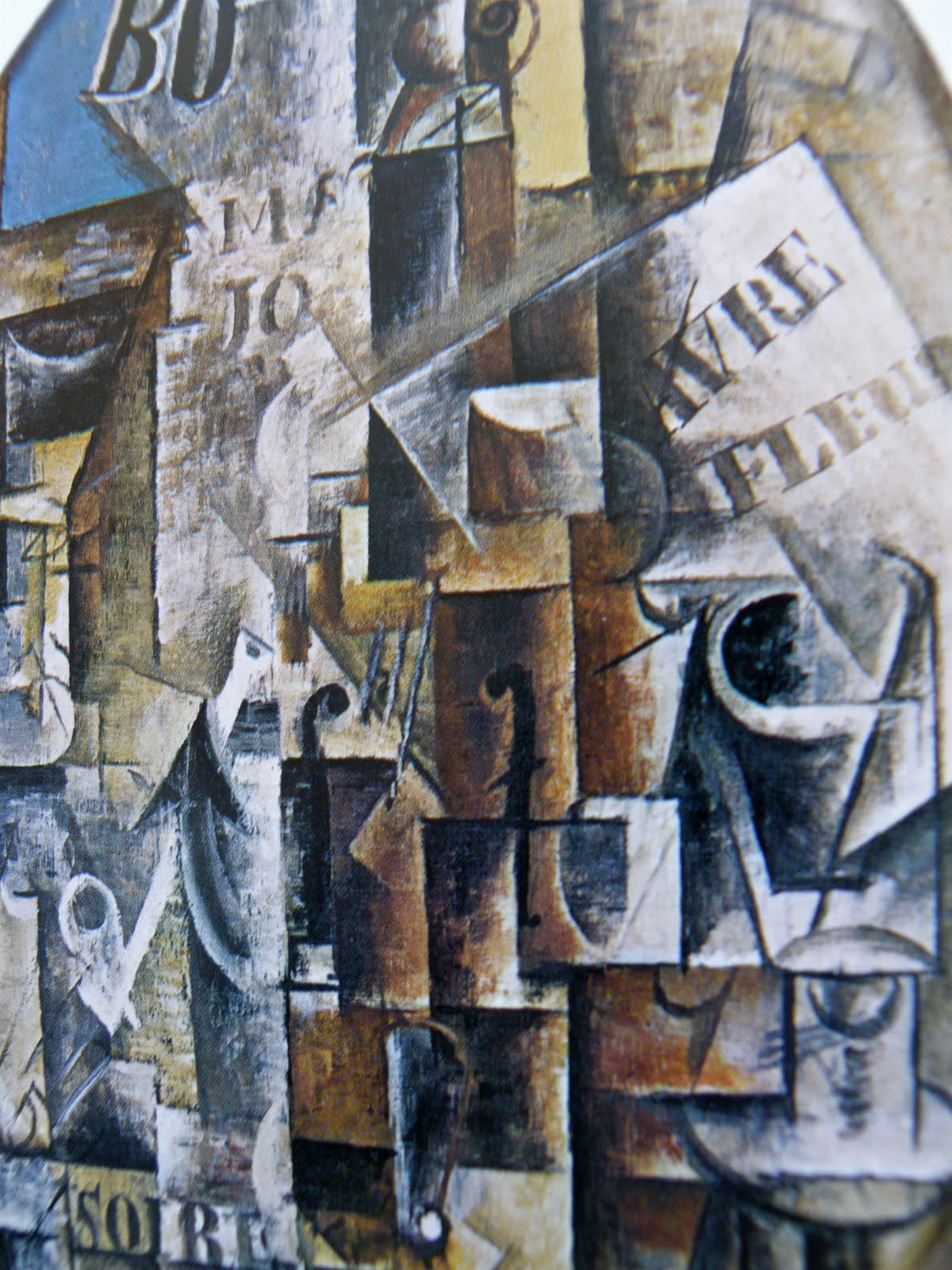
In this corner, we have a close-up of a Cubist work by Pablo Picasso, from 1912: Violin, Glass and Pipe on Table.  The painting (31 7/8" x 21 1/4" in the original) includes the classic elements, with stencilled letters, everyday objects with more than one side, as if we are walking around each one, the lines emanating from different horizons and centers, and, in a new move, some color (which would flex its muscles in the next few years):


There is no denying that this is a beautiful thing.  It's the arrow shot from Cezanne's bow. But when you read Francoise Gilot (Life with Picasso) on her conversations with Picasso about Cubism ... she reports that he dismissed it as an important era in his art. Really. And she is VERY convincing on this point.

Not long after I first read her book, Picasso appeared to me in a dream. He said to me, in a tone that was urgent and agitated, that "Cubism has become a monument. It must not be a monument." 

When Picasso stops by to converse, I always listen ... and try to determine what he meant. And so I turned to Gertrude Stein, who sat for her portrait with him (for 90 sittings) as he was turning from the harlequins to the Demoiselles. No-one converses with Stein and comes away unscathed, artistically.  Stein would develop a distinction between what she called human nature/identity and the human mind/entity. Identity is pleasurable for the artist, and seems lovely at first, and results in art created for money or reputation, totally dependent on an audience (for whom the art-work or prose was very likely painted or written). But the real thing, entity, is art that is "not necessary," and is not based in memory or reproduction, but in writing "what it knows." That, she would say, is the real thing.

When I saw was confronted with Picasso's statement in my dream ... that monuments were not so wonderful, I aligned the monument idea with Stein's idea of identity.  It is art made for reputation, money, audience. Or it is a great hulking piece of marble, remembering an event or a regiment. And so, it is sad, it is past, it is a label, it is fixed, it is finished. Here, someone was born, or celebrated a victory, or died. Monument.  Art should have no truck with monuments. Picasso was telling me (or I was telling myself, as I slept) that Cubism was at first a series of exciting and bracing and unprecedented discoveries, with Braque, but then ... once it was "done," it was done. Like a Jackson Pollock, it gets imitators, but it is, itself, a done deal.

The part of the self that creates true art is Stein's entity. She mentions arches, the arches that were near St. Remy, as part of the land, as existing in the moment. Immersed. Creative.  Not preserved in aspic, but mysterious. We struggle to keep up. And so I have this series of archways that are my response:


"Look, we have come through'"said D.H. Lawrence. An archway allows for this moment, for growth, for passage on to the next phase, for optimism in the face of fear, for art.

Thursday, April 7, 2011

artist, audience, performance

I taught an interdisciplinary class called "Artist, Audience, Performance," where we discussed the ways that one of these words might influence another. For example, an artist intent upon the performance, the work of art, could lose any potential audience by becoming too difficult, too inscrutable and enclosed.  Gertrude Stein's early works, such as Tender Buttons, need great care before they can be appreciated, because ... well, here is a sample:

A Red Stamp
If lilies are lily white and they exhaust noise and distance and even dust, if they dusty will dirt a surface that has no extreme grace, if they do this and it is not necessary it is not at all necessary if they do this they need a catalogue.

Now, I love this.  I think the poem makes it possible to say that the silence that we typically associate with lilies comes because they have worn out (or collected into themselves) all the ambient noise. And any cut flower, brought into the house and placed in a vase, will disintegrate into dust and remind us of our own deaths. And if they are going to do this to us, perhaps we need a written warning of all their properties and behaviors.

Of course, this is just one way of perhaps two hundred of talking about this stanza.

And when Stein did court an audience, with The Autobiography of Alice B. Toklas,  and found it, she nearly stopped writing altogether, so startling and upsetting was all the attention.

So today, when I was researching Italian pictures, dating from about 1910, showing peasant women,  I was looking for a very particular kind of picture.  And what I found were studies in pencil or watercolor of women or children in dresses posing ... these became, some of them, postcards for the tourists coming through Italy, or France, or Switzerland, to take or send home as souvenirs. The time of women, dressed this way, gathering in any kind of harvest, was rapidly disappearing, but tourists were searching for the "authentic" rural life, and artists and photographers found it for them.

So the audience there had been tourists. And the market was clear.  Van Gogh, he who never sold anything in his lifetime, even drew a moving, plain study: "Peasant Girl Raking" (1881).  BUT at very nearly this same time, other artists were creating a fully different kind of "performance." 

Ingres (1780-1867), Delacroix (1798-1863), John Frederick Lewis (1804-1876) and Lord Leighton (1830-1896) -- to name only the few I can think of -- all painted European women in the dress and formal settings of the Harem.  Some of these artists also painted peasant women; if they did, their peasants have none of the allure of their odalisques. And it struck me how different these two sets of portrayals were ... both were, in their way, lies.  The artists drawing the peasants (except for Van Gogh, who was telling the truth about this woman's twisted shoulders and leaning angles) are already selling nostalgia. But it isn't sexy nostalgia. The artists drawing the odalisques are part of a long, classical tradition of Venuses and Susannah and her Elders ... the nude for the sake of nakedness.

The performance is set in ... the (utterly accessible) hayfields, or the (inaccessible) private rooms of the Orient.  I think I understand the audience for the former ... who is the audience for the latter?  Hmmm...

Monday, March 28, 2011

About that belonging thing...

I do wonder about how it is a person knows where s/he belongs.  Agnes Martin was born in Canada, lived in Manhattan, and eventually became part of her Taos surroundings. Gertrude Stein said that she liked working in France, in isolation, late at night, in a place where English was not generally spoken, so that her native language was "fresh" as she composed. Paul Bowles moved between New York and Paris for awhile, but spent fifty years in Morocco.

*******"to be in different states without a change is not a possibility"--- Charles Olson**********

We thought we had moved to France, definitivement ... We stayed, the last time, nearly two years. We had bought a house and a car and fresh sheets and a farm table. We knew that, in recent years,  it had become more difficult (legally speaking) to simply move away. But we felt prepared for that, and we had always dealt well with bureaucracies, we thought.  (The representative at the French Consulate on East 74th Street in New York told me that I had put together our visa applications so beautifully that "it is just as if my mother had done it").  And in the end, it wasn't the paperwork.  While I will always wonder how exactly to put a ribbon around the whole process and put it away on a shelf, I do think that it was, as Gertrude Stein might have written about it, that "we did belong visiting to France, but we did not belong living there." I do believe it was the difference between exclaiming how marvelous and beautiful, strange or crazy, lovely or inscrutable things were ... and then, living in that same place, running out of discoveries, yet not quite being at home there either.  Not belonging. Not able to quite reconcile our French and American selves.

So, we are no longer near the Atlantic Ocean or the Mediterranean. We never saw redwoods in France, but we did see poppies. We drink the occasional Bordeaux now, but we are more likely to drink Cabernet Sauvignon; it is our "local" wine.  And objects and landscapes and people and life are all still here for the knowing.  A West Coast skyline (this one from Carmel Valley) can look the same as the skies above Saint-Tropez:


And we can find a door-panel in Carmel, below, just as if it were actually found around a corner, on an old house, on a back street in Paris:


But, in France, we never would have found a street sign -- that leads to the sea -- with Charley's Maltese nick-name stencilled brazenly on one side:

Monday, March 14, 2011

Flowers in the rain, Lathe and Plaster, and Wars I Have Seen

So, it rains a lot more... but the camellias like it. French pansies withstood everything the Normandy winter threw at them, and these flowers are just as robust, and they, too, are very beautiful, and tall enough to be out of the way of the deer:


There is a lot of color in California in late winter... there is a tree here that looks like mimosa, with yellow cascading flowers, and we just saw the orange poppies by the road the other day, and the mustard-flowers are all over Napa Valley.  The colors just come at you, right through the rain.

I have been working on a painting for months. It is 3 x 3 feet, on wood, and it was inspired by seeing a British artist, at home in his studio, discussing some very serious thing, but over his shoulder I saw the wooden frames and the bare walls of the place where he works, together with a couple of paintings hung up for the sake of the camera. It was the walls that got me... so I drew them, even though I am not usually a painter of straight lines, and I drew him new paintings (because his were not abstract enough for me)  and I have been working to tone up and trim down the geometry of the space... and I think I have it. The studio walls reminded me of our house in Upstate New York... when we bought it, my husband stripped the living and dining rooms down, pulling out all the lathe and plaster until all we could see was the original framing of the house (it turned out to have been built in 1858). I was pregnant... until all the lathe and plaster made it out of the house in boxes and into a dumpster, we had one path from the one working downstairs room (the kitchen) to the one working upstairs room (the bedroom). I still have a picture of Charley, covered in dust ... we thought the bare walls and the new start was all very romantic. So, I was working between the video of this artist I did not know and the memory of the house we lived in for so many years with our children... and the "walls" had to somehow combine the two. Here is the finished work:


If we were still in New York, I would be going to this fabulous combination of sound and sights, and orchestra lit by bedside-table style lamps from the 40's, with the female musicians speaking sections of Gertrude Stein's book of war experiences (almost the final thing she wrote) Wars I Have Seen, together with baroque music and the Sampler Suite (cantors singing songs from the 30's and 40's) and staccato machine-gun fire ... so many things to hear and to see, live on stage, and created with music and direction by Heiner Goebbels.  The piece was originally commissioned by the Southbank Centre in London, but is going to be in New York at Alice Tully Hall, on March 18th... I am sorry I will be missing it! Here is the ad, with a smiling Stein, a survivor of WW II:


Wars I Have Seen is good reading, but if you like Stein's experimental writing, try Mrs. Reynolds! It, too, deals with waiting through the war, and somehow it encourages, calms, makes better....

Tuesday, March 8, 2011

Agnes turned her back

I was watching a documentary, by Mary Lance, about the painter Agnes Martin; it is called "With my back to the world." Early on, the (then 86-year-old) artist explained that she did turn her back... she said she needed a quiet mind for inspiration to enter in, and that she only began a painting when she could see an image of it fully-formed in her mind (and then she begins the mathematical calculations to expand it to 5 x 5 feet).  Martin's paintings are, for some people, very difficult to love. They are composed largely of horizontal lines, begun in pencil, and then painted in with thin lines of very pale shades of paint. She said that she considered herself to be an Abstract Expressionist (but her work is very different from the extravagant splashes we usually associate with AbEx work... think Robert Motherwell or Joan Mitchell). But many people must love her ... the books and catalogs that remain in print are rare and pricey, and her work sells rather well.  Martin seemed to feel that her work may be accessible, if people give it a chance: "if you wake up in the morning and you feel very happy -- about nothing -- no cause -- that's what I paint about -- and I'm hoping that people when they ... respond to [these paintings] ... will realize that they make responses ... that are completely abstract, you know, and that their lives are broader than they think."

Do artists need to turn their backs in order to create work that people can respond to? Martin said that her past -- over twenty years of trying to paint and living among other painters and traveling -- gave her enough experience to work from for the rest of her life. And so she preferred living on her own. Gertrude Stein said (maybe in Alice's voice, in The Autobiography of Alice B. Toklas?) that she liked a view, but she liked to turn her back to it. She wrote after everyone else went to bed, sometimes until the birds began singing in the morning. Focus is important ... but Stein did set up her Paris apartment as a place to meet artists and writers and encouraged conversation, and only wrote after everyone had left.

This less-isolated way of working, Stein's focused moments in an otherwise social life, is also my husband's way ... Charley calls it working "in the interstices," stealing little moments "between" peeling the onions or returning the phone call or writing a Tanka prose piece or ... whatever. He came up with it as an expression long ago, in New York, as we were raised our two children, because, while he was sitting at the kitchen table or standing making dinner, he wrote a number of essays "between" talking with me or the kids. But his political theory essays (then) and his poetry (now) came of lived experience, drew images and life from everything going on around him.

Much as I like Agnes Martin's work, and the feeling in her work, I think some rhythm, some contact, is pretty crucial ... at least for most of us! Most of my work comes from thinking about the landscape as we (together) have walked or driven through it, and then I can "see" images later to bring back that experience. Everyday things, but with people.

Here are 4 of Charley's peeled apples, waiting through the "interstices"to become a pie for company: