Showing posts with label Leigh Bowery. Show all posts

Thursday, November 24, 2011

"I don't like Cubism," he said...

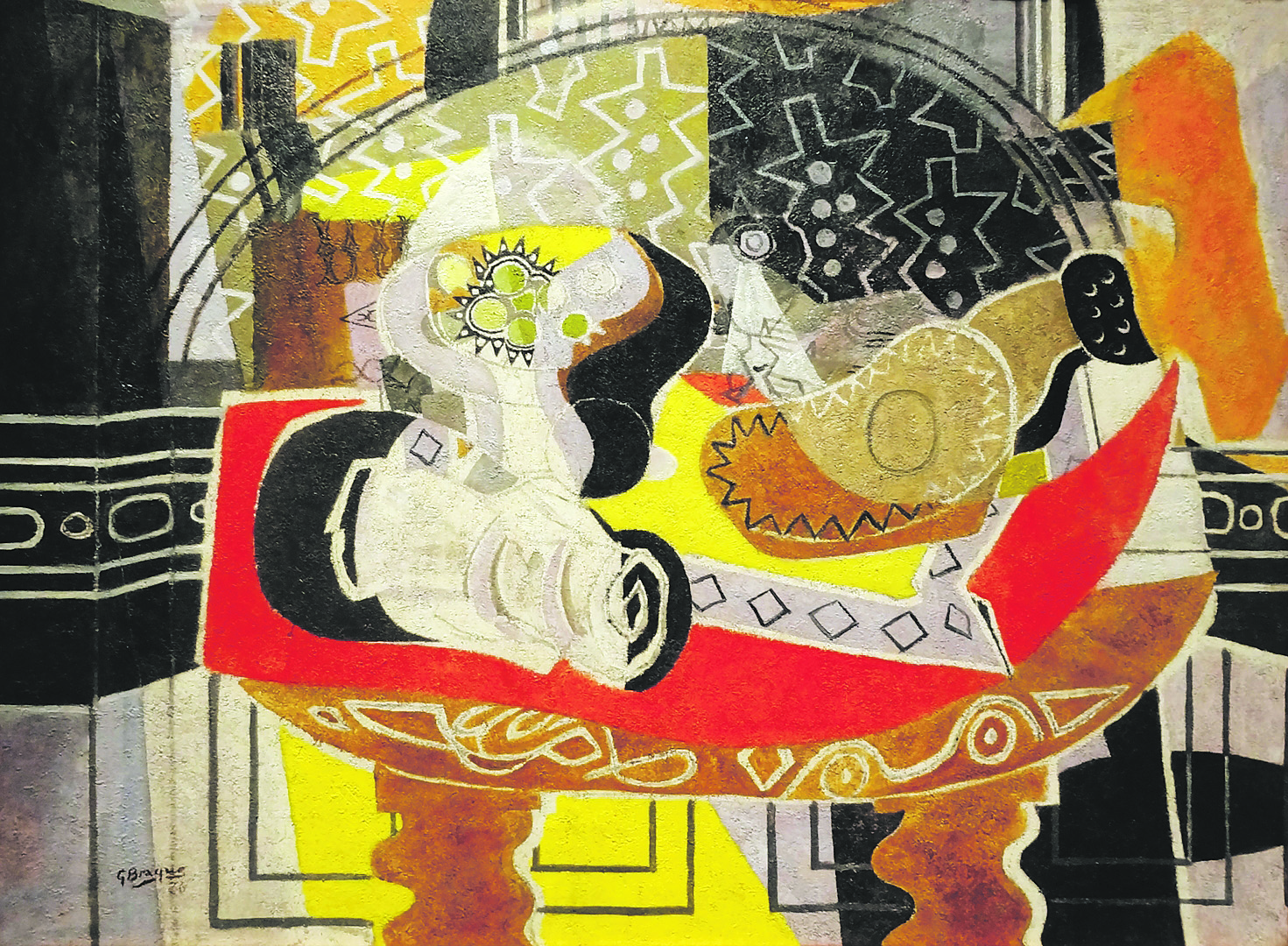
We were talking about the current show of Georges Braque's work at Acquavella Galleries in New York, which is breaking attendance records.  There have been many big-name shows (that once would have been undertaken by museums) sponsored by galleries; we saw one, last year, of Monet's late large works, at the Gagosian Gallery in Chelsea. I read that William Acquavella is bringing these works to the public in his usual risk-taking vein:  early on, he brought Sotheby's in to help him buy the entire contents of Pierre Matisse's gallery (Pierre Matisse was Henri's son and, as you can imagine, his collection was unparalleled) -- there were nearly 4,700 works.  Later, Acquavella visited Lucien Freud and bought all of his portraits of the performance artist Leigh Bowery, at a time when no-one thought a naked man could be a painterly subject.  Here is a photograph of Lucien Freud and his model, with the famous "Seated Leigh Bowery" painting, in process:


I love the Leigh Bowery series; he is one of my odalisques (see post from October 6).  But I digress... my husband says he doesn't like Cubism... we talked a bit... (there are many "Cubisms."  I talked about the phases here on August 1).  My theory is that Picasso and Braque worked their way through the discovery of picture planes and all-sides-at-once and the pre-eminence of the line and came out on the other side, Picasso would continue to change styles, Braque would continue to refine a single way of seeing.  I think these later paintings, from 1936, (these are in the Acquavella show) gain from Braque's Cubist experimentation, but are wonderfully complete in themselves. The picture plane is filled -- and yet it still has air and light. Here is "Still Life with Guitar I (Red Tablecloth)":


And here is "Woman at Easel (Yellow Screen)":

You can see the echoes of the flattened and tilted planes, the patterned, collage-like background, and yet there are sources of light here that were not present in the early Cubist works. And by the way, my husband really likes these!!! Go and see the Acquavella show for me... it closes November 30! And Happy Thanksgiving!

Thursday, October 6, 2011

LOOK: On Reflection ... Lucian Freud's Leigh Bowery Takes Target Practice (with Jasper Johns)

This is my final version of this painting, I think now.  I woke up in the middle of the night and thought about it, and I remembered that when we saw a full set of Freud's nudes, in New York, years ago, all the paintings were covered with full-glare glass... they were very difficult to see. I kept seeing other things... lights, other people, me, and so I have brought the model here into contact with a viewer who is both looking into and reflected by the glass:

Sunday, July 24, 2011

Lucian Freud has died...

We went to the Freud exhibition years ago at the Met in New York. The paintings that I remember now seem impossibly large; every "naked portrait" (Freud's term) stretched out before the viewer as if it were a landscape: a wrinkled forehead, a rolled tummy, a pale, dimpled bottom, huge as landmarks. Here is a link to an intimate photograph taken by Bruce Bernard of Freud with his very best subject, Leigh Bowery: http://www.christies.com/LotFinder/lot_details.aspx?intObjectID=4983539  Freud made Bowery's majesty come through the work (there is a wonderful film, "The Legend of Leigh Bowery," available to rent -- no-one else you know will ever inhabit this contemporary-Renaissance-man-of the-moment-party-guest world, ever). Freud was, by all accounts, a really good friend.

Many of the non-Bowery works by Freud were somber, depressing studies of men and women, the models contemplative, but depressed. It was as if the artist captured them through a keyhole. We aren't supposed to see strangers so closely; it's rather like seeing someone all alone, on the street in front of you, burst into tears. Portraits promise proximity in that way. It's difficult to know what to do. (My recollection of the pictures is that even the plants are portrayed as dying).  These "naked portraits" succeed in breaking  the spell of the "male gaze."  I suspect that is a large part of the point.

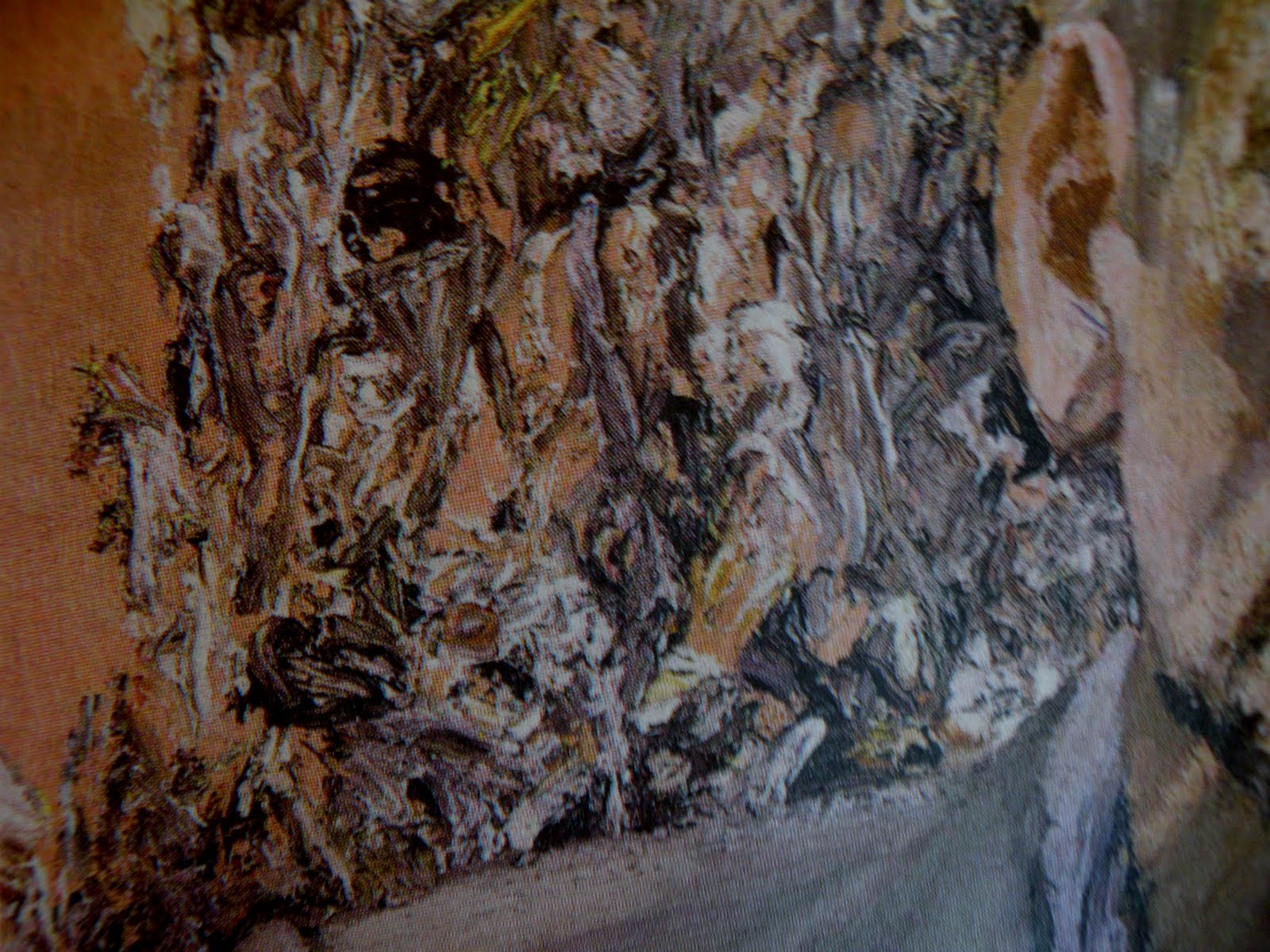
My husband says that it isn't what the works show us, exactly; it isn't about the subject, he insists. It's about the paint.  And that paint is as thickly applied as it is in a skyline by Constable. It's wonderful, tactile, and I suspect that this may be why it is so disturbing to see roomsful of Freud.  I'd like to see them again, however; it strikes me that there is much I missed years ago... there is a beauty to this man's seeing the ungainliness in people and setting it down, forever. There are hints that I may have missed some playful artistic references, too. Look at the background of this detail from a 2002 self-portrait, printed in yesterday's New York Times; isn't it a Jackson Pollock?