Showing posts with label abstract art as process. Show all posts

Friday, November 25, 2016

Matisse/Diebenkorn: Paint It Black


The Baltimore Museum of Art (BMA) is set in its own majestic portico’d place, augmented with a sweeping addition. It seems very far away from the city, and to travel there is to be (somehow) in art. BMA presents the “Matisse-Diebenkorn” through January 29, 2017 and then, after a re-hanging, the show opens again at SFMOMA in the spring.

What would these two artists say to one another across time? We know that Matisse went all the way to the edge of abstraction and just peered over with great delicacy, (with “View of Notre Dame” in 1914, for example):


and then retreated a few inches.  Diebenkorn set up shop just past his predecessor, but would make use of Matisse’s floral grillwork for safety’s sake.  You’ll see.

Pretty much everyone can picture a Matisse. Close your eyes. Okay? Got one?

This is my Matisse, “Red Room (Harmony in Red)” from 1908:


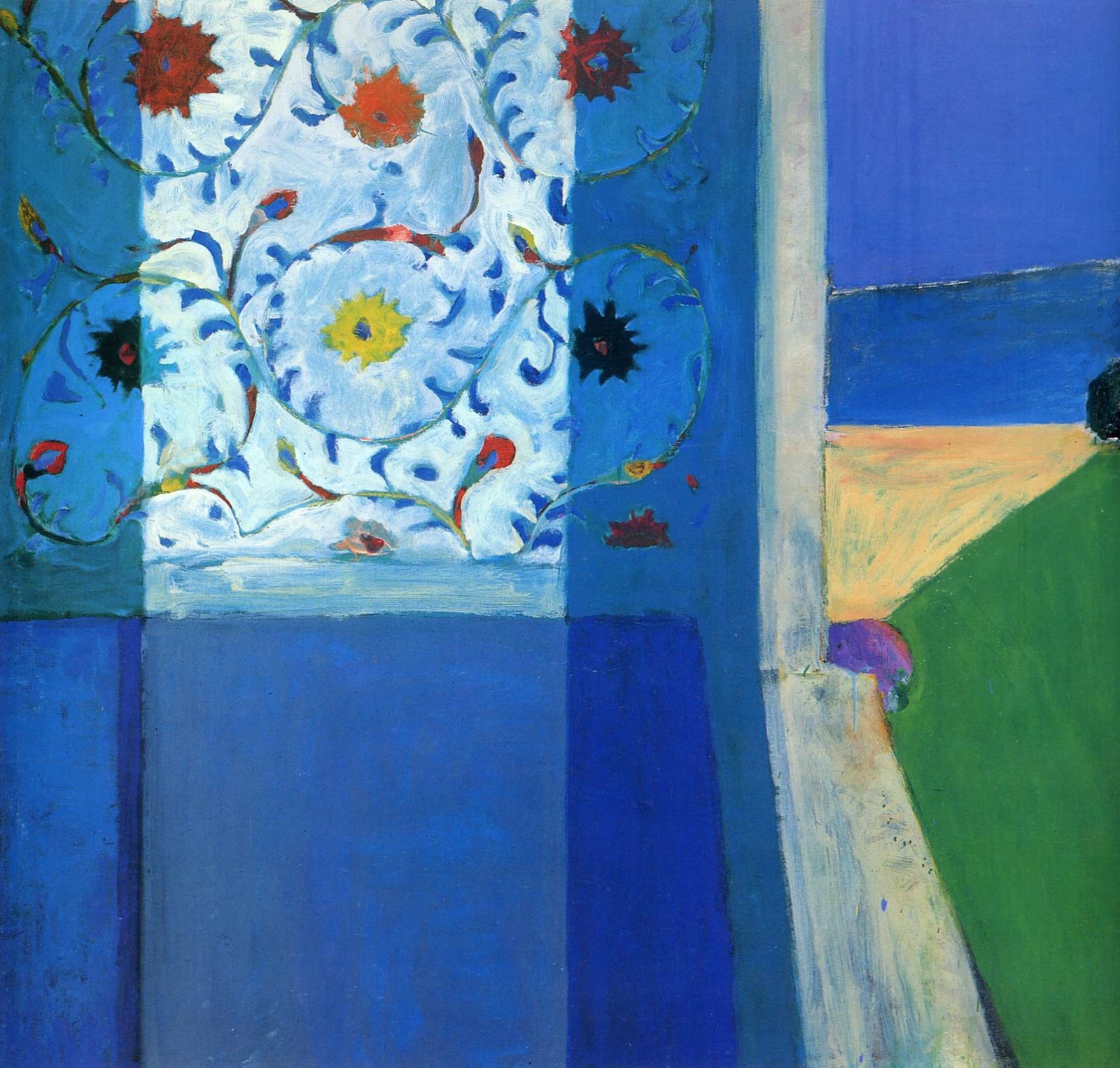
But not everyone can pull a Richard Diebenkorn image out of thin air.  And if you could, what period would you choose? Abstract? Figurative? or Ocean Park? Maybe, after seeing the show at BMA or SFMOMA, it would be this one, “Recollections of a Visit to Leningrad,” 1965, which is Matissean but also Diebenkornish:


To Begin with Diebenkorn
Let’s start by thinking about the “new” guy. I had seen a massive Diebenkorn exhibition at the Royal Academy (RA) in London in the spring of 2015.*  The Royal Academy offered generous texts on their walls and a thorough introduction to the artist on their site. Here is an example:

To weigh Diebenkorn’s reception in England, so Paul Carey-Kent, a financial policy analyst and art critic, brought 6  “well-established painters” to the RA’s Diebenkorn show, and recorded their comments along with his own. Carey-Kent started with the assumption that Diebenkorn is “a painter’s painter.” Half of his guests were pleased with the art on view, half were not. The painters are: Katrina Blamin, Claudia Carr, Christina Niederberger, Michael Stubbs, D.J. Simpson and Dolly Tompsett ; see the article for details (www.artcritical.com/2015/05/04/paul-carey-kent-richard-diebenkorn).

In the article, Michael Stubbs observes that Diebenkorn’s abstract work of the 1950’s was “typical of the early ‘50’s, in developing a Cubist space into more fluid forms which value spontaneous gestures, and which simultaneously construct and contradict the space.” YES. Diebenkorn faced into everything, right up through Cubism and Abstract Expressionism, and found his own voice. This is what makes him a “painter’s painter”: we can see him struggle, almost watch him think. Diebenkorn reveals everything beautiful and unsightly, brushstrokes that lesser artists would worry about exposing. Here is a detail from “Ocean Park 43” (Royal Academy of Arts exhibition catalogue, 14 March-17 June, 2015, p. 140):


Look at the escaped blue squiggle, up against a deliberate long dripped line. Now take another look at the gray line that anchors the blue triangle: there is another shape partly visible inside that. There are no straight lines on either top or bottom of the purple stripe; the artist didn’t auto-correct. The green drip slams into an orange line that then veers off to nothing, allowing the green to re-appear. This is not the work of a minute. This apparent spontaneity is earned through time and incredible patience on the part of the artist.  Marking, erasure, marking, stopping.

Another of the artists brought to the RA exhibition, D.J. Simpson, uses an electric router to mark/draw onto his wood support, and then paints in the backgrounds to make his art (his art is “fetishising,” says the artist and critic John Chilver). Simpson thinks that Diebenkorn knew exactly “when there was enough push and not enough pull.”  I think that, by “push” Simpson means the sustained agitation in the painting, flowing and just a bit untethered. Here is the question... Does Simpson mean that Diebenkorn would then add in the “pull” to lock in the work? Or does he mean that Diebenkorn would allow the painting to remain un-resolved, that this state of flux was the goal?

Matisse and Diebenkorn
The RA ‘s Diebenkorn show was big and beautiful. But it was a show that crested with the Ocean Park series, as if all the previous work was only preparatory.  The hanging was rather convincing as a yellow brick road, and it left me very little room to breathe. In this context, I saw the 1950’s work as flawed, and left feeling odd. I should have liked it; Diebenkorn is a painter’s painter, and, even more, an abstract painter’s painter.

So I was really eager to see the Matisse-Diebenkorn show.  Would Diebenkorn flounder in the face of the older man’s work? I had expected, because I have always loved him, to gravitate to the Matisses.  A brief aside: here is a lovely Matisse, (not at the show at BMA), called “Entrance to the Casbah,” (1912/3):

Years ago, I had gone to a Matisse show** and loved many paintings with this intense blue-dominated palette and come home immersed in what I thought of “Matisse blue.”  Bonnard said of a Matisse on his walls that

By day it is the blue that takes the lead. What an intense life the colors have, and how they vary with the light!  (1946)

On impulse, I added the color to every canvas then on my studio walls. It ruined them all, of course, because the paintings hadn’t called for that kind of interference.  What kind of interference would Matisse cause Diebenkorn? I thought blue might be involved.

But I was wrong. It was black, deep and abiding black. (Black is so important that one artist has recently claimed exclusive rights to the newest, strongest black mixture, Vantablack  (http://hyperallergic.com/279243/anish-kapoor-gets-exclusive-rights-to-the-worlds-darkest-pigment).  
But I get ahead of myself.  I should start with the observation that the wall texts and the essays for this show are entirely convincing. The research is solid, the relationship clear. Diebenkorn studied Matisse beginning with his days at Stanford. He saw Matisse’s paintings in the home of Sarah Stein. He visited MOMA in New York and the Pompidou in Paris. Diebenkorn owned forty-one books on Matisse, even loaning one to MOMA’s curator John Elderfield in 1983 to help with an upcoming exhibition. Diebenkorn saw little-known Matisse paintings as a guest of the Soviet Artists’ Union (Matisse/Diebenkorn catalogue, eds. Janet Bishop and Katherine Rothkopf, BMA and SFMOMA, 2016).

Near the show’s entrance, I found myself moving back and forth, looking at Matisse’s “Studio, Quai Saint-Michel”:


And his “Goldfish and Palette”:


And then, with those two firmly in mind, I took in “Urbana 2”


And “Urbana 6”:


 And basically didn’t want to move on. (So I will basically stay here for this writing, but know that there are many, many more works in the show and go see it!). The irony of the day was that the two Diebenkorn paintings had both been in the RA show, but I obviously hadn’t SEEN them.  I saw them now. And they blew me away. I remember thinking about each one, “is it a room? a landscape? a state of mind?”  The “Urbana” series was all that abstract paintings are meant to be. They were open, un-resolvable, but there might be a key, if I stood there long enough, maybe... I wanted to stay in front of them forever. And what held me in was the black pigment. Look back at “Urbana 6” and imagine just the black in outline as I drew it in my sketchbook:

The shapes are powerful, even in outline, but here they are again in black:

The black paint won’t give it up.  It hangs there, receding and coming forward as if it were actually moving. Curator Janet Bishop writes about “Studio, Quai Saint-Michel” and “Urbana #4” that

... the young painter appears to have repurposed the blocks of color that make up the Parisian studio interior to create a composition seemingly devoid of familiar points of reference (catalogue, p. 23)

This is the goal. The “pull,” Mr. Simpson, is left up to the viewer. 

It is as if Matisse lived long enough to move a little closer to that abstract edge; Diebenkorn completes Matisse’s line of thought, taking the loose shutter of  “French Window at Collioure” (which, curator Katherine Rothkopf writes, was changed by Matisse to cover over  ‘a balcony and a landscape in the distance” were covered over by “a wash of black paint” [!!] (catalogue, p. 123) :


 And fastening it down (the “shutter” in Ocean Park #105):


*My husband, Charles Tarlton, wrote a series of ekphrastic tanka prose about the Ocean Park paintings, based on our visit; see artistinanaframe.blogspot.com, the entry on Diebenkorn from 11/21/16; there is a drama in prose & poetry on the relationship of Matisse and Picasso printed there as well.

**”M

Monday, April 30, 2012

"The Hole Between Art and Life": Robert Rauschenberg Unpacked


A very young Robert Rauschenberg is perched high on a ladder in front of a cathedral-style arched window, answering questions (undated video, link posted at http://judys-journal.blogspot.com).  We hardly hear the interviewer.  Rauschenberg seems totally relaxed, and really interested in describing his painterly approaches as accurately as possible.

Let’s begin with his combine painting, “Rebus” (from 1955, now at MOMA; photo below by Suzanne DeChillo for The New York Times):


Rauschenberg began with “a ground of newspapers … the funnies …. I had an already-going surface, so there wouldn’t be a beginning to the picture.”  Now this is a very interesting admission.  The blank canvas can be daunting, so I really like the idea of starting, as Rauschenberg says, “an already-going surface.” (Rauschenberg is usually pretty articulate, so the awkward structure of his phrase, “already-going,” seems particularly telling –- it was deeply felt). Robert Motherwell had said that he started paintings by making some kind of painted “gesture” on the canvas, and then, he said, he would have a problem to solve.  Rauschenberg did not identify with Abstract Expressionists like Motherwell, but he says, in this video, that what he did take away from their “passion” was the fact that “they let their brushstrokes show.”  But he also, tellingly, begins with a “gesture.”  For Motherwell it was a sweeping brushstroke, for Rauschenberg it was “the funnies,” but the need for a prompt is the same.  We all need to start somewhere.

After he confirms that “there wouldn’t be a beginning to the picture,” because the funny papers had given him a starting point, he says this very strange thing:  “And so it [would] all just be additive …. It doesn’t matter what’s inside.”  I see what he means about the idea of “additive,” that, given the newspaper ground, he just starts adding more collage or paint or inks or wood.  But then what does he mean by “It doesn’t matter what’s inside”?  “Inside” of what?  He doesn’t mean inside his own mind (because that does matter) or inside his plan for a painting (because there isn’t one).  I think he means that it doesn’t matter what the bottom layer consists of, because it is “inside” the finished combine.  It may peek through, but it is merely the starting point, and it is the accumulation of stages that is important.

Rauschenberg continues, “it’s like when it stops because you’re dealing with an object, what it can make you think of how it could continue.  You begin with the possibilities of the materials and then you let them do what they can do.”  Again, the language is rolling out and he’s not policing it. 

I am going to take some liberties here to try and see what he is really saying.  Rauschenberg certainly never re-presented any objects in his work. He collaged photographs of a Titian nude, or a rocket, or a street scene, but he never described an object on a canvas with his own hand.  What he explains to us, here, is why.  The flow of working “stops” for him when he thinks about “dealing with an object” on its own.  If he were, say, to try and work on a single “object,” the way Manet has with his 1882 painting, “Flowers in a Crystal Vase”:


… it would all stop.  The initial gesture, the idea of adding elements to the combine or painting, the flow of work would all be compromised, because of the necessity of getting the vase and the water and the petals just so.  And so there can’t be a hand-painted, technically-perfect, light-and-shadows-following-the-curve object for him.  When you land on an object, it lands you. 

And I know exactly what he means (assuming this is what he means).  When I was painting my odalisque series, I was so worried about getting the outlines, getting the form, getting the whiteness down right, as here, with “RIVER: Anonymous Odalisque Reclines with Pillows” (3’ x 3’):


And I did love these paintings, but somehow the need to paint them stopped.  I thought of them as exercises in freeing the odalisques, seeing them outside in a new context, a beach, a riverbank.  But somehow they weren’t similarly freeing for me.  And then my son said (not unkindly, but trying to help me see why it wasn’t working for me anymore) “Well, there you are. A woman stuck on wood.”  And then I got it.  That’s exactly right.  The object “stops” the artist in his or her tracks.  And that’s what Rauschenberg is saying. 

We can’t, any of us, anymore, draw a vase filled with flowers, the object re-pictured in its precise entirety on canvas.  We can’t make the flowers out of wax and armatures.  But you can nail a flower to 2 x 4.  Early on in the video, Rauschenberg gives us what may be his most important piece of advice:  “You have to work in the hole between life and art,” he says, because “you can’t make either.” 


Thursday, March 8, 2012

Alberto Burri's "Grande Cretto": On "Extended Wings"

"Sweet berries ripen in the wilderness;
And, in the isolation of the sky,
At evening, casual flocks of pigeons make
Ambiguous undulations as they sink,
Downward to darkness, on extended wings."
                          from "Sunday Morning," by Wallace Stevens

"To live fully is to live with an awareness of the rumble of terror that underlies everything."
                          Ernest Becker

I was reading a passionate review of the show "The Indiscipline of Painting," in an article called "Disciplined and Polished or Burn, Burri, Burn!" by John Bunker (read it at www.abstractcritical.com, 10 February 2012).  Bunker suggests that, all too often, the way contemporary abstract artists paint and the way we write about abstraction is "too rarified, too polished, too conceptual" and he insists that painting should be about "engagement with the materiality of paint or any kind of matter without recourse to obvious mimesis."  Too often, painters copy one another, copy their thoughts, copy without feeling. Bunker goes on to say that he is "interested in abstract art as an expression of human agency operating in the cracks and fissures of an image-saturated consumer society."  And he points out that the works of the artist Alberto Burri (1915-1995) are the works that put "abstraction back into direct relationship with life lived." We need this, Bunker says, and I agree completely. Painting should wake the viewer up and feel entirely part of lived life.  Bunker concludes by saying that Burri's retrospective [at the Estorick Collection of Modern Italian Art in London] has "the advantage of channeling the power and potential of 'dark matter.'"

I had seen Burri's "Sacking and Red" and thought it in the same inventive, process-centered mode as the art of Robert Rauschenberg or Antoni Tapies.  Burri was part of a movement called "Art Informel," where process, not the finished work, was the point. But it wasn't until I read John Bunker's article and began thinking about it that I realized that I had already seen Burri's most powerful work of art.

My husband and I were driving through the Belice Valley in Northwestern Sicily. The countryside was beautiful, dramatic, with some agriculture, some goats and sheep, and very few people.  The houses were simple, stone with red-tile roofs.  But we began to see some unsettling vistas: deserted houses, towns where there were no people, no windows, and only the movement of a few flocks of birds and wandering dogs:


We stopped at the next populated cafe and asked.  "Oh, yes," an old woman told us, "the Belice Valley earthquake. 1968."  We went back out, stunned.  The hardest-hit places were Poggio Reale, Salaparuta, and Gibellina, all still there.  But they were so quiet; everyone had left and, worse,  no-one had ever come back.  I took another photograph:


And, soon after, we rounded a corner and saw this, and I began to take more pictures:


We drove up to the site. This is Alberto Burri's major work, called "Grande Cretto," created in the 1980's.  He kept the debris of the town of Gibellina, moved it into the even square blocks where houses had once stood, keeping the streets clear. He then covered all the destroyed houses with concrete:


You can walk through the streets, looking back at two or three once-grand houses in ruins up on the hill.  Below is the village, now the "Grande Cretto," with my husband in the corner of the first photo to give you an idea of the scale of this project:


It is a memorial, but one that has its own life. This was a more astonishing way to "see" the dead village than scattered ruins would have been.  This is what John Bunker meant, I think, by "direct relationship to life lived."

I see it as a combination of the beauty of Stevens's conclusion to "Sunday Morning" and the underlying monster in Ernest Becker's words above.  I think that powerful art addresses both beauty and the "rumble of terror."