Showing posts with label Richard Foreman. Show all posts

Monday, December 12, 2011

"Create a ZONE in which placed things (head) luminate!" Richard Foreman said

The playwright and director Richard Foreman has also written several sets of "manifestos" along with his plays. I suspect he does this partly to explain his methods to himself, but we can overhear the conversation!  My husband and I have seen his plays in New York, and we talk about his ideas all the time (I wrote about him here on November 30 and September 29-- and a few other times before that).  He is a powerful influence.  We both --often -- re-read a copy of a set of his writings, inter-woven with scenes from Foreman's plays, that was published originally in the journal Performance in 1972, called "HOTEL CHINA: Part 1 & Part 2."  Foreman believes, with Bertoldt Brecht and Gertrude Stein,  that art -- theater -- often puts audiences into a kind of comfortable trance, because they identify with the characters who are onstage and wait for the dilemma to be resolved.  Viewers should not be waiting, passively, for the linear progression of introduction-problem-resolution; they should be awake to "the new possibility ... a subtle insertion between logic and accident, which keeps the mind alive."  The play needs to be interrupted: "The field of the play is distorted by the objects within the play, so that each object distorts each other object and the mental pre-set is excluded" (p. 4).

In order to make this happen on his stages, Foreman has used all sorts of props and bizarre costumes; here is a scene from "What to Wear" in 2006:


There might be strings between the stage and the audience, or a plastic wall, characters might stop, mid-sentence, to wind up a huge crank or sing three bars of a song. The story? We are not watching for story. We are watching for movement, for surprise, for what is happening right this minute. Foreman wrote that the audience must "Be happy NOT knowing in condition of wanting to know. Be joyous in that tension" (p. 18).  He says, on page 5:

Art: not concerned with essence
    But with THING
               used in such a way
                  that it vanishes
                     & what is
      left is suspension:
    In life. -------> . thing is tool   --we get
    somewhere.
    In art. <---------> never get there
                        Suspended.
                  Why? Create a ZONE
                     in which placed
                  things (head) luminate!


Above, a shot from "Idiot Savant," 2009.  (You can see more by Foreman on his website, www.ontological.com). 

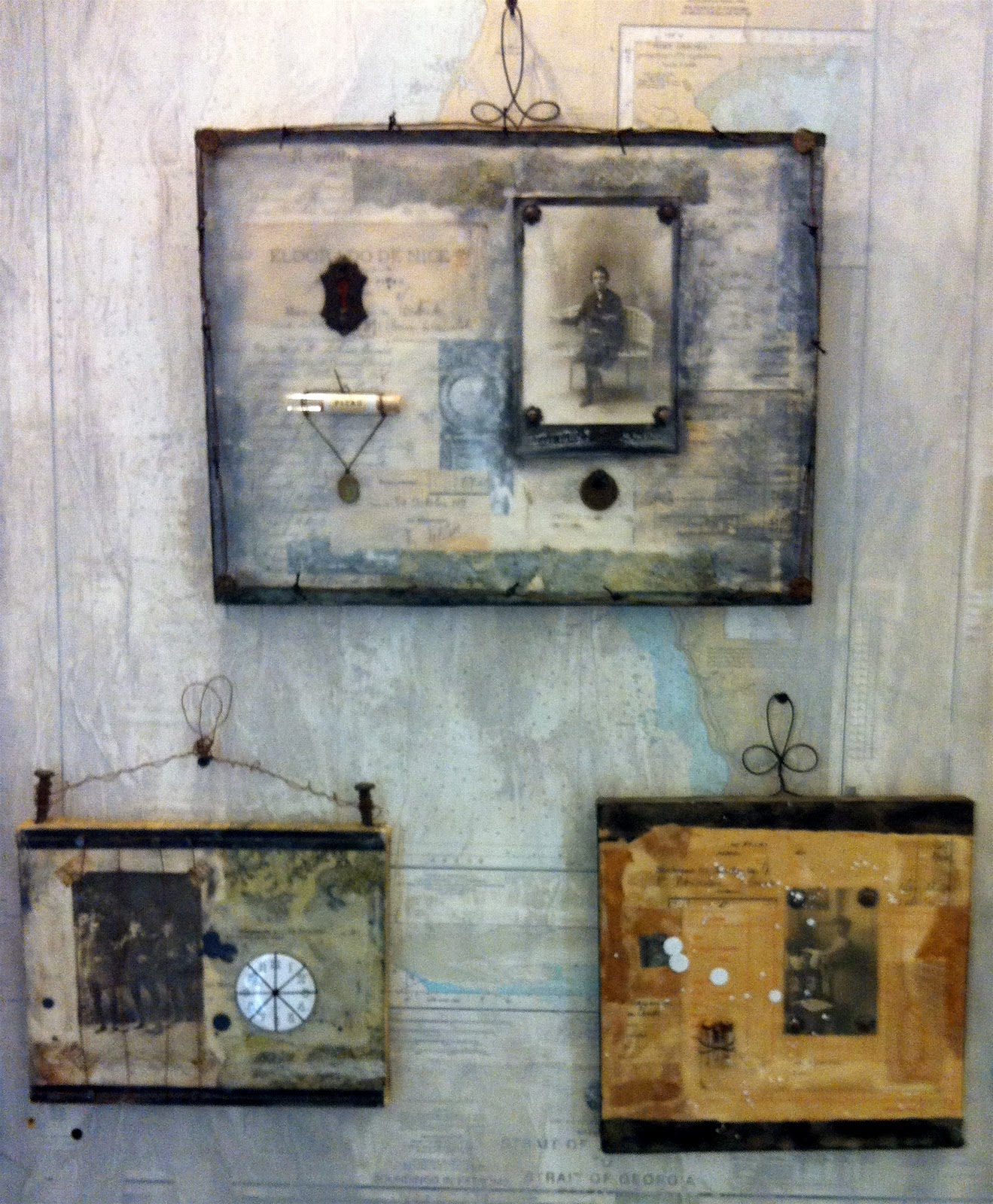
Why Foreman today, here, now?  We went to the Open Studios in the Arsenal in Benicia yesterday, and saw an artist there, Sharon Payne Bolton, whose work brings Richard Foreman's ideas to mind.  Her exhibition space is wallpapered with washed-over maps and fragments of French notebooks, and the art works (see the white-framed piece below) share shelf space with books, lasts for making shoes, lenses, glass bottles filled with vacuum radio tubes, rulers. The works themselves hold keys, or locks, or French papers from the 19th century (Bolton lived in France for a time) or small mechanical devices or waxed photographs:


We talked to Bolton about her similarities to Foreman, a writer she did not know, and about the ways her work can resonate with a viewer, because it is familiar, but not familiar, simultaneously. Her works are beautifully made (Bolton was a cabinetmaker, and her space is called "Cabinet of Curiosity"):


Each piece rewards continued scrutiny -- and holds the viewer in the present moment. Sharon Payne Bolton has created her own little world in each of her artworks:


If you can visit, do! If not, here is the artist's website: www.sharonpaynebolton.com

Sunday, November 13, 2011

Artist's Statement V: "patterns and contexts and compositions...."

To return to Richard Foreman for a moment, on foreground/background and figure/ground: in "How to Write a Play," he continues with the idea from yesterday's quote, about bringing forward the little details we do not usually see, to wake up the audience. He explains that his staging might include a chair  perched at an odd angle, tied to an orange with string, so that we see beyond the expected chair-ness to the context, or what he calls the "composition," of the play.  He disrupts the course of action of his characters to change the way we see theater.  Foreman says the tying of the string or the unexpected ringing of a bell become necessary tools for him because "the audience has never been trained to be composition perceivers rather than object perceivers. When they look at theater they use daily-life and perceptual modes and so see things and not patterns and contexts and compositions."

So I am thinking, as I work on my artist statement, that there will be times when we can be "trained," as the audience is for Foreman's work,  to look for the "non-beautiful," the "patterns" and the "contexts." And I am hoping I can do that in this odalisque series as well, where I (mostly) take the bodies out of the studio and immerse them in something ... completely different.   But I wondered if there were more paintings that might allow us to see both figure and ground, to at least choose, if we want to, to see one rather than the other, rather like focusing the lens on a camera: past the tree branch to a kestrel hunting over the cornfield and even beyond that to the way the field curves (so we look at a "composition" instead of the one -- more obvious -- "object").

We can begin with two related panels; they are related, for me, because they both show the Virgin and Child in the same space with the donor (the person who commissioned and paid for the work) and they both are set before intriguing and detailed landscapes. The first panel is by Jan Van Eyck, and is called the "Rolin Madonna" (or sometimes "Chancellor Rodin's Madonna, Rolin being the donor)  and dates from 1437:


The three figures in the foreground (as well as the angel at the top right, just setting a crown on Mary's head) are more than enough for us to contemplate.  How interesting is it, then, that Van Eyck has chosen to give us so much more? The receding tile, the archways ... but that view, as well?


Van Eyck has balanced the Child's body and the Chancellor's praying hands nearly evenly here.  The two observers looking at the river, then the bridge, the boat, the island, the village to the left with its church steeple, all lead us to thinking of the whole composition; what do we perceive, here?

The second panel was painted fifty years later, by Hans Memling; we don't know Memling's name as well as we know Van Eyck's, but he was very successful in his lifetime. This is the Diptych of Martin van Newenhoven:


Here, too, there is an implied symmetry, or very near equality, between the two portraits. And the casements and the leaded windows and stained glass are all of a piece, suggesting the Virgin and Child and donor are in the same setting.  If we look over the main subjects' shoulders, though, in each frame, we can see manicured lawns, bushes and clear walkways, and a city in the distance. And, although it is difficult to see in reproduction, there is a convex mirror over the Virgin's right shoulder, reflecting two additional figures.  Both of these artists are asking us to stay long enough to see the full "creative act."

Now I want to move to the 1940's, and a close-up of a painting by Edward Hopper called "Nighthawks":


What is figure, and what ground, here? Do we see the customers as our principal points of interest, or is it the setting: the diner, the empty city street, the late hour?  It seems to me the context matters most, but my husband argues that it is all background, here; the usual foreground suspect is not here.

Last, let's look at a contemporary, but very similar, push-pull of figure/ground. We went to the opening of the new Seager Gray Gallery in Mill Valley, California last night. Donna Seager has moved her gallery from San Rafael and taken on a partner, Suzanne Gray McSweeney.  The space is perfect and the gallery chose to represent one work from each of their artists, and all the work is really powerful. Our favorite work there was by Jylian Gustlin, called "Rara Avis 53." I did not get a photograph of that painting, as the gallery was full, but I do have a similar work from the artist's website, titled "Rara Avis 11," which I think has many of the same features and which nicely illustrates the figure/ground debate: where do you look? What is the "context," the "pattern," the "composition" that Foreman would want you to see?

I think this work is simply stunning. The figure is captured from below, looking up, and is echoed in the column at the far right. And yet there is something that I also love about the wall "behind" the figure, the ground of drips and scratches. The body and the "wall" each come forward or recede for me, as I look; what about you?

Saturday, November 12, 2011

Artist's Statement IV: "...into the midst of the heretofore rejected (non-beautiful, un-interesting, clichéd, etc.)..."

There are two kinds of artist's statements; the first presents the artist's general approach, developed over time (Cézanne's claim that "I don't think of anything when I paint") and then the artist's specific preoccupations of the moment (Constable's "I have done a good deal of skying -- for I am determined to conquer all difficulties").  At the moment, I am considering the specifics as I work on my odalisques.  And, in the main, I have a foreground/background (also known as figure/ground) question.

Richard Foreman gives me the place to start. He says he writes plays that he would like to see onstage, and he also has said that he does not want very much "story" in his work, because people fall asleep: "What this amounts to is a DECISION to view non-beautiful material in such a way that what was foreground is now background .... and the desired beauty is then projected, as the creative act, into the midst of the heretofore rejected (non-beautiful, un-interesting, clichéd, etc. ..."  So we reverse figure and ground. And we do not fall asleep!

Here is the simplest foregrounded subject, a detail from "The Blue Crab," by Ferdinand Bauer, from approximately 1810:


We have nothing else to look at but the subject, the figure; the crab is laid out upon a totally white ground. It is a specimen. The background is irrelevant; in fact, there is nothing there, which is too bad, because if we replaced the crab in its context, the seashore's sands and rocks and seaweeds would be beautiful to see.

Francis Bacon believes in the figure and the foreground, and in pushing away the background almost entirely. Against the most passive and pale -- or un-identifiably bland -- backgrounds, his figures twist and turn, the faces are contorted, pained, unstable.  Look at this center panel from the triptych "Three Portraits," 1973, apparently a self-portrait:

Bacon worked from photographs that had sometimes already been mangled; the faces, and the bodies, were the thing for him, the only thing. I think he believed that the viewer might stand long enough before the painting to put the sitter's face back into some recognizable form, and that, in the process, we might see our confrontation with these distortions as the point.  He was a "foreground" man.

But, I really love Foreman's idea. Why can't we switch the foreground and background, and bring the viewer's gaze to a new place? I think that emotion can not always be seen in a person's face or demeanor, but instead we can sense it in the surrounding air, the sidewalks, the windowsill, the forest ... wherever the setting might be.  The figure -- the blue crab, or Bacon's self-portrait -- may not be the thing we should concentrate on.  Let's imagine, with Foreman, that it's the context that is important.

So here is an unlikely co-conspirator: Caspar David Friedrich (1774-1840).  Friedrich's figures are inside the sublime. In this painting, called "The Wanderer above the Mists," the man, were we to cut him out and place him in the library of a club of his time in London, would be totally at home; he is impeccably dressed and unremarkable in himself. The man, the "figure" does not matter as much as the "ground," his context here; the painter has focused on the ice, the mist, the rocks, the mountains ... the "background" is here the foreground, the real subject:


The mountains in the distance are impossibly far and forbidding, as is the abyss before our lone figure.  The abyss matters. This is, of course, the forbidding Romantic idea of the Sublime, before which the poets and painters stood in awe. (See Wordsworth's "The Prelude" for more!). The place, the indifferent powerful world of Nature, the "ground," was the point, and not the "figure" standing before it.

Artists and their audiences "see" better when they pick up the figure's context and use it. I think that blank, open figures in a complicated space might allow us to project and imagine, particularly if we are looking at odalisques. The pale odalisque that Gerome painted in "The Moorish Bath" (my November 11 post) is in a context that matters... can we think our way inside?

So, "to illustrate my last remark," here is a detail of my painting "The River," a nude in a new context:

Wednesday, May 4, 2011

"... find the heretofore un-mapped," says Richard Foreman

On November 19, 1988, my husband and I saw a production at The Public Theater in New York that kept us talking for the full three-hour-drive home, and most of the next day, and for days and weeks after that. The play was What Did He See by Richard Foreman. We began to track down all of his writings; my husband was writing poetry and experimental dialogues and I was painting, and his complex ideas, we thought, needed to be felt, taken in, understood, and acted upon as we worked. In his "Ontological-Hysteric Manifesto I," Foreman talked about art and life and a thing he called "the scanning mechanism" which "produces art ... when its rhythms dominate the scanned object."

[I should note that, as far as I can remember, this was well before the words "scan" and "scanning" referred to anything with a tiny, pricey chip].  Instead, Foreman is talking about the way the mind and the senses of the artist look, then take in, and repeat the action, and take in again, and thus "dominate" what is seen by focusing, instead, on the process, its movement, and what it says about our creativity and ourselves.  Art, he says, should "give courage to oneself and others to be alive from moment to moment, which means to accept both flux ... and an INTERSECTING process -- scanning -- which is the perpetual constituting and reconstituting of the self."  Accepting change is one thing... Foreman wants us to seek change, flux, interchange, and in this way wake ourselves to what matters, to movement and art and to recognize "imbalance," which we "most deeply" are.

This follows, I think, from yesterday's post on Freud and "minor differences," which keep us both within civilization and aware of our "selves."  We need "imbalance" -- even to pursue it if necessary --
because that working out of who we are against what we see is critical. Foreman says that art should expose us to "the true process of a certain kind of sentence-gesture (man's inner quest for style, for a way of being in the world) as it encounters the resistance of the real object (nature)."  We see something, we imitate it, or draw it, or speak it, we "scan" it, and the natural object... is up against what we see, say, draw. It doesn't change. We do. The art shifts to explore this, and we live ... more fully.

He suggests, then, in a work called "How to Write a Play," that artists have a job: "find the heretofore un-mapped, un-notated crevices in the not-yet beautiful landscape ... and widen the gaps and plant the seed in those gaps and make those gaps flower ... and the plant over-runs the entire landscape."  The thing that everyone draws, the thing that we always see, or respond to, the easy story, the thing we know ... those are not important in art and life, as we can sleep-walk our way through them.  We want to find the things we have not yet seen, the hidden, the behind-things, the hints and "crevices" and we want to throw our lot in with all that we have not already known.

Richard Foreman has his own website, www.ontological.com, where he lists upcoming productions and opens his notebooks. Go look at it, and then tell me what you find there.... We still love his work.

Here is one of my old notebooks, and a manuscript that is clearly "in flux" --- and in need of planted seeds in its gaps. But it has value ... when I "scan" it, looking and repeating: