Showing posts with label perspective. Show all posts

Sunday, November 24, 2013

"And it is. I make sure it is." Hockney and the thrill


“The care with which the rain is wrong and the green is wrong and the white is wrong.... The care with which there is incredible justice and likeness, all this makes a magnificent asparagus, and also a fountain.”  Gertrude Stein, the final Tender Button


Consider the work of Gertrude Stein and David Hockney, and you will realize that neither artist is afraid to fail nor afraid of happiness.  For both, I get the impression, happiness is contagious.

The De Young Museum in San Francisco is showing "David Hockney: A Bigger
Exhibition," (his recent portraits and landscapes), through January 20, 2014. Hockney's landscapes are the thing, though. At the De Young, the show moves almost entirely chronologically, tracing Hockney’s movement through one medium after another in his portrayal of his Yorkshire woods and fields - water colors, oil, video, iPad drawings and charcoal, and, full circle, beginning and ending with classical tools. The classical approaches present Hockney’s art-school credentials.

But, much like his hero Picasso, Hockney appears to find that Raphael or Rembrandt pretty much had the classical thing covered, and he pours his passion into making us see – “how we see.” The works on video and iPad stop viewers in their tracks.

To the video presentations, first. 18 video screens, 3 high and six across,  are combined in a single space, although the boundaries of each camera’s view prevents the screens from fitting exactly, a slight tradeoff for having each angle and distance within the 18 screens in perfect focus.  Hedgrows wave lazily (here is a still from the catalogue... May 12th, 2011, Rudston to Kilham Road):
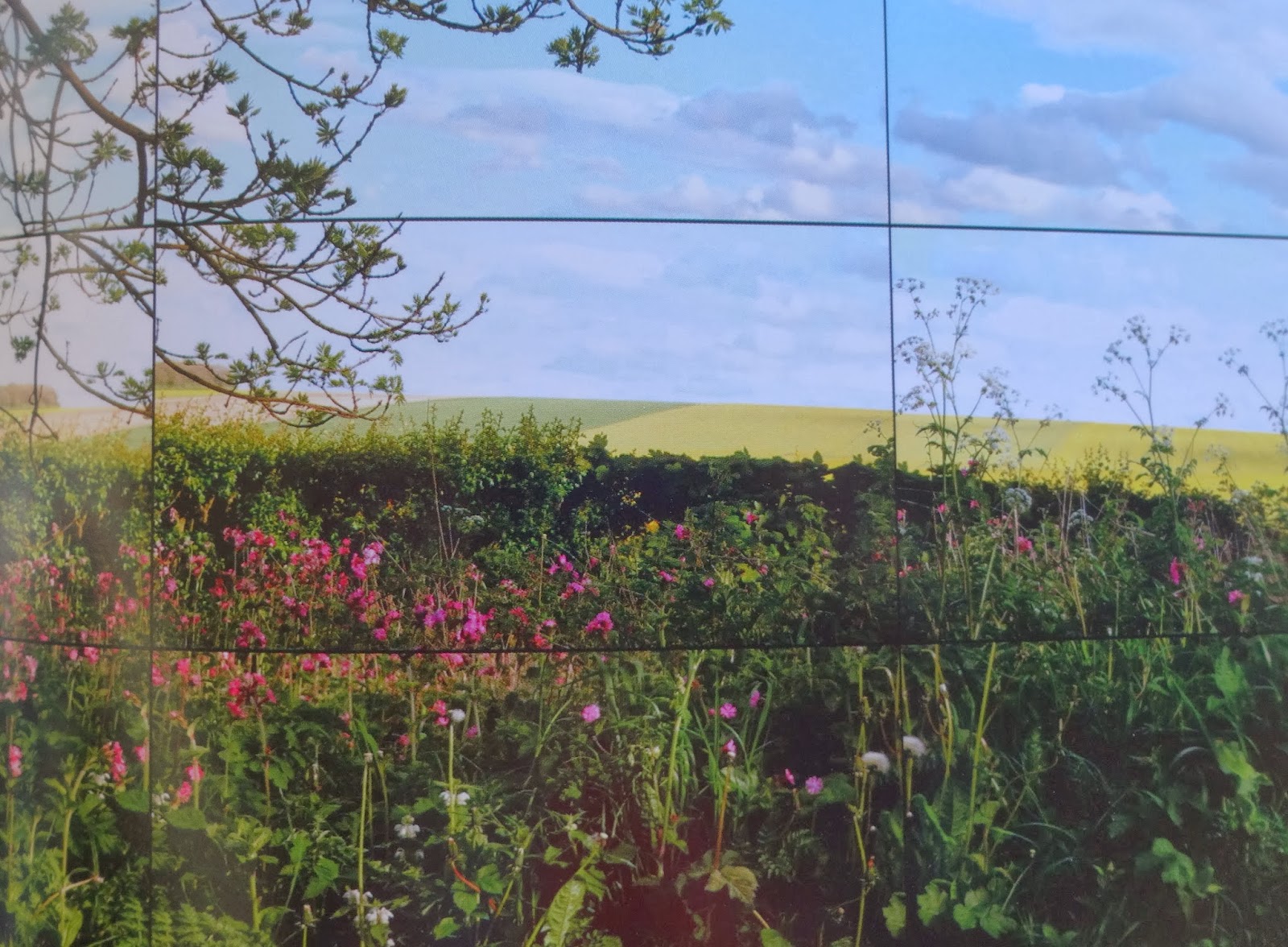

We look first at one screen, then another, then the time passes and we see we have stood there watching time, watching wind, watching air. We are surrounded, even though we are responding to just one wall of flat screens. We then move to the room of  “trees down the tunnel” that Hockney painted over and over again, here in nine screens (Woldgate Woods, June 2nd, 2010). Here is a still from the catalogue:


 Cars pass, unevenly from screen to screen. Snow falls delicately and slowly from tree branches, leaving one screen’s border, and then entering another ‘s,  just a little askew. Here is Woldgate Woods, November 26th 2010, a still photograph, from the catalogue:


The artist told Lawrence Weschler that mounting these cameras onto his car and driving through the fields meant "at least eighteen different vanishing points, and all of them moving" (catalogue essay, p. 39).  Or, in the case of the room that surrounds us with the four seasons of Woldgate Woods in the De Young, nine screens, nine moving vanishing points.

So what? you say.  Hockney has spent his life as an artist worrying about how to make art that makes us feel the way we feel when we are walking through the world. The now-famous photocollages (here, a detail of Grand Canyon from North Rim Lodge, Arizona, 1982):


offered up multiple (but rather fragmented, like broken glass) perspectives.  The  later paintings moved along further-- here is a detail of  "Mulholland Drive: The Road to the Studio," 1980:


Finally the “Bigger” series arrived; this work is part of that series, and Hockney truly began to find a straight line to our senses. (See : http://artistinanaframe.blogspot.com/2011/09/window-on-world-means-youre-cut-off.html)

He has come all his life to this point... where he shows us how we can see the world we know. It’s a little neglected corner. It isn’t Claude Monet’s towering sharp-edged cliffs at Etrétat, or Caspar David Friedrich’s Alps and fog in “Der Wanderer über dem Nebelmeer“ (The Wanderer Above the Sea of Mist) or any other landscape that would add drama all on its own.  Hockney’s landscapes are where you walk the dogs, where you go to play hide and seek, where you go for a quiet ... anything.  We all know this place. We begin to find that we love it, in all its powerful humility.

Hockney said, in 2004 (I cannot find the reference!) that  “I can get excited watching rain on a puddle. And then I paint it. Now, I admit, there are not too many people who would find that exciting. But I would. And I want life thrilling and rich. And it is. I make sure it is.”

And the puddles?  Well, they come into play in the iPad drawings. Here is 18 December, from the catalogue:


I remember when, at 13, I first noticed raindrops on a puddle, walking to the bus-stop.  But somehow I remember thinking about the dropping water and the “plop” sound it made, hitting the puddle on the asphalt.  These are very simple things Hockney offers us;  simple, yes, but so hard to recreate.

2 January:


Go and see. 


Monday, November 7, 2011

"But you the viewer...": Camille Pissarro, Paul Cezanne, and Vincent Van Gogh

David Hockney was talking about his trees-in-Bridlington paintings with his friend and (best?) critic, Lawrence Weschler:  Hockney says " 'I've taken to thinking of these recent canvases of mine as figure paintings.' He waited two beats till I obliged him: 'But they're just landscapes,' I pointed out. 'There are no figures in them.'  'Ah,' he corrected me triumphantly, 'but you the viewer are the figure in them.' " (from True to Life: 25 Years of Conversations with David Hockney, Berkeley: University of California Press, 2008, p. 222).

We visited the legion of honor and saw the new exhibit "Pissarro's People"; this was the first chance I have had to see the whole range of his art.  Pissarro seems, at least to me, the least well-known of his contemporaries.  He lost hundreds of paintings when he was forced to abandon his home during the Franco-Prussian war; this loss would have demoralized many artists, but he kept painting. Cézanne would call him "the first Impressionist," but, then,  Pissarro moved on to his own form of Post-Impressionism, and to pointillism. His final works seem free and loose, perhaps finally beyond "-isms."

The show at the Legion of Honor focuses on "People" and brings together pictures of Pissarro's family, of household servants, apple-pickers, people attending markets in Normandy and Picardy, and of men and women bringing in the harvest. The colors are generally muted and soft, and brushstrokes are dominant.  My husband pulled me over to a painting. "Look," he said, "it's Cézanne's tilted table." And, if you look at this one work, "The Little Country Maid," from 1882, you can see that in addition to the single, front-view perspective, Pissarro has added a second viewpoint, almost an overhead glance at the chair seats and tabletop:

It's very casual, almost tossed-off, but it's definitely there. When we got home, we did some research on the interests and influence of Pissarro. He loved Japanese prints, and he was impressed enough with pointillism after seeing Seurat and Signac to work for three years in that style. Pissarro exhibited with the Impressionists at the Salon des Refusés in 1863 and, later, became "a father for me," said Cézanne. Vincent Van Gogh showed Pissarro his work and was influenced by him. I think if we look at three works by these artists, we will see the line of sight they shared. The first painting is a pastel by Pissarro:


Look at these colors... look at the forms! Now, here is a Van Gogh, "Shelter on Montmartre," from 1886, (in the permanent collection of the Legion of Honor):


Again, the shapes and the colors ... along Pissarro's lines, but developing into what we think of as the style of Van Gogh.  And here is an 1895 painting by Cézanne, "Large Pine and Red Earth":

In their way, I think, these painters are best seen, at least once, as a group; there, they are complete, finished, as it were, by all of us, as Hockney notes.

Friday, September 23, 2011

Orange slices series: a change to "CRANE"


--- this is 2 x 4' --- have finished it today, I do believe (and have brought it into the living room to look at it and feel certain)...

It may not look like it, but this is a short treatise on love, loss and perspective. The scraping and sanding and over-painting is about time and its passing... as it passes, our landscape changes. We are in a different place; we have changed, and not everyone that we started with is "right here" anymore.  But that doesn't mean that we don't remember what we have lost -- as we stop for a millisecond and see what we have gained.  We are often in two places, presence and absence being something we all know ... and yet, traditional perspective doesn't allow the viewer to look back. It is not "for" movement or feeling. It is meant to be a reasonable, scientific scan of the world... but there is no method that grants every body, flower, tree, parent, child or building or pig its place.  As we move, the world blurs, and we must choose what to see. But we do choose. And we must not let perspective, well-dressed and recommended though it is, choose for us.

The painting above concerns a crane in Coyote Hills (present)... and it is also a recipe for the pie of my childhood... the recipe that came out once a year (absent).  My father was the only person who truly loved it... later, my mother would add strawberries in an effort to appease the rest of us. This came in the mail from Rob and Barbara yesterday:

We are there, in the hills of middle Connecticut, at a small summer family dinner, and here, driving to and fro in the hills and the fog:

And a CRANE "in the midst of all."

Monday, July 18, 2011

A Few (Playful!) Ideas on Perspective and the Fourth Wall


 "Me to play" (Hamm, in Samuel Beckett's Endgame)

In the first chapter of her book, The Originality of the Avant-Garde, Rosalind Krauss mentions perspective. She is working on detaching perspective’s crossed wires (the ones we all remember from Art History blackboards) from her reader’s impressions of the grid, which she wants to discuss at much greater length. It may not be fully polite to pull these few brief phrases on perspective away from their context for greater attention, but I do believe that Rosalind Krauss will understand. I am playing with what she says here, starting with her entirely authoritative view on the subject....

A young model and painter recently remarked that she was collecting books about perspective. She doesn’t mention why. I believe that we do not think about the ways we “assume” perspective, any more than we think about the fourth wall between us and actors on the stage -- until a dramatist calls our attention to it. Modernism and post-modernism and post-post were the arts meant to wake us up -- but we still see those lines in our dreams.

Here is the core of what Krauss writes: for fifteenth- and sixteenth-century artists, “the perspective lattice is inscribed on the depicted world as the armature of its organization …. Perspective was … the science of the real, not the mode of withdrawing from it.  Perspective was the demonstration of the way reality and its representation could be mapped onto one another, the way the painted image and its real-world referent did in fact relate to one another – the first being a form of knowledge about the second …” (10). 

The “lattice” of perspective is “inscribed on” a picture as the “armature of its organization,” Krauss says. She is perfectly right; the “lattice” is not integral to the scene the artist wishes to portray. Lovely word, lattice, but, architecturally, it is meant to separate the man or woman at the window from all that he or she surveys, as with these women in John Frederick Lewis's "Indoor Gossip, Cairo" from 1873:


 And, as Krauss notes, perspectival lines must be “inscribed” by the artist’s hand, imposed from without; the landscape is branded, really, re-organized, so that we can readily trace the object back from our marked spot as viewer to the vanishing point.  

We have been taught to see. We imagine the horizon line, and not only when we look at a painted landscape.  As we go on vacation, and gaze at sunsets, we sketch in the diagonal lines ourselves, and see the two rows of trees, or the grapevines, or the jetty, stretching to that imaginary horizon, each tree or rock diminishing, one after the other, in precise rhythm.  As we do this bit of artwork up against real horizons, we must not move, ourselves, as that would completely spoil the lines.

Krauss says that perspective was  [and many would say, still is] “the science of the real, not the mode of withdrawing from it.”  And yet, think of that lattice: a means of withdrawal; again, John Frederick Lewis, in "The Siesta," from 1876:


(See... isn't this fun?) We must remain motionless, on its other side, just as we must remain motionless in our seats and imagine that “wall” between us and the very-contemporary human onstage playing the role of the king, the one written in the 16th century.  And yet, even Shakespeare wrote in asides, the little winks to the audience that broke the wall.  Aren’t we able, then, to move from our rooted spot in the landscape, as Constable did when he packed up his brushes and went in to lunch, after painting "Hadleigh Castle, the Mouth of the Thames -- Morning After a Stormy Night," in 1829:


Wouldn’t movement be more scientific?

Krauss ends the remarks on perspective by saying that “reality and its representation” were, for these early artists, “mapped onto one another,” since they saw perspective as a “form of knowledge” about their “real-world referent” (10).  It was, for a long time, a required way of knowing. But it should not carry such pure authority now. David Hockney has said that the problem with perspective is that “it stops time. …. Space has become frozen, petrified” (from True to Life: Twenty-Five Years of Conversations with David Hockney, by Lawrence Wechsler, published in paper by The University of California Press, p. 66).  And that same critic who interviewed Hockney, Lawrence Wechsler, quotes an earlier artist, Jacques Riviere, who said in 1912 that “perspective is the sign of an instant, of the instant when a certain man is as a certain point …. But in reality, we can change position: a step to the right, a step to the left, completes our vision” (Wechsler, 197). 

So, wouldn’t it be fun to really think about perspective; if we do use it, as painters, let’s play with it, let’s break it down, the way a Shakespearean actor breaks down that final wall, with an aside to our audiences…. As Hamm would say, "Me to play."

Saturday, April 9, 2011

Classic portraiture vs. Cubism and Francis Bacon and David Hockney....

We were travelling in Dublin, spending time with our daughter ... found a lovely little easel:


This easel sits in my studio and supports my plates for my prints. But it was very likely created to carry out into the landscape... and so I was thinking... after Constable, after Turner, after Renoir and their forays into open-air painting, come the questions about one-point perspective, posed by Picasso and Braque, that were answered by Cubism. But Cubism is mostly about human-made objects (pitchers, guitars, newspaper headlines) and fruits and sometimes faces... but very seldom about landscape... trees are harder to "square" and reduce... So if Cubism is in part ditching perspective, and staying indoors, then, when it does deal with organic things and with humans, isn't it also jettisoning the one view of the face, the classic portrait (like this terrific picture of Sir Hugh Lane by John Singer Sargent):


(This is a page from my journal where I taped in a postcard from the Hugh Lane Gallery, which also has recreated Francis Bacon's studio in its entirety -- and lovely mess).  The face in Cubism is broken into facets... David Hockney has said that "all drawing is collage" and in that sense, then, maybe Cubism was inevitable... the artist is always making choices: what to add or subtract, what to priveledge, what to shade or make whole... where we see and what we see from that angle... And Francis Bacon (in my notes in my journal picture above) says that "Half my painting activity is disrupting what I can with ease" (Picasso said something like this, too) and "I see every image all the time in a shifting way and almost in shifting sequences."  I think we all do, now... the permanent legacy of Cubism. Not a style, but a way of seeing.