
Saturday, September 10, 2011
"Maybe your Baby
done made ... some ... other plan...." I am listening to this song by Stevie Wonder (I love it!) and working on a 4 x 6' painting; here is a detail:


Thursday, September 8, 2011
"A window on the world means you're cut off from it." --David Hockney
I still have my cold... so I watched, again, the wonderful "A Bigger Picture," a film by Bruno Wollheim, from 2009, on David Hockney, painting across the seasons in Yorkshire. From the beginning... where Hockney shows us a folding sketchbook filled with delicate sketches of each kind of flower and plant and leaf and blade of grass that makes up the roadside splendor in Yorkshire, when he says, "When you've drawn it ... you've seen the hedgerow ... and you realize ... there's a tremendous lot to it," the viewer (also) realizes that this is Hockney, teaching us all to see. There isn't any window between Hockney and his subject ... not even in the winter cold, where he is photographed in what look to me like gardening gloves, handling the paintbrush, trying to catch the mist before the sun clears it away.
The filmmaker notes that Hockney chooses subjects for these landscapes that seem, to any of us, "unremarkable," and Hockney admits that he intends to "make something quite different out of it. "
And he does; he makes "big, dramatic landscapes," with the biggest destined for the Royal Academy of Art walls, and then, in a hugely generous move, Hockney gives the painting and its giant reproductions to the Tate ... As he is making this multi-(50?)-canvas piece, Hockney says "Time and space are not separate, are they? I used to think they were.... It's the NOW that's eternal, actually."
And he does do it... he makes you see "the NOW." Here is a still from the film, looking through Hockney's windshield at the Yorkshire countryside, quickly painted over, by me, to show you what a painting of an "unremarkable" Yorkshire road might have looked like if Hockney were an average "Sunday" painter:

And another:
 But below is (a rather well-worn) example of what Hockney painted of this same Yorkshire in 1997, from my poster (which has, as you can see, been hanging in my studio ever since) from the Boston Museum of Fine Arts show in 1998. Check out the way the landscape in front of us seems to move towards us. It defies single-lens perspective. It will not confine the viewer. It rises up at us just like Cezanne's fruit-laden tables, but on a far larger scale, and without fear. It pulls painting away from camera obscura and allows you to see far more than the canvas's four sides would normally allow. You see the sweep of Yorkshire. You feel as though you are turning in a big circle. Look!:
 And as for this latest effort, twelve years later, documented in the Wollheim film from 2009, here's a link to an article on it from the Guardian newspaper:
http://www.guardian.co.uk/artanddesign/2009/nov/23/hockney-tate-britain-trees
Just astonishing. And that's just one of the walls with the reproduction... here is a wrinkled and bent ad from an art magazine, showing another smaller (!! --108 x 144") work, "Bigger Trees Nearer Warter," that was shown in 2009 at Pace Wildenstein (copyright for all work retained by David Hockney):

At one point, near the end of the film, Hockney gestures at one of the paintings and asks the filmmaker "Does that seem like an empty wood to you?" ... The answer from Wollheim comes slowly, because he says there are "no people" in it, but after some consideration, no, it doesn't look empty. Hockney continues, in almost the same breath, that it's "because somebody is looking at it ..." and then he adds, with a smile, "do we know what an empty room looks like?"
Well, of course not. And that's a large part of the point. Looking brings things into being. That's what we can do, here, now. And yet, we won't always agree on the final representation of the thing. And that is going to have to be alright, because, this painter says, we all see things differently. Hockney says that even when we are in the "now," two or three of us standing looking at a road, a tree, a hedgerow, that what we each see is different, because we each have our own distinct memories that crowd into our sight. There's a sadness -- but also a sense of quiet triumph -- in his saying, that, because of this, "we're all on our own." This is a great, great movie. And I will not give you the last lines of the film, so that you will be sure to go and see it.
The filmmaker notes that Hockney chooses subjects for these landscapes that seem, to any of us, "unremarkable," and Hockney admits that he intends to "make something quite different out of it. "
And he does; he makes "big, dramatic landscapes," with the biggest destined for the Royal Academy of Art walls, and then, in a hugely generous move, Hockney gives the painting and its giant reproductions to the Tate ... As he is making this multi-(50?)-canvas piece, Hockney says "Time and space are not separate, are they? I used to think they were.... It's the NOW that's eternal, actually."
And he does do it... he makes you see "the NOW." Here is a still from the film, looking through Hockney's windshield at the Yorkshire countryside, quickly painted over, by me, to show you what a painting of an "unremarkable" Yorkshire road might have looked like if Hockney were an average "Sunday" painter:

And another:


http://www.guardian.co.uk/artanddesign/2009/nov/23/hockney-tate-britain-trees
Just astonishing. And that's just one of the walls with the reproduction... here is a wrinkled and bent ad from an art magazine, showing another smaller (!! --108 x 144") work, "Bigger Trees Nearer Warter," that was shown in 2009 at Pace Wildenstein (copyright for all work retained by David Hockney):

At one point, near the end of the film, Hockney gestures at one of the paintings and asks the filmmaker "Does that seem like an empty wood to you?" ... The answer from Wollheim comes slowly, because he says there are "no people" in it, but after some consideration, no, it doesn't look empty. Hockney continues, in almost the same breath, that it's "because somebody is looking at it ..." and then he adds, with a smile, "do we know what an empty room looks like?"
Well, of course not. And that's a large part of the point. Looking brings things into being. That's what we can do, here, now. And yet, we won't always agree on the final representation of the thing. And that is going to have to be alright, because, this painter says, we all see things differently. Hockney says that even when we are in the "now," two or three of us standing looking at a road, a tree, a hedgerow, that what we each see is different, because we each have our own distinct memories that crowd into our sight. There's a sadness -- but also a sense of quiet triumph -- in his saying, that, because of this, "we're all on our own." This is a great, great movie. And I will not give you the last lines of the film, so that you will be sure to go and see it.
Tuesday, September 6, 2011
Richard Holmes, on the biographer's art ... not unlike the painter's
I have been reading Richard Holmes's Footsteps: Adventures of a Romantic Biographer (N.Y.: Vintage Books, 1985) and he is a splendid observer; we go into the Cévennes on the trail of Robert Louis Stevenson and into Italy with Shelley (and that is only the first half of the book). Holmes finds an aspect of the landscape that existed in Stevenson or Shelley's time and works to imagine that world; instead of photographing the outside of Shelley's rented house, he looks from the windows out to the sea... seeing Shelley's view. Or, having waited in vain for a taxi of any sort, he walks up the path Shelley would have taken from the station at the Bagni:
"I passed through the long colonnades of chestnuts and plane trees, the leaves dropping around me, the smoke rising white and blue in the light, the sky full of leaves, beautiful and purgatorial. Shelley wrote at length in his letters about these trees, the water, the sky, the stars at night, entranced by them" (p.145).
But, as he has already warned us, this kind of tracing footsteps, turning corners, almost seeing his quarry, with something like a child's joy in the game of hide-and-seek, has its limits and its responsibilities. He discovers that the modern bridge he crossed with great glee is not the bridge Stevenson used... that bridge stands, broken, neglected, further down the road. So then he reminded himself, he tells us, that:
"You could not play-act into the past, you could not turn it into a game of make-believe .... Somehow you had to produce the living effect, while remaining true to the dead fact. The adult distance -- the critical distance, the historical distance -- had to be maintained. You stood at the end of the broken bridge and looked across carefully, objectively, into the unattainable past on the other side. You brought it alive, brought it back, by other sorts of skills and crafts and sensible magic" (p. 27).
I paint many working-through-the-past landscapes; this always begins as great fun (which day? which beach?) and ends with my working to pull "the unattainable past" into a "true" version of itself in the present... And I like seeing it as "sensible magic"; that appeals to me as a description.
Here is the next version of my "Stone" painting in the "orange slices" series. This series came into being from Van Gogh's idea, (quoted in the "Every Painter Paints Himself" blog), that as we paint a bird's nest, say, we also hold in mind the outline of a cottage; this hidden second idea enriches the painting. And so I am taking this literally, and bringing to the surface two simultaneous images. This draft of "Stone" is made of the memory of walking along the beach at Watch Hill, and, at the same time, remembering a room overlooking the sea on the Western coast, at Pacific Grove:

"I passed through the long colonnades of chestnuts and plane trees, the leaves dropping around me, the smoke rising white and blue in the light, the sky full of leaves, beautiful and purgatorial. Shelley wrote at length in his letters about these trees, the water, the sky, the stars at night, entranced by them" (p.145).
But, as he has already warned us, this kind of tracing footsteps, turning corners, almost seeing his quarry, with something like a child's joy in the game of hide-and-seek, has its limits and its responsibilities. He discovers that the modern bridge he crossed with great glee is not the bridge Stevenson used... that bridge stands, broken, neglected, further down the road. So then he reminded himself, he tells us, that:
"You could not play-act into the past, you could not turn it into a game of make-believe .... Somehow you had to produce the living effect, while remaining true to the dead fact. The adult distance -- the critical distance, the historical distance -- had to be maintained. You stood at the end of the broken bridge and looked across carefully, objectively, into the unattainable past on the other side. You brought it alive, brought it back, by other sorts of skills and crafts and sensible magic" (p. 27).
I paint many working-through-the-past landscapes; this always begins as great fun (which day? which beach?) and ends with my working to pull "the unattainable past" into a "true" version of itself in the present... And I like seeing it as "sensible magic"; that appeals to me as a description.
Here is the next version of my "Stone" painting in the "orange slices" series. This series came into being from Van Gogh's idea, (quoted in the "Every Painter Paints Himself" blog), that as we paint a bird's nest, say, we also hold in mind the outline of a cottage; this hidden second idea enriches the painting. And so I am taking this literally, and bringing to the surface two simultaneous images. This draft of "Stone" is made of the memory of walking along the beach at Watch Hill, and, at the same time, remembering a room overlooking the sea on the Western coast, at Pacific Grove:

Sunday, September 4, 2011
Kouros, a Demoiselle and a cold....
Couch-bound with a cold, I was leafing through a year-old journal from a trip to Los Angeles and found a postcard of a Kouros from our visit to the Getty. I noted in the margins that the museum says that the authenticity of this statue is in question -- and may be for some time -- so this might date from 530 B.C. or perhaps much, much later. But I do think that, despite its questionable age, this statue is representative, perhaps because he was created by a very careful forger, but ... certainly he is typical of his fellow young males in marble, one foot forward, upright, shoulders back, some generic muscular definition, without any distinctive facial characteristics (not an unforgettable face, for example, like the Fayyum portraits--see my entry of 5/15/11). Here is the Getty Kouros:

And, because I never forget the Demoiselles, I think of the young woman to the far left of that painting:
 The Kouros, turned sideways? The fist, the foot forward, the mask-like face, the strong shoulder?

And, because I never forget the Demoiselles, I think of the young woman to the far left of that painting:

Thursday, September 1, 2011

Wednesday, August 31, 2011
A sketch for the nest and cottage series....
Taking yesterday's beginnings, sketching something to try tomorrow, thinking of the final stanza of my new favorite Wallace Stevens poem, "Final Soliloquy of the Interior Paramour," which is
"Out of this same light, out of the central mind,

"Out of this same light, out of the central mind,
We make a dwelling in the evening air,
In which being there together is enough."
The ideas of light, of making, of together, of air and having two as one... here is the newest drawing, crossing picking up rocks on east Beach at Watch Hill with a stay at Pacific Grove, East and West coasts:

Tuesday, August 30, 2011
"One approaches, simply, the reality /Of the other eye" wrote Wallace Stevens, in "The Bouquet"
My husband has been writing tanka-prose, and was inspired by the same letter as I was (see 8/28/11 post) to write this new piece:
Painterly Eye(s)
The cottage with its thatched roof, made me think of a wren’s nest.
—Vincent Van Gogh
What if you were wandering through a second-hand shop in the center of the City,
and you found an old fashioned Holmes stereoscope, its lenses cloudy and the varnish
peeling from the wooden shaft. And what if there were a shoebox filled with old-
fashioned stereo photo cards that went with it, and you bought the lot and took them
home. When you looked more closely, later, you discovered that the cards were all very
odd; instead of the same windmills or smiling field laborers repeated left and right,
there were entirely different pictures on each side of every card—say, for example, a
cottage on the left and a bird’s nest on the right. When you looked through the viewer,
what might you see?
the poet sees
with both eyes wide open
the painter’s vision
travels at the speed of light
down parallel tracks
arriving
at different times
images
in reds and yellows
crash into flowers
Card 53-4, Underwood & Underwood—Cape Cod, Provincetown in winter, snow curling
away from the plow. Ice mounds built by the recurring sea’s surges block Dickensian
strugglers in top hats in frozen progress. On the table, the images doubled and dead as
the past.
no one alive
when the stereo camera
took this picture
remains. The cards are always
antiques, dead-bone relics
But, fit the card between the wire guides, and slide the viewer up and, then, back, and it
breathes—the snow mounds fold and threaten to tumble upon us! We can hear the top
hat struggling, puffing against the storm!
impossible! but
even movement’s not too much
imagining
you peer through the darkened hood
to Morris dancers at the end
---by Charles Tarlton
And my beginnings of the next painting in the (possible!) series:

Painterly Eye(s)
The cottage with its thatched roof, made me think of a wren’s nest.
—Vincent Van Gogh
What if you were wandering through a second-hand shop in the center of the City,
and you found an old fashioned Holmes stereoscope, its lenses cloudy and the varnish
peeling from the wooden shaft. And what if there were a shoebox filled with old-
fashioned stereo photo cards that went with it, and you bought the lot and took them
home. When you looked more closely, later, you discovered that the cards were all very
odd; instead of the same windmills or smiling field laborers repeated left and right,
there were entirely different pictures on each side of every card—say, for example, a
cottage on the left and a bird’s nest on the right. When you looked through the viewer,
what might you see?
the poet sees
with both eyes wide open
the painter’s vision
travels at the speed of light
down parallel tracks
arriving
at different times
images
in reds and yellows
crash into flowers
Card 53-4, Underwood & Underwood—Cape Cod, Provincetown in winter, snow curling
away from the plow. Ice mounds built by the recurring sea’s surges block Dickensian
strugglers in top hats in frozen progress. On the table, the images doubled and dead as
the past.
no one alive
when the stereo camera
took this picture
remains. The cards are always
antiques, dead-bone relics
But, fit the card between the wire guides, and slide the viewer up and, then, back, and it
breathes—the snow mounds fold and threaten to tumble upon us! We can hear the top
hat struggling, puffing against the storm!
impossible! but
even movement’s not too much
imagining
you peer through the darkened hood
to Morris dancers at the end
---by Charles Tarlton
And my beginnings of the next painting in the (possible!) series:

Sunday, August 28, 2011
A nest, a cottage...
I would like to quote a letter that Vincent Van Gogh wrote to Theo, but I am taking the quote, the sentences below, from "Every Painter Paints Himself," a very creative, thoughtful set of observations (posted August 26, 2011; please do go and visit http://www.everypainterpaintshimself.com/blog/ ). From that site, then, this idea:
"For a painter, it is probably twice as interesting if, while painting a nest, he dreams of a cottage, and, while painting a cottage, he dreams of a nest. It is as though one dreamed twice, in two registers, when one dreams of an image cluster such as this. For the simplest image is doubled; it is itself and something else than itself."
Now I know that Van Gogh didn't mean this literally. But I decided to give myself an ssignment and paint it, literally. I was thinking of a bird in a nest, and stencilled in the word "BIRD" on my canvas. Then I sketched and painted, over and under that word, the recollection of our visit some years ago to Jane Austen's cottage and her writing-room. The canvas is as tiny as the bird and the room, 10 x 10":
 Thanks to Simon Abrahams, the blog's author, for the suggestion.
"For a painter, it is probably twice as interesting if, while painting a nest, he dreams of a cottage, and, while painting a cottage, he dreams of a nest. It is as though one dreamed twice, in two registers, when one dreams of an image cluster such as this. For the simplest image is doubled; it is itself and something else than itself."
Now I know that Van Gogh didn't mean this literally. But I decided to give myself an ssignment and paint it, literally. I was thinking of a bird in a nest, and stencilled in the word "BIRD" on my canvas. Then I sketched and painted, over and under that word, the recollection of our visit some years ago to Jane Austen's cottage and her writing-room. The canvas is as tiny as the bird and the room, 10 x 10":

Saturday, August 27, 2011
Annotation: Orange Slices
So my (2 x 4') painted annotation has become a little more complete, today:

Gertrude Stein wrote, in Paisieu (the full title is PAISIEU: A WORK OF PURE IMAGINATION IN WHICH NO REMINISCENCES INTRUDE) that:
"A name is always cut in orange slices."
And the same can be said for an annotation....

Gertrude Stein wrote, in Paisieu (the full title is PAISIEU: A WORK OF PURE IMAGINATION IN WHICH NO REMINISCENCES INTRUDE) that:
"A name is always cut in orange slices."
And the same can be said for an annotation....
Friday, August 26, 2011
Annotation, in paint
After yesterday (and dreaming about orange slices), I went into the studio and looked at one of my large whited-out wooden canvases and decided to try a centered start; here is a detail:
 Presence and absence... I expect I will be working through hiding and revealing and overlaying these shapes. One of Patricia Meyer Spacks's characteristically subtle annotations for Pride and Prejudice (see yesterday's post as well) occurs in Volume III, Chapter 1, where she writes that "Elizabeth's change of feeling towards Darcy takes place mainly in his absence" (and she also draws our attention to an article by Susan C. Greenfield called "The Absent-Minded Heroine; or, Elizabeth Bennet has a Thought' from Eighteenth-Century Studies 39;3, 2006, Spacks p. 292). I hadn't really worked that through; Elizabeth needs time, and letters, and stories, and, yes, absence, to "see" Darcy's true person, to see past the "presence" of his apparently poor behavior.
I don't have an orange in my house.
I don't have an orange in my house.
Thursday, August 25, 2011
An annotation for Cy Twombly
" .... Then we,
As we beheld her striding there alone,
Knew that there never was a world for her
Except the one she sang and, singing, made."
from Wallace Stevens, "The Idea of Order at Key West," from 1934
I have been reading Patricia Meyer Spacks's annotated Pride and Prejudice. I was worried that she might include too many instances of mere "translation": Bingley's "design" means his "plan," that sort of thing. And there are a few simple explanations... but principally what matters to Spacks is her observations. She discusses the importance of the "visit" -- acquaintances must begin, yet only a man may visit another man, and that first visit should be made promptly (p. 31, note 13) -- I feel these notes are very useful to twenty-first-century readers, who do not "visit." About a request from her father, "What say you Mary? for you are a lady of deep reflection..." that poor Mary is unable to answer, "Mary wished to say something very sensible, but knew not how," Spacks says this: "Austen's capacity at least momentarily to solicit sympathy for foolish Mary, as earlier for foolish Mrs. Bennett, suggests the breadth of her comprehension" (p.37, final sentence of note 17). It isn't simply vocabulary, or story ... it is the very nature of the author's "comprehension."
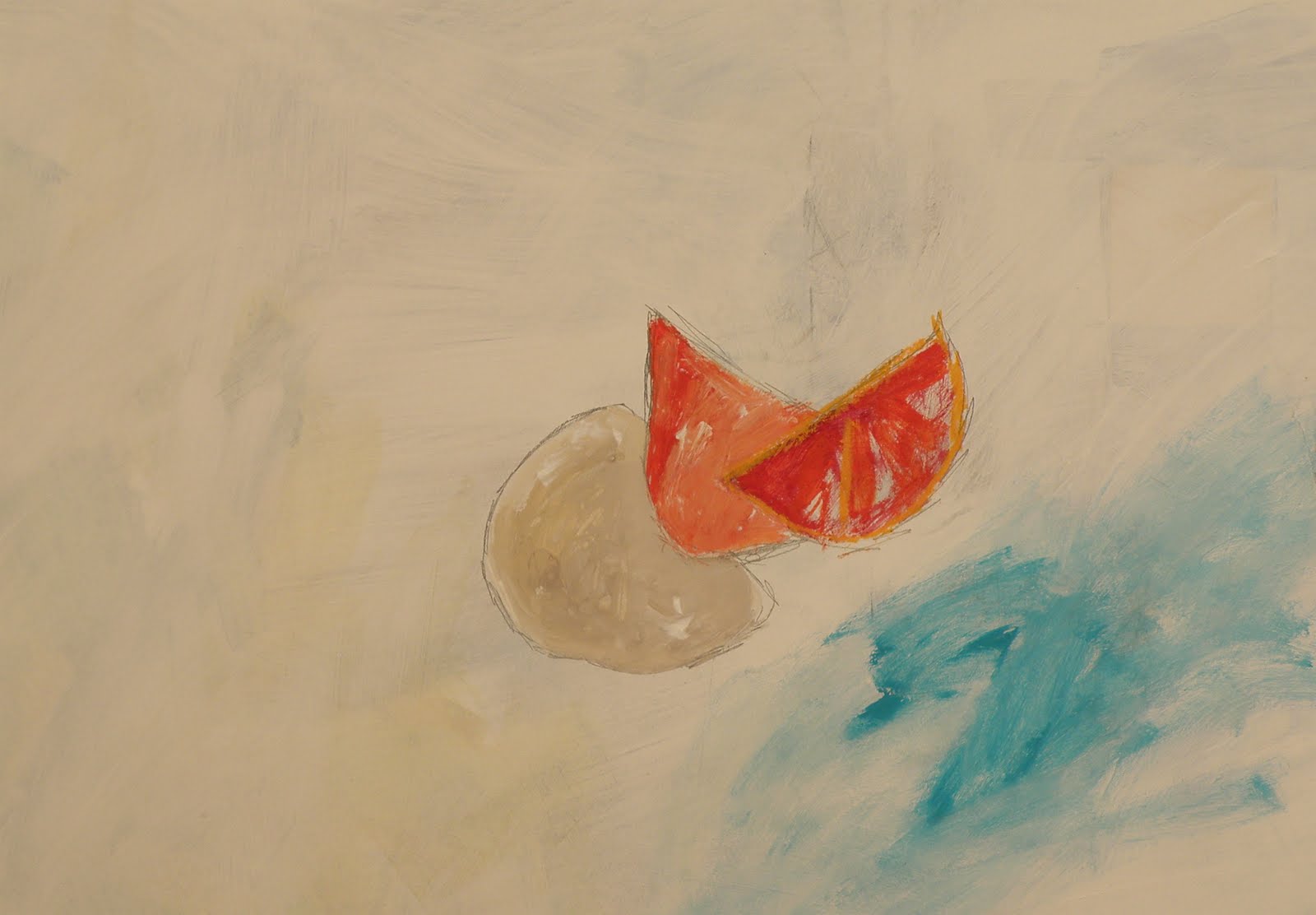
This got me wondering about the nature of annotation, and, beyond its meaning an explanation or comment, the origins of the word: it comes from the Latin annotare, "to mark." And I thought how used we are to annotating texts and reading marginal notes in texts; but we are not at all used to the idea of annotating a painting. Museum and gallery labels inform, but distract from the thing itself. Perhaps words are not the useful thing to comment on painting. Maybe we need to go back to Stevens's "Idea of Order": creative marks may be made to comment on other creative works... paint and pencil annotate paintings and drawings. So here is an annotation for Cy Twombly from me, a drawing called "Orange Slices":

As we beheld her striding there alone,
Knew that there never was a world for her
Except the one she sang and, singing, made."
from Wallace Stevens, "The Idea of Order at Key West," from 1934
I have been reading Patricia Meyer Spacks's annotated Pride and Prejudice. I was worried that she might include too many instances of mere "translation": Bingley's "design" means his "plan," that sort of thing. And there are a few simple explanations... but principally what matters to Spacks is her observations. She discusses the importance of the "visit" -- acquaintances must begin, yet only a man may visit another man, and that first visit should be made promptly (p. 31, note 13) -- I feel these notes are very useful to twenty-first-century readers, who do not "visit." About a request from her father, "What say you Mary? for you are a lady of deep reflection..." that poor Mary is unable to answer, "Mary wished to say something very sensible, but knew not how," Spacks says this: "Austen's capacity at least momentarily to solicit sympathy for foolish Mary, as earlier for foolish Mrs. Bennett, suggests the breadth of her comprehension" (p.37, final sentence of note 17). It isn't simply vocabulary, or story ... it is the very nature of the author's "comprehension."
This got me wondering about the nature of annotation, and, beyond its meaning an explanation or comment, the origins of the word: it comes from the Latin annotare, "to mark." And I thought how used we are to annotating texts and reading marginal notes in texts; but we are not at all used to the idea of annotating a painting. Museum and gallery labels inform, but distract from the thing itself. Perhaps words are not the useful thing to comment on painting. Maybe we need to go back to Stevens's "Idea of Order": creative marks may be made to comment on other creative works... paint and pencil annotate paintings and drawings. So here is an annotation for Cy Twombly from me, a drawing called "Orange Slices":

Wednesday, August 10, 2011
Totally out of white paint....
after a day of re-visiting and then painting over three not-so-wonderful paintings (two at 2 x 4' and one at 18 x 24") and re-arranging the studio. Gorgeous day, empty paint jar:

Gorgeous day, an ex-painting:

Gorgeous day, a new small sketch (pretty realistic, for me, Central Valley and our "Tunisian" chairs):


Gorgeous day, an ex-painting:

Gorgeous day, a new small sketch (pretty realistic, for me, Central Valley and our "Tunisian" chairs):

Monday, August 1, 2011
Thinking, once more, about Cubism
The "early"/Analytic phase of Cubism came together through the combined efforts of Georges Braque and Pablo Picasso. Cubism came of real struggle. No-one had ever pulled all the pieces together before. And the resulting new painting was harsh, jagged, deep, an ugly overthrow of everyone whose recent art was so pleasing, from Klimt to Renoir. "Synthetic" Cubism, then, coming later, when the tempest winds were calmer, amounts to something far less potent.
I had not ever worried about this distinction until now. But I have just been reading "Dime Novels," the final chapter of Rosalind Krauss's "The Picasso Papers." And while distinguishing between these phases is not her full argument, it is a distinction she feels to be crucial. Were the later practitioners leaning on their oars?
Douglas Cooper's The Cubist Epoch changes the names and takes, as he says, the terminology of Renaissance art (which, he says, held sway for about four hundred and fifty years by painting "only what the eye sees of things, incomplete and deceptive though this may often be" until Cubism arrived). Cooper prefers the terms "early" Cubism (from the end of 1906 until the summer of 1910), "high" (summer of 1910 until winter 1912), "late" (a.k.a. Synthetic, the time of collage, roughly 1912-14) and an "aftermath" (not a Renaissance term, but a time of freer development of the art by Braque, Gris and Picasso). "Early" and "high" Cubism are also, for Cooper, "True" Cubism, and Picasso's "Three Musicians" was the end of Cubism entirely, he says (pp. 11, 13 15-6).
If we think of the important phases of Cubism as those which taught us to see... taking the slight upward tilt of Cezanne's tables all the way, or thinking of all sides of an object instead of just one... yes, both sets of categories, Krauss's and Cooper's, work perfectly. The latter phase does seem to be weaker. Let's look....
Two examples, one from "early" and one from "late" Cubism here.... The first, "early" work is by Georges Braque, "Piano and Mandola," from 1909-1910, here shown in a detail:
 Cooper says that, generally, Braque's work from this time is "painterly, lyrical, suave and cohesive," and he says about this work that it is "superb," the "faceting" is "elaborate," yet "the objects represented remain legible' (p.44). Yes, to all that; also, there is an incredible, dizzying depth here, that I can't readily unpack.... and yet the whole work looks effortless. Our second example is by Albert Gleizes, again in a detail; this "late" Cubist painting is called "Harvest Threshing," and it is from 1912:
 Cooper is very critical of this work, saying that "nowhere are the geometric forms derived from the objects represented, nor do they serve to create volumes; sometimes they are awkward stylizations, often their significance is ambiguous" (p. 74). And I agree; while the painting is very pretty, with a round frame of figures that functions almost as a wreath, its tidiness is very flat. It is totally off its point, it seems to me; if I were looking at this without its title, I would see it as a portrayal of an indoor scene, dancers and spectators on couches. One-point perspective is still there, I would argue, just a little dazzled by a refined re-arrangement; not the point of the Cubist endeavor, not at all.
So, the "late" works, the Synthetic works are, with a few exceptions, different. Perhaps it isn't fair to say that the painters are leaning on their oars, since Gleizes, for instance, is a co-author of a treatise on Cubism; he took its directives seriously. Maybe the temptation towards the harmonies of one-point perspective are unconscious, here, but the pull seems clear to me. Stand just there and don't move. The pull of that vanishing point is so ingrained that these artists didn't see it there... it's just that, in this painting, the vanishing point is in the center. Still pulling us in, hypnotically, not breaking the spell... Cubism may not be "a monument" (see my May 11th entry) but it does mean to break the spell.
I had not ever worried about this distinction until now. But I have just been reading "Dime Novels," the final chapter of Rosalind Krauss's "The Picasso Papers." And while distinguishing between these phases is not her full argument, it is a distinction she feels to be crucial. Were the later practitioners leaning on their oars?
Douglas Cooper's The Cubist Epoch changes the names and takes, as he says, the terminology of Renaissance art (which, he says, held sway for about four hundred and fifty years by painting "only what the eye sees of things, incomplete and deceptive though this may often be" until Cubism arrived). Cooper prefers the terms "early" Cubism (from the end of 1906 until the summer of 1910), "high" (summer of 1910 until winter 1912), "late" (a.k.a. Synthetic, the time of collage, roughly 1912-14) and an "aftermath" (not a Renaissance term, but a time of freer development of the art by Braque, Gris and Picasso). "Early" and "high" Cubism are also, for Cooper, "True" Cubism, and Picasso's "Three Musicians" was the end of Cubism entirely, he says (pp. 11, 13 15-6).
If we think of the important phases of Cubism as those which taught us to see... taking the slight upward tilt of Cezanne's tables all the way, or thinking of all sides of an object instead of just one... yes, both sets of categories, Krauss's and Cooper's, work perfectly. The latter phase does seem to be weaker. Let's look....
Two examples, one from "early" and one from "late" Cubism here.... The first, "early" work is by Georges Braque, "Piano and Mandola," from 1909-1910, here shown in a detail:


So, the "late" works, the Synthetic works are, with a few exceptions, different. Perhaps it isn't fair to say that the painters are leaning on their oars, since Gleizes, for instance, is a co-author of a treatise on Cubism; he took its directives seriously. Maybe the temptation towards the harmonies of one-point perspective are unconscious, here, but the pull seems clear to me. Stand just there and don't move. The pull of that vanishing point is so ingrained that these artists didn't see it there... it's just that, in this painting, the vanishing point is in the center. Still pulling us in, hypnotically, not breaking the spell... Cubism may not be "a monument" (see my May 11th entry) but it does mean to break the spell.
Subscribe to:
Posts (Atom)