Tuesday, December 31, 2013

Inside Confined Spaces and Breaking Free

We drove into Milan... its historic, winding vortex of streets was pretty tough to navigate... and difficult to fully appreciate until we parked our car and walked the cobblestones and piazzas.

My eye kept moving towards the fitted-together, the deliberate, artistic urge to design even the simplest thing. A parking lot, where each stone was fitted into the cement:


The wall of the caffé LARTE (these are real books!):


An even more apparent frame, the Duomo, is pulled together with thousands of figures:

We came to Lyon with this mind-set and... find the same compulsion to repeat and confine and build:
And, a well-protected tree:

So I drew "Bubble Breaking Free," playing with the ways the water breaks the flat patterns of the paper:


Saturday, December 21, 2013

Wild Geese and Fairy Tales


We drove from Macon to see family who live between Annecy and Geneva. We drove up into the Alps in Haute-Savoie for a day of seeing goats, cross-country-skiers, and to eat in a small and friendly restaurant. It was very friendly, that is, until the table next to ours was set on fire (by the meats-over-coals dish the couple had ordered). The customers were not worried... as the waiter was putting out the fire, their only remark was “more sauce, please.”

After our two days there, we left for Freiburg, a city that was re-built (after WWII) according to its original city plan. The streets are narrow and lovely, the store- and hotel-fronts blend old with new, and there is a canal running down one side of all the walking and biking streets. Our hotel has been running on Oberlinden for (roughly) 700 years. Here was the view:


The city’s people are very friendly, and the shops very interesting      do you need an umbrella store?

or a lovely restaurant?

Moving north, farther into Germany, we noticed that the houses became more concerned with rooflines... that is, each house and barn seemed hugely roof, against the snow to come. And there seems to be some interest in trapping the sun through solar panels:


We had planned to visit more cities, but, on finding that our next hotel had lied to us (they were not in Heidelberg, so it was impossible to find them there), we decided to change our plans. The autobahn is awe-inspiring; if there are no work-stations or problems, the speed limit is up to the driver, who can go as fast as desired, as long as s/he maintains control of the car. We were also seeing that cities seem more alike, from one country to the next, than countryside, and we thought the German countryside utterly gorgeous, so, why not slow down and see the landscape?

As we drove, we saw geese and swans and hawks, and chased down hotels (that we sometimes could not find) and small and interesting villages. “It’s a wild goose chase!” my husband said, and, yes, that’s what we have begun.
Logs are being harvested and stacked for pick-up. These smaller roads are accompanied by walking and biking paths. It is late in December, but the fields are still green, or ploughed up for the next crop. Vineyards are stacked up on careful hillside shelving. We pass a glassblower’s huge compound, an Audi factory, a “polizei” speed trap (cars here blink their lights, too). Someone has died along this road and her family has left candles and a white marble angel. We stay in two hotels in a row run by families; one speaks English, the other does not.

We drive by the town of Speilberg. It is 7 degrees Celsius. We stay in another hotel and leave the window open. The church bells ring all night. When it is 2:00 in the morning, the louder bell rings four times for the hour, then a smaller bell rings twice, then the louder bell rings once to say it is the quarter hour, then twice for the half hour, then three times for three-quarters of the hour, then at 3:00 the whole cycle begins again.

A covered bridge: “Did you think they started in Vermont?” my husband asks. We are driving in and out of the Schwarzwald, the Black Forest. Woodpiles become very important:

Two shaggy cows. Muddy sheep by a beautiful stream. We drive higher into the mountains, and see snow, ravines, waterfalls, and our car tells us “Risque de verglas” (black ice). The woods are dark and deep... again, Robert Frost didn’t invent these forests... these are fairy-tale forests, thick with moss... and dragons. I start reading Grimm’s Fairy Tales.

We stop for a Renaissance castle, WasserSchloss Glatt, with moat and timbered buildings:

And a town, later, on the Bodensee, called Meersburg, with defensive walls:

This is a fairy tale. Charley looks at the orchards, bare branches now, with a few scattered apples left:


and he says the apples seem to have given way, over the years, to decorated shiny balls and the Christmas tree.

I start a drawing:

And we head for another lake-side town.

Saturday, December 14, 2013

The autoroute in winter

We left Paris and drove the A6 past Fontainebleu... the forest goes on forever. The shadows of the trees lengthened as we drove. It was 2 degrees centigrade when we started in. We saw turned-up fields with frost settled into the lines of the tractor's tires. Just outside the péage (toll gates) at Fleury-en-Biére, we saw a huge abstract painting-- something along the lines of a Joan Mitchell. Just there. We headed deeper into Burgundy, and the road is now called The Autoroute du Soleil (the highway of the sun). A church with a pitched slate roof tells us we are still pretty far north. Clustered village and two distant farms, a yellow "la Poste" truck on the parallel little road.

Mistletoe clusters in bare trees... the mistletoe is green against the greys and browns. More frost, now on the grasses near the highway. A fat French hawk on a fence. The greens in the field sparkle... melting frost? Shadows of trees stretching down their hill.

Then, a "Pays de Charolais" sign, and up come the white cattle against the brown and green grassy hills. We see two more hawks.

Then the "Côte d'Or."  Tidy little (trimmed?) hedgerows around planted fields, and more white cattle. Two trees, nearly disappearing under the mistletoe. Then we see our first field of rolled hay bales.

Molly and Bloom... two people, in one. Molly, in James Joyce's Ulysses, stays at the center of Bloom's moving world. One part of us moves, one part of us stays. This is the time when we are moving, and loving the moving.

It is so beautiful here. Charley sees a hawk hunting.

Fifth hawk, passing the Chateau d'Eguilly. A broken, but still imposing, fort/castle. A village behind, still protected. A hillside, all snow. Clumps of grass sticking together, iced and green all at once.

"Chateauneuf" village off to our left. The canal de Bourgogneon our right. Then, the valley of the Ouche River, all white hills.

"Alert Meteo: Nuit Prochaine Verglas" the sign says, warning that the roads will freeze tonight.

All of a sudden, everything is mist. Like a fairy tale. Then, at the Beaune exit, grapevines covered in white frost. It is now -2 degrees centigrade outside. Sixth hawk. Department: Saône et Loire. Seventh hawk, huge and shaggy. 8th hawk, then birches, with some yellow and some frosted leaves.  -1 degree centigrade. A row of farmed poplars.

Now it is 0 degrees. The grass is green again, but anything standing up in the air is white: bushes, vines, straggly grass, trees, fences. The houses remain grey and beige. Ninth and tenth hawks.

Our diesel Citroen C3 has used 1/4 of its little tank in 4 hours.

11th hawk. 12th hawk. Charley says they are watching the cars.

13the hawk. 14th hawk, wings spread, looking down at his claws.

Fifteenth and final hawk.

We arrive in Maçon. We fall, somehow, into the best, smallest, warmest restaurant in town.


This is lapin en gelée with mâche salad and onion confit at "le Carafé: Les Vins en Liberté," a bistro-cave in Maçon. There are three choices of first course, three choices of second, three desserts. The wines of the night were Minervois and Morgon. A man came in from his vineyard with a bottle of Volnay and gave us a taste... we then talked with some of the customers about wines and Maçon.

Today, we were wanderers.


Sunday, December 8, 2013

Monuments and Archways: Constable and Pissarro


I have this idea that the world of art divides into monuments and archways. I think of a monument as something created at the peak of an artist’s desire to solidify every artistic achievement that has occurred up to the moment of signing the art work. Up against monumental art work comes the archway piece, the one that an artist makes as s/he looks towards an un-realized artistic future.

I’m going to take two small works, both in London’s National Gallery, as examples. John Constable’s “Cenotaph to the Memory of Sir Joshua Reynolds, erected in the grounds of Coleorton Hall, Leicestershire” (from 1833-36) helps my theory by being a painting of a monument,


but that’s not why I chose it. Constable has put everything he knows into this painting, everything about every leaf, the way light falls within a cluster of trees, the way dead leaves blow onto stones... it’s a memoriam to everything he would have us know that Reynolds means to him, but, more than that, it is everything, down to the stag, pictured in an almost photographic perfection.It is letting us know that a painting of a landscape deserves the same recognition as a painting of a battle.

The second painting, my archway painting, is Camille Pissarro’s “Fox Hill, Upper Norwood,” from 1870:


It, too, is a landscape, but something is different. There is a tree, but it is sketched in, a fence, caught in a few brushstrokes, dirty lines of snow where the carriages have come, a man meeting women... nothing is firmly placed. This is not aiming at grandeur. Blink and it’s gone.

Even though the Constable places us in the center of his personal artistic debt, and it’s a beautiful and arresting work, the Pissarro feels more personal to me. The viewer is invited to walk down that same road, in that same contented mood, crossing through the archway that links us (impossibly, but artistically) to a country road in 1870.


Saturday, November 30, 2013

"And be contented to charm/ the birds off the trees..."


Playing. Cole Porter's song "Get Out of Town" (Ella Fitzgerald singing, of course) is playing in my head, against my photograph with iPad sketch-markings:

WHY WISH ME HARM
WHY NOT RETIRE TO A FARM
AND BE CONTENTED TO CHARM
THE BIRDS OFF THE TREES

Watching the birds whirling around the sky... some migrating, others flying up, dark against the pinks and greys of the now-receding fog. Our hummingbird is still for about 5 seconds, taking a very small rest on a branch, then visiting the flowers on the tree outside our window. His body is again on a branch, but his head is constantly moving; he is perched for longer now, 10 seconds, perhaps... tiny movements of the natural world silhouetted on the greys of more distant pipes, air conditioners, stuccoed walls of the apartments across the way.


 And now lines from an old Seals and Crofts song from my college years come back:

Hummingbird, don't fly away, fly away

Monday, November 25, 2013

Mary Mountcastle Eubank: "The Deep Heart's Core"

.... I will arise and go now, for always night and day
I hear lake water lapping with low sounds by the shore;
While I stand on the roadway, or on the pavements grey
I hear it in the deep heart's core.
                       ---From W.B. Yeats's "The Lake Isle of Innisfree"


Mary Mountcastle Eubank is presenting a show called "Edges and Flows" at Gallery Route One in Point Reyes Station, where I am an artist member. Eubank is a founding member of the gallery, now in its thirtieth year. Here are two installation views of her show:


"Out of Nothing," a small (18" x 24") painting near the entrance, feels to me the way the pistil and stamens of a flower might look to a visiting honeybee.    The ceramic shards come cleanly out of the blurred surface of the canvas, but we feel so close, as if zoomed into that surface, and it's as if some small, silent explosion has just happened, and we have landed in its center:


Eubank wrote in her artist's statement that "I want to imagine a replica of a landscape that is not an imitation, but a reflection of my inner response to landscape and place." Pure imitation would be photographic; a reflection of a response is a purely intangible thing, something to take a lifetime reaching. Like Yeats, Eubank seems to be able to reach across pavements and time back into this reserve of blue water and red sands that she so ably portrays in this show. Eubank has written that hers is "a sensuous relationship to the natural world." To be truly sensuous, I think! one must hold nothing back, and that is just what we see here. Wide-open art.

Here is a piece without title or price, representing, perhaps, some of the ingredients in the work on display:


Reminds me of something... My husband, our two children and I lived for a year and a half on the island of Malta, located in the Mediterranean between Tunisia and Sicily. In winter, the mistral blew the red sands up from Northern Africa, and the particles fell on cars, roads, tree limbs... And it was just this color; desert sand could blow right by us, so the world was very small, wasn't it?

Eubank would seem to agree. Yes, the natural world is vast, but each piece of it, each fragment that makes up our world, is part of us, can be small enough to be seen and understood, if only a little, by each of us. The artist has explained that her works "develop with alternating layers of thin washes and heavy impasto, often laced with organic materials, such as sand, decomposed granite and wood ash."  It is an unusual set of tools for painting, but one that echoes the colors of earth and water in Eubank's home, West Marin.

"Passage," a monumental mixed-media painting  (49" x 72"), could be a landscape. I could say it looks like a cold morning pathway seen from The deck of a ship, with icebergs threatening on either side:


But, for this artist, the painting is far more likely to refer to an interior journey. Possibilities are there, rich in color and warmth and light, if you can just steer clear of those icebergs. Those two brown built-up paper objects -- or obstacles -- are deeply etched. We know these rocks and shoals. We have been on them ourselves, marooned for a time until that bit of light at the bottom breaks through and sets us free.

There is another Irish poet whose work has been running through my mind these last few days. Seamus Heaney wrote a poem called "Postscript," published in his book "The Spirit Level." He talks about driving in a car past the kinds of landscape we see in Northern California (or, in his case, the West of Ireland):

....So that the ocean on one side is wild
With foam and glitter, and inland among stones
The surface of a slate-grey lake is lit
By the earthed lightning of a flock of swans....

Useless to think you'll park and capture or
More thoroughly. You are neither here nor there,
A hurry through which known and strange things pass
As big soft buffetings come at the car sideways
And catch the heart off guard and blow it open.

We viewers are "A hurry through which known and strange things pass." If we are lucky, we stop in front of one of Eubank's paintings of the landscapes of the "deep heart's core," and we feel our hearts blown open.


Sunday, November 24, 2013

"And it is. I make sure it is." Hockney and the thrill


“The care with which the rain is wrong and the green is wrong and the white is wrong.... The care with which there is incredible justice and likeness, all this makes a magnificent asparagus, and also a fountain.”  Gertrude Stein, the final Tender Button


Consider the work of Gertrude Stein and David Hockney, and you will realize that neither artist is afraid to fail nor afraid of happiness.  For both, I get the impression, happiness is contagious.

The De Young Museum in San Francisco is showing "David Hockney: A Bigger
Exhibition," (his recent portraits and landscapes), through January 20, 2014. Hockney's landscapes are the thing, though. At the De Young, the show moves almost entirely chronologically, tracing Hockney’s movement through one medium after another in his portrayal of his Yorkshire woods and fields - water colors, oil, video, iPad drawings and charcoal, and, full circle, beginning and ending with classical tools. The classical approaches present Hockney’s art-school credentials.

But, much like his hero Picasso, Hockney appears to find that Raphael or Rembrandt pretty much had the classical thing covered, and he pours his passion into making us see – “how we see.” The works on video and iPad stop viewers in their tracks.

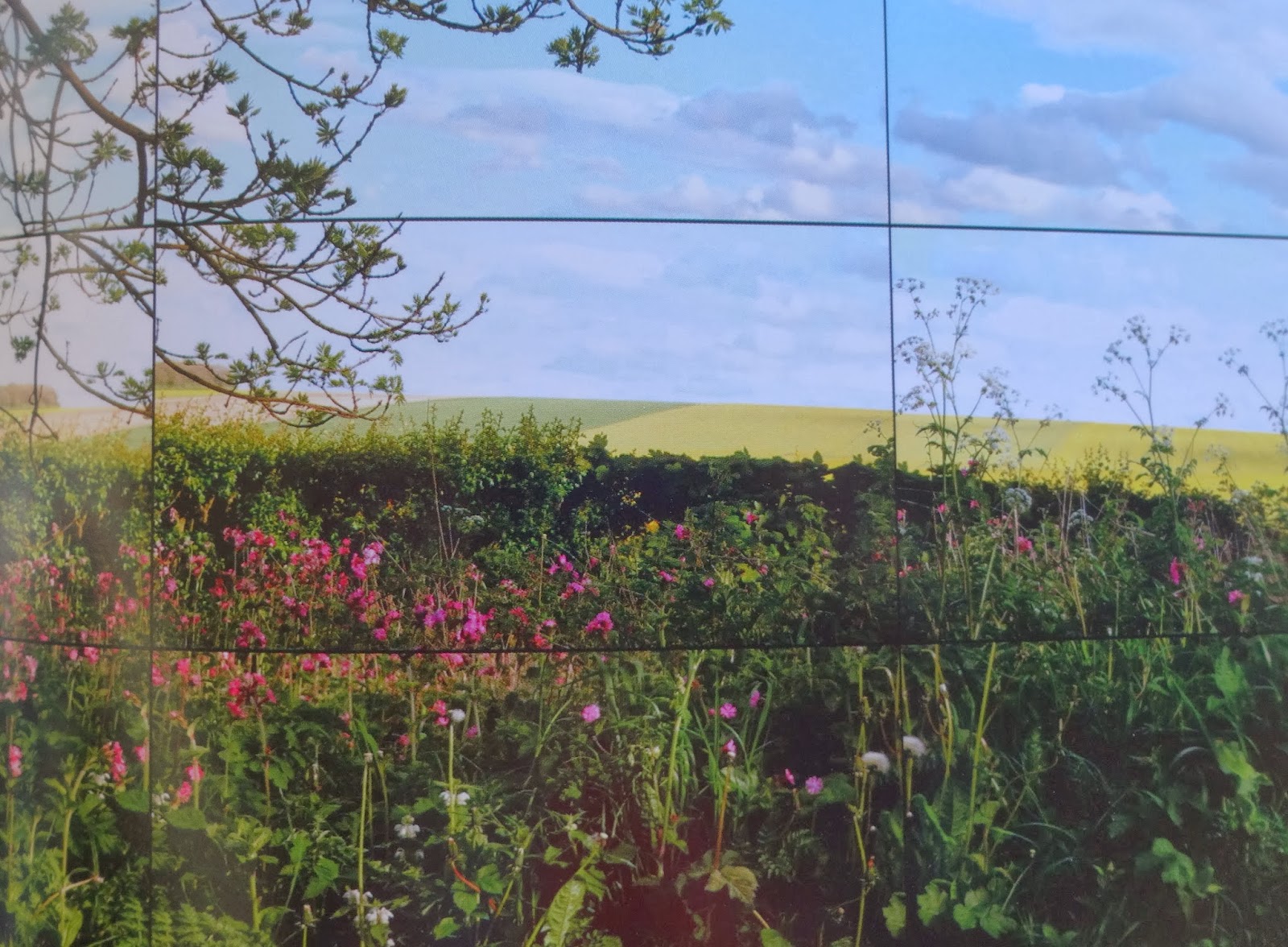
To the video presentations, first. 18 video screens, 3 high and six across,  are combined in a single space, although the boundaries of each camera’s view prevents the screens from fitting exactly, a slight tradeoff for having each angle and distance within the 18 screens in perfect focus.  Hedgrows wave lazily (here is a still from the catalogue... May 12th, 2011, Rudston to Kilham Road):


We look first at one screen, then another, then the time passes and we see we have stood there watching time, watching wind, watching air. We are surrounded, even though we are responding to just one wall of flat screens. We then move to the room of  “trees down the tunnel” that Hockney painted over and over again, here in nine screens (Woldgate Woods, June 2nd, 2010). Here is a still from the catalogue:


 Cars pass, unevenly from screen to screen. Snow falls delicately and slowly from tree branches, leaving one screen’s border, and then entering another ‘s,  just a little askew. Here is Woldgate Woods, November 26th 2010, a still photograph, from the catalogue:


The artist told Lawrence Weschler that mounting these cameras onto his car and driving through the fields meant "at least eighteen different vanishing points, and all of them moving" (catalogue essay, p. 39).  Or, in the case of the room that surrounds us with the four seasons of Woldgate Woods in the De Young, nine screens, nine moving vanishing points.

So what? you say.  Hockney has spent his life as an artist worrying about how to make art that makes us feel the way we feel when we are walking through the world. The now-famous photocollages (here, a detail of Grand Canyon from North Rim Lodge, Arizona, 1982):


offered up multiple (but rather fragmented, like broken glass) perspectives.  The  later paintings moved along further-- here is a detail of  "Mulholland Drive: The Road to the Studio," 1980:


Finally the “Bigger” series arrived; this work is part of that series, and Hockney truly began to find a straight line to our senses. (See : http://artistinanaframe.blogspot.com/2011/09/window-on-world-means-youre-cut-off.html)

He has come all his life to this point... where he shows us how we can see the world we know. It’s a little neglected corner. It isn’t Claude Monet’s towering sharp-edged cliffs at Etrétat, or Caspar David Friedrich’s Alps and fog in “Der Wanderer über dem Nebelmeer“ (The Wanderer Above the Sea of Mist) or any other landscape that would add drama all on its own.  Hockney’s landscapes are where you walk the dogs, where you go to play hide and seek, where you go for a quiet ... anything.  We all know this place. We begin to find that we love it, in all its powerful humility.

Hockney said, in 2004 (I cannot find the reference!) that  “I can get excited watching rain on a puddle. And then I paint it. Now, I admit, there are not too many people who would find that exciting. But I would. And I want life thrilling and rich. And it is. I make sure it is.”

And the puddles?  Well, they come into play in the iPad drawings. Here is 18 December, from the catalogue:


I remember when, at 13, I first noticed raindrops on a puddle, walking to the bus-stop.  But somehow I remember thinking about the dropping water and the “plop” sound it made, hitting the puddle on the asphalt.  These are very simple things Hockney offers us;  simple, yes, but so hard to recreate.

2 January:


Go and see. 


Sunday, July 28, 2013

The WOW of "The Image in Its Otherness" at Three Geary Street Galleries


It was a quiet Friday lunchtime. Some of the galleries at the Geary Street buildings in San Francisco had closed their doors. But some doors to fabulous shows were open.  The three artists below seem to me to embody something a critic once wrote about “Les Demoiselles d’Avignon,” that it is “about the image in its otherness locked in with the real world” (Lisa Florman on Picasso in “The Difference Experience Makes in ‘The Philosphical Brothel,’” The Art Bulletin, Vol. 85, No. 4, Dec. 2003, p. 777).

The “image in its otherness locked in with the real world”: what, exactly, is “otherness”?  Difference… distinguished by achievement or characteristics? or simply non-conforming? Strange? or distinctive, memorable? Me, and not-me.  The expected. The unexpected.  I want to take us into “otherness,” step by step, through the galleries, and return to Picasso at the end.

First, Ian McDonald offers a show of ceramic pieces at the Rena Bransten Gallery (77 Geary, San Francisco, through August 17, www.renabranstengallery.com). Ceramics are often viewed as purely utilitarian.  Museums offer rooms of early functional vessels created by hunter-gatherers and then, over time, we all begin to see a departure, finding artists who are searching for beauty and meaning: a fragile vase, a transformative mask, or Judy Chicago’s “The Dinner Party.” 

Ian McDonald’s chosen “difference” in this show (called, tellingly, “Parts and Pottery”) is not the province of the totem or the icon, but total, brazen, sensuality… the unexpected aesthetic pleasure of clay nearly morphing into iron.  A gleaming crankshaft, a rusting piston, screws, nuts and bolts laid out for a repair, looking under the hood of a ’65 Mercury … all these implements in the idea, now made soft and quiet and things-in-themselves by the touch of a hand:

 
This is my favorite of the 12 exhibits in this show,  “Arrangement #3 (Split Shelf).


The materials list reads “glazed ceramic, powder coated steel, wood and paint.” The show is calming, surprising, beautifully lit, wonderfully sculpted. It is “otherness” because it brings the pistons and crankshafts of the “real world’ into a soft, silent rebirth.

The second gallery exhibit was -- a “mixed media on paper” dress -- but not just any mixed media, and not just any dress -- by Isabelle De Borchgrave at Serge Sorokko, at 55 Geary Street. (Isabelle De Borchgrave is one of several artists represented (http://www.sorokko.com/artists/de_borchgrave/blue_delphos_dress/blue_delphos_dress.html).  


De Borchgrave immerses her work in art-historical riches. The Legion of Honor here in San Francisco exhibited rooms filled with  her paper costumes inspired by paintings (http://artistinanaframe.blogspot.com/2011/04/thick-rugs-and-thin-paper-at-legion-of.html). 

For this piece, a sculptural column at Serge Sorokko, the Charioteer at Delphi is the first source:


but the second source layer is a pleated silk dress with glass Murano beads hanging from the shoulders, designed and made by Mariano Fortuny y Madrazo in Venice in 1907…. it was designed, in the era of corsets, to be worn over bare skin:

In the “Blue Delphos Dress,” there is also “nothing” underneath, “nothing” but air and imagination:

It isn’t just that De Borchgrave’s work is different, that she re-interprets the fabric of painted portraits or Greek statues or fashion designed in a Venetian palazzo and twists and irons and otherwise bends paper to serve as her art. It isn’t, here, just about the process. It’s about the new “real world” she makes us see.

The third artist will bring us back to Picasso and “The Demoiselles d’Avignon.” Picasso wrestled with several sets of drawn images, at last confining his women within a flat space, body parts touching, overlapping or going missing in folds of drapery.  I find myself disagreeing with Lisa Florman. This painting is not about “the image in its otherness locked in with the real world”; only half of this poetic statement is true. This painting is, instead, only “locked in with” a strange kind of powerful “otherness” of its very own.   There is no “real world” to see “locked in” or otherwise, here.  Picasso never pursued anything with this level of ferocity again.  He didn’t seem to know where to go from this point, and so backed away from connecting these women up with any kind of “real world.”

But there is an artist whose work pulls the “Demoiselles” -- and his other portraits -- into a fierce struggle with “the real world.”  The Haines Gallery, at 49 Geary Street in San Francisco is showing the work of Aimé Mpane (http://www.hainesgallery.com/mainpages/Exhib_Current/Exhib_Current.html)


The preoccupied figures in this massive piece, “La Peche Contemporaine,” are themselves caught up in a net (they are made of painted wood pieces floating on string, and the piece measures 81 “ x 84”) and are fishing for something they cannot eat, that peculiarly Western preoccupation with getting the ball into the net.  Mpane comes from Kinshasa (once the capital of the Belgian Congo, now in the Democratic Republic of Congo).  The question of exactly what one ought to fish for -- for food, for fame, for one’s country and history or for someone else’s profit -- might serve, all by itself, as a sufficiently pressing subject for art.

But then there’s the larger question of identity, present not just as an issue for the fishermen but for the rest of Mpane’s compelling show as well.  Mpane has “drawn” portraits (with layers of glued plywood that he edges with an adze -- a tool first used in the Stone Age), portraits of people that he knows in the Congo.  The resulting paintings/carvings are complete and missing, here and there, parts and whole, almost giving us the rings of years in the wood.  Here is my favorite single portrait, because it is so spare and simple, “Kinoct #40”:

There is enough left of her portrait head to give the wall a shadow.  Are we looking “through” or “beyond”? Is this woman hiding … or gone? How much do we actually see when we look?  Anything that is not a self-portrait is “other,” another, me, but not-me as well, a person, but not my person. How do we reconcile ourselves with the world?

Mpane’s strongest suit in the show -- for me -- is his artistic dialogue with Picasso and his “Demoiselles,” a conversation that is very much in “the real world.” There are seven of these two-sided masks arranged along a shelf in the gallery’s middle wall.  The wooden sides of each face are three-dimensional Demoiselles. Here is the face Picasso painted in as he completed the painting, the face we see to the far right:

And here is Mpane’s “La Demoiselle Perde/Masque Bi-Face: Picasso-Pende #2,” a two-sided piece, 12” x 12.5,” in that same adze-edged wood:

Look back and forth at these two.  Picasso’s Demoiselle-face would be physically impossible, not just for its jarring features, but because her back is towards the viewer; she could not be cupping her chin in that enormous hand.  When we first look at her face, her expression might seem angry, but the mouth is pursed, questioning, and she could also look…. surprised. Is she about to ask a question? She has that look.  Mpane’s response is to make his jagged face seem more human, the expression even more ambiguous, and then just as we are taking that in we see the other side of this face:

And we see the inner light. It’s an astonishingly uplifting image. These works will stay with me for a long, long time.

Thanks to the galleries and assistants, particularly Kate and Blake.


Sunday, February 3, 2013

Bewteen winter and summer of 2013, I shifted to a new landscape, concentrating on small works of art, made at my coffee table, combining text and image, as you will see on my experimental blog: asmallfineartsketchbook.blogspot.com

And here is an example of my sketchbook-sized art you may see there. I found a drawing by René Descartes from 1644, where he drew magnetism and gravity as a lettered diagram (the earth is the piece I have colored blue).  It is filled with the excitement of discovery … his … and so I started thinking about another favorite theme of mine, audience: who would he have shown this to? How would he have explained it? And then I pulled in Motherwell’s idea of the colors black and white as protagonists, fighting and succumbing to magnetism:

But now, I am revising this older blog post, because I am coming back to "Artist in an A-Frame." Stay tuned!

Thursday, September 20, 2012

The Edge: Abstraction vs. Realism in Two Irish Painters


I love abstract art; it turns out that I also love art that rests on the edge between abstraction and representation.  The two approaches are often defined pictorially, because they are, after all, pictures, but I think it might also help to find that edge between the two if we look at examples of prose from a master of each style.

Here is Henry James, in a passage from The Golden Bowl:

He saw the sleeves of her jacket drawn to her wrists, but he again made out the free arms within them to be of the completely rounded, the polished slimness that Florentine sculptors, in the great time, had loved, and of which the apparent firmness is expressed in their old silver and old bronze …. He knew above all the extraordinary fineness of her flexible waist, the stem of an expanded flower, which gave her a likeness also to some long, loose silk purse, well filled with gold pieces, but having been passed, empty, through a finger-ring that held it together. It was as if, before she turned to him, he had weighed the whole thing in his open palm and even heard a little the chink of the metal. When she did turn to him it was to recognise with her eyes what he might have been doing.                  (from the novel, first published in 1904)                 

And here is Gertrude Stein, writing about the increasing dangers of World War II, in Mrs. Reynolds:

It was getting pretty serious, nobody saw anybody they used to see and it was getting pretty serious, oh dear me said Mrs. Reynolds and when she said oh dear me she wanted to say to Mr. Reynolds that it was getting pretty serious but she did not say that it was getting pretty serious she did not say it just then she only said that she was not seeing any one she used to see no not any one, and Mr. Reynolds said and what then but what he really meant to say was that he still saw her and she still saw him, so what then.  (published posthumously, 1952)


James appears, as a realist, to be giving us more details of the moment he describes, but when we look again at this passage of his, we see that the only actual details are:

--the Prince sees that “the sleeves of her jacket [are] drawn to her wrists”
--he notices that “[her] arms [are] rounded”
--he observes her waist

All the rest is metaphorically described. Charlotte is compared to three things: an “old” bronze or silver Florentine sculpture, an “expanded flower” and a “long, loose silk purse.”  These sound like lovely terms, and no doubt we are meant to think that the Prince sees them as desirable and sensuous objects, objects that he thinks may describe perfectly his need for her, and yet… we are, as readers, also supposed to pick up on the fact that these are incredibly vague ways of describing true feeling. Kenneth Burke wrote, in A Grammar of Motives, that "Metaphor is a device for seeing something in terms of something else. It brings out the thisness of a that, or the thatness of a this."  But it isn’t, importantly, the “thisness of a this.”

Stein’s writing may, in contrast, intially strike us as … simple. But perhaps it would be too easy to say just that. Simple, stark, repetitive thinking is a very human response to tragedy, when words seem wholly inadequate and silence, horribly, seems easier.  We do not say what we are thinking. And this passage from Stein ends with a statement, “so what then,” that stops the motion of all the previous thoughts; we are stilled by those words. She has exposed us for our said and unsaid words of fear and love. We stop and think, held in the moment, dreadful… or seemingly inconsequential… as it is.  

And I think that, finally, this is the difference between realistic and abstract artists: that representative painters form reference points that outline recognizable things, but these realists can not produce the things themselves; instead, they have perfected linear description.  Abstract artists produce something that, in itself, stops our usual referring back to an “other” object or state of feeling. Abstraction is meant to arrest our attention in the moment, as our attention would be held as we fall into extreme joy or sorrow. Painting at this moment in our history often seems confused, torn between the two approaches, neither of which is wholly adequate. It may be that the best of current art must bridge these two methods of perceiving and creating: the outline of the familiar combined with a more abstract grasp of feeling.

To enter into this struggle, to create something that is, itself, arresting, a painter needs to be able to pull together aspects of a place or a sensibility that will still be accessible and enthralling to a potential viewer. It is an incredibly difficult task, this kind of painting.  Robert Motherwell talked about recognizing the many “internal relations” in painting:

I always looked at just the total over-all effect. And apart from the obvious sensuality and color… there's something in Matisse that is as remorselessly, relentlessly adjusted in terms of internal relations as somebody like Piero della Francesca…. That's why all painters really love him - well, not the only reason, but a reason. He's as strong as Piero, and it was that double aspect that I liked- the sensuality, and the color and the so-and-so plus this thing that is almost - well, Georges Duthuit wrote … "Matisse is as strong as the mosaics of Ravenna" - I've never seem them -- and whatever he's trying to say by that, in my own way, I also saw.    (Oral history interview with Robert Motherwell, 1971 Nov. 24-1974 May 1, Archives of American Art, Smithsonian Institution).

The Ravenna images, while realistic for their time, have a kind of simple direct nature that does freeze us in our tracks:


Rather like this Matisse, “Open Window at Collioure,” a view into another space:


We can see “the sensuality, and the color” and the sheer strength of these works; they come from the same intense scrutiny and sense of space. Two painters here in Ireland have landed in that terrain between Piero della Francesca and Matisse, the kind of “relentlessly adjusted” work that pulls the viewer in: Keith Wilson and Donald Teskey.

Keith Wilson’s work, “A Change in the Air,” is showing through October 25th at the Oliver Sears Gallery in Dublin.  In the catalogue, Oliver Sears writes That Keith Wilson, who lives in North County Mayo, has given us “changing time, light and place …  in [his] finely honed mark making.”  But the works are not pure recording, or metaphorical references. As Sears says, they are “part real, part imagined” in what then becomes, for the viewer, “a distinctly contemporary construction.”  Let’s take a look at Wilson’s painting, “A Change in the Air, 8,” (oil on panel, 21.5 x 19.5 cm):


Wilson lived for a time not far from Assisi, where he could hear the bells from two churches as he painted, and “Doves here too that sing one extra note than the ones at home.”  We can see the influence of Italian arches and loggias in this painting, which opens through to a garden.  And yet, while we could, potentially, “see” the outlines of trees and branches and bushes and blossoms, we don’t actually see them… we see the traces they have left behind, traces offered by an artist who has lived with them for a long time. They become familiar to us – even though we don’t yet “know” them.  When I see a photograph or a very realistic painting of a place (for example, Canalettos’ Venice) I can feel regret that I am not there. With Wilson’s paintings, I am there. No need for regret. I am looking through that archway. I am, in short, involved.

Wilson says that he discovered that “I might study places in order to figure out where I am” (from his catalogue essay).  We all try to figure out where we are, but Wilson has achieved his “place” to a spectacular degree. His work is of Ireland and Italy, but it is also of the mind. With some perspectival landscapes, we feel rooted to one spot. With Wilson’s work, on the other hand, we feel as if we could continue to walk through. Here is “Across the Field,” (conté crayon on gessoed paper, 56 x 76 cm) in full and then in a detail:


Yes, it’s descriptive. But it’s what he leaves out that allows this drawing to give us the feeling of the air around the grasses, the trace of weight under the tractor-wheel imprints… painters since Vermeer have contested with ways to re-introduce breathing into their art.  It’s happening here. The viewer is invited in.  Here is one more painting, “Days Ahead, 5,” (oil on panel, 36.5 x 40 cm):


This has the quality of a beautiful morning after a fresh rain. We all can “see” what’s here, and imagine what isn’t. We have a job to do, to look, imagine, and be in the moment.  This is Wilson’s gift.

The second artist I would like to discuss here -- an artist working on these very same connections to “place” and fine evocation of feeling-- is Donald Teskey. His show of paintings, “Nature Reserve,” has been at the Town Hall in Macroom, curated by John P. Quinlan.  Teskey spent several weeks as an artist in residence in the Gearagh. The name comes from An Gaorthadh, meaning the wooded river. This is a valley just west of Cork City, on a bed of limestone, the oak trees having formed in the basin of the Lee River in the last Ice Age. This is the “only significant alluvial forest in Ireland” (information from the plaque on site).  Here are two photographs I took, in early morning:


Close to, the wooden oak remnants appeal to you in an almost human way -- faces, expressive shapes -- but from a distance, through the filter of the light, you can see the mystery and the majesty of place here.  Donald Teskey wrote that he worked “amongst the tangle of trees and grasses, on the mudflats and from the higher vantage points on the surrounding hillsides and side roads. The light on the Gearagh can, at times, be extraordinary … It is an inscrutable and fascinating place for a painter” (www.artfirst.co.uk, 2008).  Or a printer. We can see the lines here that cross over between printmaking and painting (both areas of expertise for Teskey), and see the space between the lines for what it is, an entryway. Here is “The High Road 8” (30 x 30, acrylic on paper -- images courtesy of John P. Quinlan):


This is that crossover between the familiar and the imagined: we see rooflines, the vertical presence of trees, but we don’t really attend to these, past the initial glance: we become lost in the wild markings of the painting’s lower half, fabulous things. This is not a nostalgic view. This is an explosion of feeling and mood, directed at us, inviting a response. Teskey has noted that “keeping the spontaneity and urgency in the mark is vital” (interview with Mike Fitzpatrick, 31 January, 2005, www.rubicongallery.ie).  Done.

My particular favorite from Teskey are the paintings that reach a little bit further into abstraction, almost daring us to “see” as he does. Here is “The Gearagh Study VI”:


Yes, we can see the reeds, the oaks, the water, a little. But what is that scattering of pale blue? And the underlying scraped white? Part reflection, part “urgency.” I know, from my own painting experience, how much of a risk he takes here. One foul scrape or too broad a gesture with the brush and the work could easily be ruined.  This is painting on the edge, indeed.  One more, called “The Gearagh IV,” gives us both earth and water and yet…


Both Donald Teskey and Keith Wilson explore this territory between the two warring forms of the twentieth century, abstraction and representation, a place “between” that is unresolved for so many painters. These two have come to terms with their inheritance, and have achieved their own “way” onto the edge.  One of Ernest Hemingway’s characters in Across the River and Into the Trees said that “terrain is what remains in the dreaming part of your mind.”  Both Wilson and Teskey merge the terrain, and the mind, in paintings that stay with the viewer. Seek out their work. 

Thanks to both Oliver Sears and John P. Quinlan for their generosity.